Clotrimazole and Betamethasone Dipropionate
Managing this medication for someone you care for? Eleplan keeps diagnoses, medications and appointments in one plan.
Start free with EleplanMedication reference
Clotrimazole and Betamethasone Dipropionate
Azole Antifungal [EPC] — TOPICAL
Clotrimazole and Betamethasone Dipropionate — Azole Antifungal [EPC]. INDICATIONS AND USAGE Clotrimazole and Betamethasone Dipropionate Cream is indicated in patients 17 years and older for the topical treatment of…
Brand names
Clotrimazole and Betamethasone Dipropionate
Active ingredients
BETAMETHASONE DIPROPIONATECLOTRIMAZOLE
Indications
INDICATIONS AND USAGE Clotrimazole and Betamethasone Dipropionate Cream is indicated in patients 17 years and older for the topical treatment of symptomatic inflammatory tinea pedis, tinea cruris and tinea corporis due to Epidermophyton floccosum , Trichophyton mentagrophytes , and Trichophyton rubrum . Effective treatment without the risks associated with topical corticosteroid use may be obtained using a topical antifungal agent that does not contain a corticosteroid, especially for noninflammatory tinea infections. The efficacy of clotrimazole and betamethasone dipropionate cream for the treatment of infections caused by zoophilic dermatophytes (e.g., Microsporum canis ) has not been established. Several cases of treatment failure of clotrimazole and betamethasone dipropionate cream in the treatment of infections caused by Microsporum canis have been reported
Dosage
DOSAGE AND ADMINISTRATION Treatment of tinea corporis or tinea cruris: • Apply a thin film of clotrimazole and betamethasone dipropionate cream into the affected skin areas twice a day for one week. • Do not use more than 45 grams per week. Do not use with occlusive dressings. • If a patient shows no clinical improvement after 1 week of treatment with clotrimazole and betamethasone dipropionate cream, the diagnosis should be reviewed. • Do not use longer than 2 weeks. Treatment of tinea pedis: • Gently massage a sufficient amount of clotrimazole and betamethasone dipropionate cream into the affected skin areas twice a day for two weeks. • Do not use more than 45 grams per week. Do not use with occlusive dressings. • If a patient shows no clinical improvement after 2 weeks of treatment with clotrimazole and betamethasone dipropionate cream, the diagnosis should be reviewed. • Do not use longer than 4 weeks. Clotrimazole and betamethasone dipropionate cream is for topical use only. It is not for oral, ophthalmic, or intravaginal use. Avoid contact with eyes. Wash hands after each application. • Tinea pedis: Apply a thin film to the affected skin areas twice a day for 2 weeks. Do not use longer than 4 weeks. ( Error! Hyperlink reference not valid. ) • Tinea cruris and tinea corporis: Apply a thin film to the affected skin area twice a day for 1 week. Do not use longer than 2 weeks. ( Error! Hyperlink reference not valid. ) • Do not use with occlusive dressings unless directed by a physician. ( Error! Hyperlink reference not valid. ) • Not for ophthalmic, oral or intravaginal use. ( Error! Hyperlink reference not valid. )
Warnings
WARNINGS AND PRECAUTIONS • Clotrimazole and betamethasone dipropionate cream can cause reversible HPA axis suppression with the potential for glucocorticosteroid insufficiency during and after withdrawal of the treatment. Risk factor(s) are: use of high-potency topical corticosteroid, use over a large surface area or to areas under occlusion, prolonged use, altered skin barrier, liver failure, and young age. Modify use should HPA axis suppression develop. ( Error! Hyperlink reference not valid. , Error! Hyperlink reference not valid. ) • Pediatric patients may be more susceptible to systemic toxicity. ( Error! Hyperlink reference not valid. , Error! Hyperlink reference not valid. ) • The use of clotrimazole and betamethasone dipropionate cream in the treatment of diaper dermatitis is not recommended. ( Error! Hyperlink reference not valid. ) • Topical corticosteroid products may increase the risk of cataracts and glaucoma. If visual symptoms occur, consider referral to an ophthalmologist. ( Error! Hyperlink reference not valid. ) 5.1 Effects on Endocrine System Clotrimazole and betamethasone dipropionate cream can cause reversible hypothalamic-pituitary-adrenal (HPA) axis suppression with the potential for glucocorticosteroid insufficiency. This may occur during treatment or after withdrawal of treatment. Cushing’s syndrome and hyperglycemia may also occur due to the systemic effect of corticosteroids while on treatment. Factors that predispose a patient to HPA axis suppression include the use of high-potency steroids, large treatment surface areas, prolonged use, use of occlusive dressing, altered skin barrier, liver failure, and young age. Because of the potential for systemic corticosteroid effects, patients may need to be periodically evaluated for HPA axis suppression. This may be done by using the adrenocorticotropic hormone (ACTH) stimulation test. In a small trial, clotrimazole and betamethasone dipropionate cream was applied using large dosages, 7 g daily for 14 days (BID) to the crural area of normal adult subjects. Three of the 8 normal subjects on whom clotrimazole and betamethasone dipropionate cream was applied exhibited low morning plasma cortisol levels during treatment. One of these subjects had an abnormal cosyntropin test. The effect on morning plasma cortisol was transient and subjects recovered 1 week after discontinuing dosing. In addition, 2 separate trials in pediatric subjects demonstrated adrenal suppression as determined by cosyntropin testing [see Use in Specific Populations ( Error! Hyperlink reference not valid. )]. If HPA axis suppression is documented, gradually withdraw the drug, reduce the frequency of application, or substitute with a less potent corticosteroid. Pediatric patients may be more susceptible to systemic toxicity due to their larger skin-surface-to-body mass ratios [see Use in Specific Populations ( Error! Hyperlink reference not valid. )]. 5.2 Diaper Dermatitis The use of clotrimazole and betamethasone dipropionate cream in the treatment of diaper dermatitis is not recommended. 5.3 Ophthalmic Adverse Reactions Use of topical corticosteroids may increase the risk of posterior subcapsular cataracts and glaucoma. Cataracts and glaucoma have been reported in postmarketing experience with the use of topical corticosteroid products, including topical betamethasone products [see Adverse Reactions ( Error! Hyperlink reference not valid. )] . Avoid contact of clotrimazole and betamethasone dipropionate cream with eyes. Advise patients to report any visual symptoms and consider referral to an ophthalmologist for evaluation.
Contraindications
CONTRAINDICATIONS Clotrimazole and betamethasone dipropionate cream is contraindicated in patients who are sensitive to clotrimazole, betamethasone dipropionate, other corticosteroids or imidazoles, or to any ingredient in these preparations.
Adverse reactions
ADVERSE REACTIONS Most common adverse reactions reported for clotrimazole and betamethasone dipropionate cream, 1%/0.05% (base) were paraesthesia in 1.9% of patients and rash, edema, and secondary infections each in less than 1% of patients. ( 6.1 ) To report SUSPECTED ADVERSE REACTIONS, contact Fougera Pharmaceuticals Inc. at 1-800-645-9833 or FDA at 1-800-FDA-1088 or www.fda.gov/medwatch. 6.1 Clinical Trial Experience Because clinical trials are conducted under widely varying conditions, adverse reaction rates observed in the clinical trials of a drug cannot be directly compared to rates in the clinical trials of another drug and may not reflect the rates observed in practice. In clinical trials common adverse reaction reported for clotrimazole and betamethasone dipropionate cream, 1%/0.05% (base) was paresthesia in 1.9% of patients. Adverse reactions reported at a frequency < 1% included rash, edema, and secondary infection. 6.2 Postmarketing Experience Because adverse reactions are reported voluntarily from a population of uncertain size, it is not always possible to reliably estimate their frequency or establish a causal relationship to drug exposure. The following local adverse reactions have been reported with topical corticosteroids: itching, irritation, dryness, folliculitis, hypertrichosis, acneiform eruptions, hypopigmentation, perioral dermatitis, allergic contact dermatitis, maceration of the skin, skin atrophy, striae, miliaria, capillary fragility (ecchymoses), telangiectasia, and sensitization (local reactions upon repeated application of product). Ophthalmic adverse reactions of blurred vision, cataracts, glaucoma, increased intraocular pressure, and central serous chorioretinopathy have been reported with the use of topical corticosteroids, including topical betamethasone products. Adverse reactions reported with the use of clotrimazole are: erythema, stinging, blistering, peeling, edema, pruritus, urticaria, and general irritation of the skin.
Mechanism of action
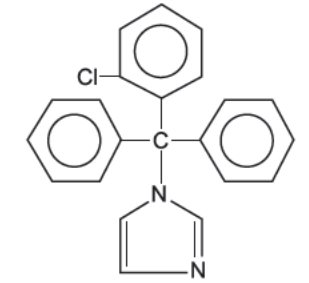
CLINICAL PHARMACOLOGY Clotrimazole and Betamethasone Dipropionate Clotrimazole and betamethasone dipropionate cream has been shown to be at least as effective as clotrimazole alone in a different cream vehicle. Use of corticosteroids in the treatment of fungal infection may lead to suppression of host inflammation leading to worsening or decreased cure rate. Clotrimazole Skin penetration and systemic absorption of clotrimazole following topical application of clotrimazole and betamethasone dipropionate cream have not been studied. The following information was obtained using 1% clotrimazole cream and solution formulations. Six hours after the application of radioactive clotrimazole 1% cream and 1% solution onto intact and acutely inflamed skin, the concentration of clotrimazole varied from 100 mcg/cm 3 in the stratum corneum, to 0 . 5 to 1 mcg/cm 3 in the reticular dermis, and 0 . 1 mcg/cm 3 in the subcutis. No measurable amount of radioactivity (<0 . 001 mcg/mL) was found in the serum within 48 hours after application under occlusive dressing of 0 . 5 mL of the solution or 0 . 8 g of the cream. Only 0 . 5% or less of the applied radioactivity was excreted in the urine. Microbiology Mechanism of Action: Clotrimazole is an imidazole antifungal agent. Imidazoles inhibit 14-(-demethylation of lanosterol in fungi by binding to one of the cytochrome P-450 enzymes. This leads to the accumulation of 14-(-methylsterols and reduced concentrations of ergosterol, a sterol essential for a normal fungal cytoplasmic membrane. The methylsterols may affect the electron transport system, thereby inhibiting growth of fungi. Activity In Vivo: Clotrimazole has been shown to be active against most strains of the following dermatophytes, both in vitro and in clinical infections as described in the INDICATIONS AND USAGE section: Epidermophyton floccosum , Trichophyton mentagrophytes , and Trichophyton rubrum . Activity In Vitro: In vitro , clotrimazole has been shown to have activity against many dermatophytes, but the clinical significance of this information is unknown . Drug Resistance: Strains of dermatophytes having a natural resistance to clotrimazole have not been reported. Resistance to azoles including clotrimazole has been reported in some Candida species. No single-step or multiple-step resistance to clotrimazole has developed during successive passages of Trichophyton mentagrophytes . Betamethasone Dipropionate Betamethasone dipropionate, a corticosteroid, has been shown to have topical (dermatologic) and systemic pharmacologic and metabolic effects characteristic of this class of drugs. Pharmacokinetics: The extent of percutaneous absorption of topical corticosteroids is determined by many factors, including the vehicle, the integrity of the epidermal barrier and the use of occlusive dressings (see DOSAGE AND ADMINISTRATION section). Topical corticosteroids can be absorbed from normal intact skin. Inflammation and/or other disease processes in the skin may increase percutaneous absorption of topical corticosteroids. Occlusive dressings substantially increase the percutaneous absorption of topical corticosteroids (see DOSAGE AND ADMINISTRATION section). Once absorbed through the skin, the pharmacokinetics of topical corticosteroids are similar to systemically administered corticosteroids. Corticosteroids are bound to plasma proteins in varying degrees. Corticosteroids are metabolized primarily in the liver and are then excreted by the kidneys. Some of the topical corticosteroids and their metabolites are also excreted into the bile. Studies performed with clotrimazole and betamethasone dipropionate cream indicate that this topical combination antifungal/corticosteroid may have vasoconstrictor potencies in a range that is comparable to high potency topical corticosteroids. Therefore, use is not recommended in patients less than 17 years of age, in diaper dermatitis, and under occlusion.
NDC examples
63629-875868788-841951672-404850090-487685766-19663187-09550090-31210168-025870518-235250090-074168071-413416714-496
Indicated ICD-10 codes
Treats these conditions
Source: openFDA + RxNorm · 2026
Look up another medication