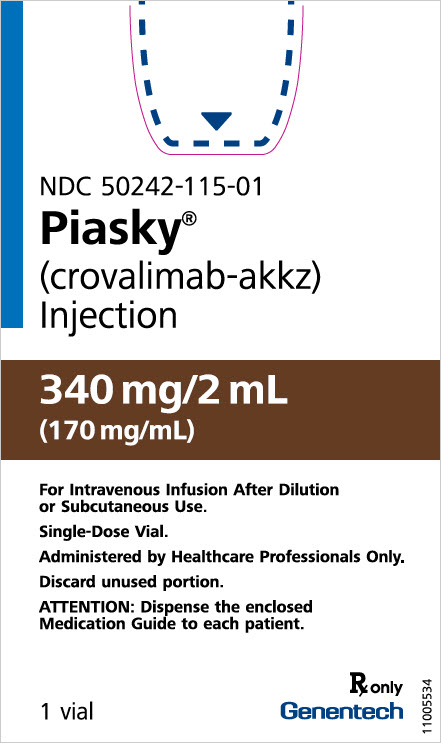
Crovalimab — Complement C5 Inhibitor [EPC]. INDICATIONS AND USAGE PIASKY is indicated for the treatment of adult and pediatric patients 13 years and older with paroxysmal nocturnal…
Boxed warning
WARNING: SERIOUS MENINGOCOCCAL INFECTIONS PIASKY, a complement inhibitor, increases the risk of serious infections caused by Neisseria meningitidis [see Warnings and Precautions (5.1) ] . Life-threatening and fatal meningococcal infections have occurred in patients treated with complement inhibitors. These infections may become rapidly life-threatening or fatal if not recognized and treated early. Complete or update vaccination for meningococcal bacteria (for serogroups A, C, W, Y, and B) at least 2 weeks prior to the first dose of PIASKY, unless the risks of delaying therapy with PIASKY outweigh the risk of developing a serious infection. Comply with the most current Advisory Committee on Immunization Practices (ACIP) recommendations for meningococcal vaccination in patients receiving a complement inhibitor. See Warnings and Precautions (5.1) for additional guidance on the management of the risk of serious infections caused by meningococcal bacteria. Patients receiving PIASKY are at increased risk for invasive disease caused by N. meningitidis , even if they develop antibodies following vaccination. Monitor patients for early signs of serious meningococcal infections and evaluate immediately if infection is suspected. Because of the risk of serious meningococcal infections, PIASKY is available only through a restricted program under a Risk Evaluation and Mitigation Strategy (REMS) called PIASKY REMS [see Warnings and Precautions (5.2) ] . WARNING: SERIOUS MENINGOCOCCAL INFECTIONS See full prescribing information for complete boxed warning. PIASKY increases the risk of serious and life-threatening infections caused by Neisseria meningitidis . Complete or update meningococcal vaccination at least 2 weeks prior to the first dose of PIASKY, unless the risks of delaying PIASKY outweigh the risks of developing a serious infection. Comply with the most current Advisory Committee on Immunization Practices (ACIP) recommendations for meningococcal vaccination in patients receiving a complement inhibitor ( 5.1 ). Patients receiving PIASKY are at increased risk for invasive disease caused by N. meningitidis , even if they develop antibodies following vaccination. Monitor patients for early signs of meningococcal infections and evaluate immediately if infection is suspected ( 5.1 ). PIASKY is available only through a restricted program called the PIASKY REMS ( 5.2 )
INDICATIONS AND USAGE PIASKY is indicated for the treatment of adult and pediatric patients 13 years and older with paroxysmal nocturnal hemoglobinuria (PNH) and body weight of at least 40 kg. PIASKY is a complement C5 inhibitor indicated for the treatment of adult and pediatric patients 13 years and older with paroxysmal nocturnal hemoglobinuria (PNH) and body weight of at least 40 kg ( 1 )
Dosage
DOSAGE AND ADMINISTRATION See Full Prescribing Information for instructions on preparation, dosage, and administration. ( 2.2 , 2.3 , 2.4 , 2.5 ) Start with one loading dose administered by intravenous infusion, followed by 4 additional loading doses administered by subcutaneous injection. Then administer a maintenance dose every 4 weeks by subcutaneous injection. For patients switching from another complement inhibitor, the first loading dose of PIASKY should be administered no sooner than the time of the next scheduled complement inhibitor administration. See Full Prescribing Information for considerations when switching from another C5 inhibitor. Administer doses based on the patient's actual body weight ( 2.2 ) 2.1 Recommended Vaccination and Prophylaxis for Meningococcal Infection Vaccinate patients for meningococcal infection (serogroups A, C, W, Y and B) according to current ACIP recommendations at least 2 weeks prior to initiation of PIASKY [see Warnings and Precautions (5.1) ] . If urgent PIASKY therapy is indicated in a patient who is not up to date with meningococcal vaccines according to ACIP recommendations, provide the patient with antibacterial drug prophylaxis and administer these vaccines as soon as possible. Healthcare providers who prescribe PIASKY must enroll in the PIASKY REMS [see Warnings and Precautions (5.2) ]. 2.2 Recommended Dosage Regimen The recommended dosage regimen consists of one loading dose administered by intravenous (IV) infusion (on Day 1), followed by four additional weekly loading doses administered by subcutaneous (SUBQ) injection (on Days 2, 8, 15, and 22). The maintenance dose starts on Day 29 and is then administered every 4 weeks by subcutaneous injection. Administer doses based on the patient's actual body weight, as shown in Table 1 . Table 1 PIASKY Dosage Regimen Based on Body Weight Body Weight ≥ 40 kg to < 100 kg ≥ 100 kg IV = intravenous, SUBQ = subcutaneous Loading Dose Day 1 Day 2, 8, 15, 22 1,000 mg (IV) 340 mg (SUBQ) 1,500 mg (IV) 340 mg (SUBQ) Maintenance Dose Day 29 and Q4W Q4W=every 4 weeks thereafter 680 mg (SUBQ) 1,020 mg (SUBQ) The dosing schedule is allowed to occasionally vary within 2 days of the scheduled administration day (except at Day 1 and Day 2). If this occurs, the subsequent dose should be administered according to the regular schedule. Modification of the maintenance dose is required if the patient's body weight changes to become consistently greater than or lower than 100 kg during the course of therapy. 2.3 Recommended Timing for Switching to PIASKY from Another C5 Inhibitor Healthcare providers should consider the benefits of the timing of switching C5 inhibitors vs. the risks of Type III hypersensitivity reactions [see Warnings and Precautions (5.3) ] . For patients switching from another C5 inhibitor (e.g., eculizumab or ravulizumab), the first intravenous loading dose of PIASKY should be administered no sooner than the time of the next scheduled complement inhibitor administration. The administration of the additional subcutaneous loading doses and maintenance doses of PIASKY should follow as per the schedule shown in Table 1 . 2.4 Delayed or Missed Dose If an entire planned dose or part of a planned dose of PIASKY is missed, administer the missed dose or remainder of the missed dose as soon as possible before the day of the next scheduled dose. Then administer the next dose on the regularly scheduled dosing day. Do not administer two doses or more than the prescribed dose on the same day to make up for a missed dose. 2.5 Preparation and Administration Each vial of PIASKY is for one-time use in only one patient. PIASKY is administered as an intravenous infusion (first dose) and as a subcutaneous injection (subsequent doses). Only healthcare providers should administer PIASKY. Parenteral drug products should be inspected visually for particulate matter and discoloration prior to administration, whenever solution and container permit. PIASKY is clear to opalescent, and an almost colorless to brownish-yellow solution. PIASKY should be discarded if the medicine looks cloudy, discolored, or has particles in it. Preparation of Intravenous Infusion Use aseptic technique to prepare PIASKY for intravenous administration. PIASKY must be diluted and administered as an intravenous infusion over 60 minutes ± 10 minutes (1,000 mg) or 90 minutes ± 10 minutes (1,500 mg). PIASKY solution must be diluted in 0.9% Sodium Chloride Injection prior to administration. A 0.2 micron in-line filter must be used with the infusion set during administration. A dedicated infusion line must be used during intravenous administration. Only dilute PIASKY in 0.9% Sodium Chloride Injection. Dilution of Intravenous Infusion Withdraw the required volume of PIASKY from the vial (see Table 2 ) using a sterile syringe and dilute into the infusion bag. Use multiple vials to meet the required volume of PIASKY to be added to the infusion bag. Discard any unused portion left in the vial. Dilution of PIASKY in infusion bags containing 0.9% Sodium Chloride Injection must be in the range of 4-15 mg/mL (final concentration after dilution) (see Table 2 ). Intravenous infusion bags of a volume of 100 mL or 250 mL can be used. Table 2 Dose Example Volume Determination Dose (mg) Volume of Piasky (mL) Size of 0.9% Sodium Chloride Injection Bag (mL) Concentration in Bag (mg/mL) 1,000 5.9 250 4 1,500 8.8 250 6 1,000 5.9 100 10 1,500 8.8 100 15 Gently mix the infusion bag by slowly inverting the bag. Do not shake. Inspect the infusion bag for particles and discard if present. Flushing of infusion line is required to ensure complete administration of the entire dose. Storage of Diluted Solution for Infusion The diluted solution for intravenous infusion should be used immediately because PIASKY does not contain any antimicrobial preservative. If immediate use is not possible, see Table 3 for detailed storage conditions of the prepared solution for infusion, which depends on the type of infusion bags used. Table 3 Storage Conditions for the Prepared Solution for Infusion Infusion bags Storage conditions polyolefins (PO), polyethylene (PE), polypropylene (PP), polyvinyl chloride (PVC) PO/PE/PP Refrigerate at 2°C to 8°C (36°F to 46°F) for up to 64 hours protected from light, and store at room temperature up to 30°C (86°F) for up to 6 hours including infusion time under ambient light conditions. Protect from direct sunlight. PVC Refrigerate at 2°C to 8°C (36°F to 46°F) for up to 12 hours protected from light, and store at room temperature up to 30°C (86°F) for up to 6 hours including infusion time under ambient light conditions. Protect from direct sunlight. No incompatibilities have been observed between PIASKY and intravenous infusion bags with product-contacting materials made of polyvinyl chloride, or polyolefins such as polyethylene and polypropylene. In addition, no incompatibilities have been observed with infusion sets or infusion aids with product-contacting materials made of polyvinyl chloride, polyethylene, polyurethane, polybutadiene, acrylonitrile butadiene styrene, polycarbonate, or polytetrafluorethylene. The infusion of PIASKY may be slowed or interrupted if the patient develops an infusion-related reaction. The infusion should be discontinued immediately if the patient experiences a serious hypersensitivity reaction [see Warnings and Precautions (5.5) ] . Preparation of the Subcutaneous Injection For subcutaneous injection, PIASKY must be used undiluted. Remove the vial cap and clean the vial rubber stopper. Attach the transfer needle on the syringe. Withdraw all the medicine from the vial. Remove air bubbles if any. Remove the transfer needle from the vial. Recap the transfer needle using a one-handed scoop technique. Detach the transfer needle. Attach the injection needle on the syringe. Clean the injection site with an alcohol pad and let air dry. Inject the medicine subcutaneously. If the dose requires multiple
Warnings
WARNINGS AND PRECAUTIONS Type III hypersensitivity reactions: Monitor patients switching from another C5 inhibitor to PIASKY or from PIASKY to another C5 inhibitor as they are at risk of Type III hypersensitivity reactions related to the formation of drug-target-drug complexes ( 5.3 ) Other Infections: PIASKY can increase susceptibility to serious infections especially those caused by encapsulated bacteria. ( 5.4 ) Infusion- and Injection-Related Reactions: Monitor for these reactions and initiate medical management as needed ( 5.5 ) 5.1 Serious Meningococcal Infection PIASKY, a complement inhibitor, increases a patient's susceptibility to serious, life-threatening, or fatal infections caused by meningococcal bacteria (meningococcemia and/or meningitis) in any serogroup, including non-groupable strains. Life-threatening and fatal meningococcal infections have occurred in both vaccinated and unvaccinated patients treated with complement inhibitors. The initiation of PIASKY is contraindicated in patients with a serious unresolved Neisseria meningitidis infection. Complete or update meningococcal vaccination (for serogroups A, C, W, Y, and B) at least 2 weeks prior to administration of the first dose of PIASKY, according to the current Advisory Committee on Immunization Practices (ACIP) recommendations for patients receiving a complement inhibitor. Revaccinate patients in accordance with ACIP recommendations considering the duration of PIASKY therapy. Note that ACIP recommends an administration schedule in patients receiving complement inhibitors that differs from the administration schedule in the vaccine prescribing information. If urgent PIASKY therapy is indicated in a patient who is not up to date with meningococcal vaccines according to ACIP recommendations, provide the patient with antibacterial drug prophylaxis and administer meningococcal vaccines as soon as possible. Various durations and regimens of antibacterial drug prophylaxis have been considered, but the optimal durations and drug regimens for prophylaxis and their efficacy have not been studied in unvaccinated or vaccinated patients receiving complement inhibitors, including PIASKY. The benefits and risks of treatment with PIASKY, as well as the benefits and risks of antibacterial drug prophylaxis in unvaccinated or vaccinated patients, must be considered against the known risks for serious infections caused by N. meningitidis . Vaccination does not eliminate the risk of meningococcal infections, despite development of antibodies following vaccination. Closely monitor patients for early signs and symptoms of meningococcal infection and evaluate patients immediately if infection is suspected. Inform patients of these signs and symptoms and instruct patients to seek immediate medical care if these signs and symptoms occur. Promptly treat known infections. Meningococcal infection may become rapidly life-threatening or fatal if not recognized and treated early. Consider interruption of PIASKY in patients who are undergoing treatment for serious meningococcal infection. PIASKY is available only through a restricted program under a REMS [see Warnings and Precautions (5.2) ] . 5.2 PIASKY REMS PIASKY is available only through a restricted program under a REMS called PIASKY REMS, because of the risk of serious meningococcal infections [see Warnings and Precautions (5.1) ] . Notable requirements of the PIASKY REMS include the following: Prescribers must enroll in the REMS. Prescribers must counsel patients about the risk of serious meningococcal infection. Prescribers must provide the patients with the REMS educational materials. Prescribers must assess patient vaccination status for meningococcal vaccines (against serogroups A, C, W, Y, and B) and vaccinate if needed according to current ACIP recommendations two weeks prior to the first dose of PIASKY. Prescribers must provide a prescription for antibacterial drug prophylaxis if treatment must be started urgently, and the patient is not up to date with both meningococcal vaccines according to current ACIP recommendations at least two weeks prior to the first dose of PIASKY. Healthcare settings and pharmacies that dispense PIASKY must be certified in the REMS and must verify prescribers are certified. Patients must receive counseling from the prescriber about the need to receive meningococcal vaccines per ACIP recommendations, the need to take antibiotics as directed by the prescriber, and the signs and symptoms of meningococcal infection. Patients must be instructed to carry the Patient Safety Card with them at all times during and for 11 months following treatment with PIASKY. Further information is available at www.PIASKYREMS.com or 1-866-4My-Skyy (469-7599). 5.3 Type III Hypersensitivity Reactions Related to Drug-Target-Drug Complexes Patients who are switching from another C5 inhibitor (e.g., eculizumab or ravulizumab) to PIASKY or from PIASKY to another C5 inhibitor are at risk of serious Type III hypersensitivity reactions related to the formation of drug-target-drug-complexes (DTDCs), because PIASKY and these other C5 inhibitors bind different epitopes of C5 [see Drug Interactions (7) ] . In clinical trials, Type III hypersensitivity reactions were reported in 39 of 201 patients (19%) who switched from eculizumab or ravulizumab to PIASKY. Four of these patients (10%) had not fully recovered from symptoms of Type III hypersensitivity reactions at the time of their last follow up visit. In addition, Type III hypersensitivity reactions were reported in 2 of 8 patients (25%) who switched from PIASKY to eculizumab or ravulizumab, including one patient who developed Grade 3 axonal neuropathy [see Adverse Reactions (6) ] . Symptoms of Type III hypersensitivity reactions that occurred in more than 2 patients were arthralgia, rash, pyrexia, myalgia, headache, fatigue, petechiae and abdominal pain. Among patients who experienced Type III hypersensitivity reactions, 8 (21%) had events that were considered serious due to hospitalization. Symptoms of serious Type III hypersensitivity reactions included pyrexia and arthralgia. Type III hypersensitivity reactions can also cause renal abnormalities. Healthcare providers should consider the benefits of the timing of switching C5 inhibitors vs. the risks of Type III hypersensitivity reactions. Patients are expected to no longer be at risk of Type III hypersensitivity reactions if the prior C5 inhibitor has been cleared from the body prior to starting PIASKY or if PIASKY has been cleared from the body prior to starting another C5 inhibitor. Therefore, initiating PIASKY sooner than 5.5 half-lives from the last dose of a C5 inhibitor (e.g., eculizumab or ravulizumab) or initiating a C5 inhibitor (e.g., eculizumab or ravulizumab) sooner than 5.5 half-lives from the last dose of PIASKY increases the risk of Type III hypersensitivity reactions. Based on time-to-onset of Type III hypersensitivity reactions observed in clinical trials, patients should be monitored for the first 30 days of the new therapy for the occurrence of symptoms of Type III hypersensitivity reactions. For mild or moderate Type III hypersensitivity reactions, administer symptomatic treatment, such as topical corticosteroids, antihistamines, antipyretics, and/or analgesics. For severe reactions, initiate and taper oral or systemic corticosteroid therapy as clinically indicated. 5.4 Other Infections Due to its mechanism of action, PIASKY may increase susceptibility to infections, especially with encapsulated bacteria, such as infections with Neisseria spp. but also Streptococcus pneumoniae, Haemophilus influenzae , and to a lesser extent, Neisseria gonorrhoeae . Children treated with PIASKY may be at increased risk of developing serious infections due to Streptococcus pneumoniae and Haemophilus influenzae type b (Hib). Vaccinate patients against Streptococcus pneumoniae and Haemophilus influenzae type b (Hib) infections according to ACIP reco
Contraindications
CONTRAINDICATIONS PIASKY is contraindicated: For initiation in patients with an unresolved serious Neisseria meningitidis infection [see Warnings and Precautions (5.1) ]. In patients with a known serious hypersensitivity reaction to crovalimab or any of the excipients [see Warnings and Precautions (5.5) ] . Initiation during unresolved serious Neisseria meningitidis infection ( 4 ) Serious hypersensitivity to crovalimab or any of the excipients ( 4 )
Drug interactions
7. DRUG INTERACTIONS PIASKY binds different epitopes on C5 compared to eculizumab and ravulizumab, which can lead to the formation of DTDCs when patients switch between PIASKY and either eculizumab or ravulizumab. These DTDCs comprise one or more units of C5 bound to both PIASKY and to eculizumab or ravulizumab. These DTDCs are expected to be cleared within approximately 8 weeks (in the case of eculizumab) or longer (in the case of ravulizumab) and can result in Type III hypersensitivity reactions [see Warnings and Precautions (5.3) , Adverse Reactions (6.1) and Clinical Pharmacology (12.3) ] .
Adverse reactions
ADVERSE REACTIONS The following clinically significant adverse reactions are discussed in greater detail in other sections of the label: Serious Meningococcal Infection [see Warnings and Precautions (5.1) ] Type III Hypersensitivity Reactions Related to Drug-Target-Drug Complexes [see Warnings and Precautions (5.3) ] Other Infections [see Warnings and Precautions (5.4) ] Infusion- and Injection-Related Reactions [see Warnings and Precautions (5.5) ] The most common adverse drug reactions (incidence ≥10%) were infusion-related reaction, respiratory tract infection, viral infection, and Type III hypersensitivity reactions. ( 6.1 ) To report SUSPECTED ADVERSE REACTIONS, contact Genentech at 1-888-835-2555 or FDA at 1-800-FDA-1088 or www.fda.gov/medwatch. 6.1 Clinical Trial Experience Because clinical trials are conducted under widely varying conditions, adverse reaction rates observed in the clinical trials of a drug cannot be directly compared to rates in the clinical trials of another drug and may not reflect the rates observed in practice. Patients Who are Complement Inhibitor-Naïve The data described below reflect exposure of 204 patients with PNH who were complement inhibitor-naïve and who were randomized in COMMODORE 2 to receive PIASKY (n = 135) or eculizumab (n = 69) at the recommended dosing regimen for 24 weeks [see Clinical Studies (14) ] . Serious adverse reactions occurred in 6% of patients receiving PIASKY in the COMMODORE 2 study, including epistaxis and pneumonia, which occurred in 2 patients each, and infusion related reaction, pyelonephritis, COVID-19, and hypovolemic shock which were reported in 1 patient each. Table 4 lists adverse reactions that occurred at a rate of 5% or more among patients randomized to PIASKY treatment for 24 weeks in the COMMODORE 2 study. The most common adverse reactions (≥10%) in patients treated with PIASKY were infusion related reaction, respiratory tract infection, and viral infection. Table 4 Adverse Reactions Reported In 5% or More of Complement-Inhibitor Naïve Patients with PNH Randomized to PIASKY in COMMODORE 2 Adverse reactions PIASKY (N = 135) % ECULIZUMAB (N = 69) % Infusion-related reaction 16 13 Respiratory tract infection Grouped terms. Diarrhea includes diarrhea and diarrhea infectious. Headache includes headache and migraine. Injection-related reaction includes injection related reaction and injection site reaction. Respiratory tract infection includes nasopharyngitis, pharyngitis, rhinitis, rhinitis allergic, upper respiratory tract infection and pneumonia. Viral infection includes viral infection, COVID-19, influenza, herpes virus infection and oral herpes. 13 20 Viral infection 11 7 Hyperuricemia 8 9 Headache 8 6 Diarrhea 7 1 Injection-related reaction Injection-related reactions are only expected to occur in the PIASKY arm as eculizumab is not given by subcutaneous injection 6 0 Patients Previously Treated with a Complement C5 Inhibitor The data described below reflect exposure of 86 patients with PNH who received PIASKY (n=44) or eculizumab (n=42) at the recommended dosing regimen for 24 weeks in COMMODORE 1, an open-label, active-controlled, multicenter study conducted in patients switching from eculizumab. The median age was 47 years (range: 21 to 85); 52% were female, and race included White (73%), Asian (19%), unknown (5%), and Black/African-American (3%). The population ethnicities were 17% Hispanic or Latino and 76% not Hispanic or Latino. Serious adverse reactions in COMMODORE 1 were reported in 3 patients (7%) with PNH receiving PIASKY. Serious adverse reactions included pneumonia, nasopharyngitis, and urinary tract infection, which occurred in 1 patient each. Table 5 lists adverse reactions that occurred at a rate of 5% or more among patients randomized to PIASKY treatment for 24 weeks in the COMMODORE 1 study. The most common adverse reactions (≥10%) in patients treated with PIASKY were viral infections, respiratory tract infection, Type III hypersensitivity reaction, infusion-related reaction, peripheral edema, and headache. Table 5 Adverse Reactions Reported In 5% or More of Complement-Inhibitor Treated Patients with PNH Randomized to PIASKY in COMMODORE 1 Adverse reactions PIASKY (N = 44) % ECULIZUMAB (N = 42) % Viral infection Grouped terms Fatigue includes fatigue, malaise and asthenia. Injection-related reaction includes injection related reaction and injection site reaction. Rash includes rash and skin exfoliation. Peripheral edema includes edema peripheral and peripheral swelling. Respiratory tract infection includes respiratory tract infection, nasopharyngitis, pneumonia and upper respiratory tract infection. Viral infection includes viral infection, influenza, COVID-19, and respiratory syncytial virus infection 23 21 Respiratory tract infection 18 5 Type III hypersensitivity reaction Type III immune complex mediated reaction is only expected to occur in the PIASKY arm as patients in the eculizumab arm did not change C5 inhibitor treatment 16 0 Infusion-related reaction Infusion-related reactions are not expected to occur in the eculizumab arm as these patients tolerated eculizumab prior to study initiation 14 0 Peripheral edema 11 2 Headache 11 2 Injection-related reaction Injection-related reactions are only expected to occur in the PIASKY arm as eculizumab is not given by subcutaneous injection 9 0 Fatigue 9 12 Rash 9 0 Diarrhea 7 2 Nausea 7 5 Arthralgia 7 0 Type III Hypersensitivity Reactions Related to Drug-Target-Drug Complexes [see Warnings and Precautions (5.3) , and Drug Interactions (7) ] . Across the COMMODORE 1 and 2 studies, 39 out of 201 (19.4%) patients who switched from eculizumab or ravulizumab to PIASKY experienced a Type III hypersensitivity reaction (reported as Type III immune complex mediated reaction). A total of 6 patients had switched two times and of the 6 patients, 2 patients experienced a second episode of Type III hypersensitivity reaction after discontinuing PIASKY and switching to ravulizumab. One of these patients developed Grade 3 axonal neuropathy and a Type III hypersensitivity reaction could not be excluded and the other developed Grade 2 arthralgia and myalgia. These two events remained unresolved at the last follow up visit of the clinical studies (the duration of the events until last follow-up was 313 days for the event of Grade 3 axonal neuropathy and 142 days for the event of Grade 2 arthralgia and myalgia, respectively). Two additional patients who experienced Grade 3 rash and Grade 3 arthralgia, respectively, had unresolved Type III hypersensitivity reaction at the last follow-up visit. The median time to onset of Type III hypersensitivity reaction in patients who switched treatment from eculizumab or ravulizumab to PIASKY was 1.6 weeks (range: 0.7 – 4.4 weeks) and the median duration of Type III hypersensitivity reactions was 1.9 weeks (range 0.4 – 34.1 weeks). The majority of events were Grade 1-2. Grade 3 Type III hypersensitivity reaction occurred in 8% of patients who switched from eculizumab or ravulizumab to PIASKY. Out of 42 Type III hypersensitivity reactions, 37 (88%) resolved, including 1 (2.4%) that resolved with PIASKY discontinuation, 2 (4.8%) that resolved with PIASKY interruption and 34 (81%) that resolved without discontinuation, interruption, or dose change in PIASKY therapy. Axonal Neuropathy In COMMODORE 1 and 2, Grade 3 distal axonal demyelinating polyneuropathy and Grade 3 axonal neuropathy were reported, each in 1 patient who switched from another C5 inhibitor to PIASKY or from PIASKY to another C5 inhibitor. The Grade 3 distal axonal demyelinating polyneuropathy occurred 11 weeks after a patient switched from eculizumab to PIASKY (with first dose of PIASKY received 12 days after the last dose of eculizumab treatment) and was preceded by a bacterial respiratory tract infection. The Grade 3 axonal neuropathy occurred in a patient who had switched to ravulizumab treatment after 6 weeks of treatment with
Mechanism of action
Mechanism of Action Crovalimab-akkz is a monoclonal antibody that specifically binds with high affinity to the complement protein C5, inhibiting its cleavage into C5a and C5b, preventing the formation of the membrane attack complex (MAC). Crovalimab-akkz inhibits terminal complement-mediated intravascular hemolysis in patients with PNH.
A drug lookup is just the start. Eleplan keeps the whole care plan in one place.
Medications, diagnoses, documents, appointments, and the whole care team — organized and always in sync, with Ellie, your AI care assistant, on top of it. Free to start.