Elagolix and Estradiol and Norethisterone. INDICATIONS AND USAGE ORIAHNN is indicated for the management of heavy menstrual bleeding associated with uterine leiomyomas (fibroids) in…
Boxed warning
WARNING: THROMBOEMBOLIC DISORDERS AND VASCULAR EVENTS Estrogen and progestin combinations, including ORIAHNN, increase the risk of thrombotic or thromboembolic disorders including pulmonary embolism, deep vein thrombosis, stroke and myocardial infarction, especially in women at increased risk for these events [see Warnings and Precautions ( 5.1 )] . ORIAHNN is contraindicated in women with current or a history of thrombotic or thromboembolic disorders and in women at increased risk for these events, including women over 35 years of age who smoke and women with uncontrolled hypertension [see Contraindications ( 4 )] . WARNING: THROMBOEMBOLIC DISORDERS AND VASCULAR EVENTS See full prescribing information for complete boxed warning. Estrogen and progestin combinations, including ORIAHNN, increase the risk of thrombotic or thromboembolic disorders, especially in women at increased risk for these events. ( 5.1 ) ORIAHNN is contraindicated in women with current or a history of thrombotic or thromboembolic disorders and in women at increased risk for these events including women over 35 years of age who smoke or women with uncontrolled hypertension. ( 4 )
INDICATIONS AND USAGE ORIAHNN is indicated for the management of heavy menstrual bleeding associated with uterine leiomyomas (fibroids) in premenopausal women. Limitation of Use: Use of ORIAHNN should be limited to 24 months due to the risk of continued bone loss, which may not be reversible [see Dosage and Administration ( 2.1 ) and Warnings and Precautions ( 5.2 ) ] . ORIAHNN is a combination of elagolix, a gonadotropin-releasing hormone (GnRH) receptor antagonist, estradiol, an estrogen, and norethindrone acetate, a progestin, indicated for the management of heavy menstrual bleeding associated with uterine leiomyomas (fibroids) in premenopausal women. ( 1 ) Limitation of Use: Use of ORIAHNN should be limited to 24 months due to the risk of continued bone loss, which may not be reversible. ( 1 )
Dosage
DOSAGE AND ADMINISTRATION One capsule (elagolix 300 mg, estradiol 1 mg, norethindrone acetate 0.5 mg) in the morning and one capsule (elagolix 300 mg) in the evening for up to 24 months. ( 2.1 ) 2.1 Important Dosing Information Exclude pregnancy before starting ORIAHNN or start ORIAHNN within 7 days from the onset of menses [see Use in Specific Populations ( 8.1 ) and ( 8.3 ) ] . The recommended dosage of ORIAHNN is: ○ One elagolix 300 mg, estradiol 1 mg, and norethindrone acetate 0.5 mg capsule in the morning (AM), and ○ One elagolix 300 mg capsule in the evening (PM). Take the morning and evening capsules at approximately the same time each day, with or without food. The recommended duration of treatment with ORIAHNN is 24 months [see Warnings and Precautions ( 5.2 ) ] . 2.2 Missed Dose Instruct the patient to take the missed dose of ORIAHNN within 4 hours of the time that it was supposed to be taken and then the next dose at the usual time. If more than 4 hours have passed since a capsule is usually taken, instruct the patient not to take the missed dose and take the next dose at the usual time. Take only one morning capsule and one evening capsule per day.
Warnings
WARNINGS AND PRECAUTIONS Thromboembolic Disorders and Vascular Events: Discontinue ORIAHNN if an arterial or venous thrombotic, cardiovascular, or cerebrovascular event occurs. Stop ORIAHNN if there is sudden unexplained partial or complete loss of vision, proptosis, diplopia, papilledema, or retinal vascular lesions and evaluate for retinal vein thrombosis immediately. ( 5.1 ) Bone Loss: Duration-dependent decreases in bone mineral density (BMD) that may not be completely reversible. Baseline and periodic BMD assessments are recommended. Assess risk-benefit for women with additional risk factors for bone loss. ( 5.2 ) Suicidal Ideation and Mood Disorders: Advise patients to seek medical attention for suicidal ideation, suicidal behavior, new onset or worsening depression, anxiety, or other mood changes. ( 5.4 ) Hepatic Impairment and Transaminase Elevations: Counsel patients on signs and symptoms of liver injury. ( 5.5 ) Elevated Blood Pressure: Do not use in women with uncontrolled hypertension. For women with well-controlled hypertension, continue to monitor blood pressure and stop ORIAHNN if blood pressure rises significantly. ( 5.6 ) Change in Menstrual Bleeding Pattern and Reduced Ability to Recognize Pregnancy: Advise women to use non-hormonal contraception during treatment and for 28 days after discontinuing ORIAHNN. ORIAHNN may delay the ability to recognize the occurrence of a pregnancy because it alters menstrual bleeding. Perform pregnancy testing if pregnancy is suspected and discontinue ORIAHNN if pregnancy is confirmed. ( 5.8 ) Risk of Allergic Reactions Due to the Inactive Ingredient (FD&C Yellow No 5): This product contains FD&C Yellow No. 5 (tartrazine), which may cause allergic-type reactions (including bronchial asthma) in certain susceptible persons. ( 5.12 ) 5.1 Thromboembolic Disorders and Vascular Events ORIAHNN is contraindicated in women with current or history of thrombotic or thromboembolic disorders and in women at increased risk for these events [see Contraindications ( 4 ) ] . In the Phase 3 clinical trials (Studies UF-1, UF-2, and UF-3), two thrombotic events occurred in 453 ORIAHNN-treated women (thrombosis in the calf and pulmonary embolism) [see Adverse Reactions ( 6.1 ) and Clinical Studies ( 14 ) ] . Estrogen and progestin combinations, including the estradiol/norethindrone acetate component of ORIAHNN, increase the risk of thrombotic or thromboembolic disorders, including pulmonary embolism, deep vein thrombosis, stroke, and myocardial infarction, especially in women at high risk for these events. In general, the risk is greatest among women over 35 years of age who smoke, and women with uncontrolled hypertension, dyslipidemia, vascular disease, or obesity. Discontinue ORIAHNN if an arterial or venous thrombotic, cardiovascular, or cerebrovascular event occurs or is suspected. If feasible, discontinue ORIAHNN at least 4 to 6 weeks before surgery of the type associated with an increased risk of thromboembolism, or during periods of prolonged immobilization. Stop ORIAHNN immediately if there is sudden unexplained partial or complete loss of vision, proptosis, diplopia, papilledema, or retinal vascular lesions and evaluate for retinal vein thrombosis as these have been reported in patients receiving estrogens and progestins. 5.2 Bone Loss ORIAHNN is contraindicated in women with known osteoporosis [see Contraindications ( 4 )] . ORIAHNN may cause a decrease in bone mineral density (BMD) in some patients. BMD loss is greater with increasing duration of use and may not be completely reversible after stopping treatment [see Adverse Reactions ( 6.1 ) ] . In the Phase 3 clinical trials (Studies UF-1, UF-2, and UF-3) [see Clinical Studies ( 14 ) ] , seven out of 453 (1.5%) ORIAHNN-treated women experienced fractures, including one (0.2%) with a fragility fracture, compared to one out of 196 (0.5%) placebo-treated women (patient had a non-fragility fracture). Five of the seven ORIAHNN-treated women reported these fractures in the post-treatment follow-up period. The impact of BMD decreases on long-term bone health and future fracture risk in premenopausal women is unknown. Consider the benefits and risks of ORIAHNN treatment in patients with a history of a low-trauma fracture or other risk factors for osteoporosis or bone loss, including taking medications that may decrease BMD (e.g., systemic or chronic inhaled corticosteroids, anticonvulsants, or proton pump inhibitors). Assessment of BMD by dual-energy X-ray absorptiometry (DXA) is recommended at baseline and periodically thereafter. Consider discontinuing ORIAHNN if the risk associated with bone loss exceeds the potential benefit of treatment. Limit the duration of use to 24 months to reduce the extent of bone loss [see Indications and Usage ( 1 ) and Dosage and Administration ( 2.1 ) ] . Although the effect of supplementation with calcium and vitamin D was not studied, such supplementation for patients with inadequate dietary intake may be beneficial. 5.3 Hormonally-Sensitive Malignancies ORIAHNN is contraindicated in women with current or history of breast cancer and in women at increased risk for hormonally-sensitive malignancies, such as those with mutations in BRCA genes [see Contraindications ( 4 ) ] . In the Phase 3 clinical trials (Studies UF-1, UF-2, and UF-3), two (0.4%) cases of breast cancer in 453 ORIAHNN-treated women were observed. No breast cancer cases were seen in placebo-treated women [see Adverse Reactions ( 6.1 ) ] . The use of estrogen alone and estrogen plus progestin has been reported to result in an increase in abnormal mammograms requiring further evaluation. Surveillance measures, such as breast examinations and regular mammography, are recommended. Discontinue ORIAHNN if a hormonally-sensitive malignancy is diagnosed. 5.4 Suicidal Ideation, Suicidal Behavior, and Exacerbation of Mood Disorders In Phase 3 placebo-controlled clinical trials (Studies UF-1 and UF-2), ORIAHNN-treated women had a higher incidence (3%) of depression, depressed mood, and/or tearfulness compared to placebo-treated women (1%) [see Adverse Reactions ( 6.1 ) ] . Suicidal ideation and behavior, including a completed suicide, occurred in women treated with lower doses of elagolix in clinical trials conducted for a different indication. Promptly evaluate patients with depressive symptoms to determine whether the risks of continued therapy outweigh the benefits. Patients with new or worsening depression, anxiety, or other mood changes should be referred to a mental health professional, as appropriate. Advise patients to seek immediate medical attention for suicidal ideation and behavior. Reevaluate the benefits and risks of continuing ORIAHNN if such events occur. 5.5 Hepatic Impairment and Transaminase Elevations Contraindication in Patients with Hepatic Impairment ORIAHNN is contraindicated in women with known hepatic impairment or disease [see Contraindications ( 4 ) , Use in Specific Populations ( 8.7 ) , and Clinical Pharmacology ( 12.3 ) ] . Transaminase Elevations In Phase 3 placebo-controlled clinical trials (Studies UF-1 and UF-2), elevations (> 3 times the upper limit of the reference range) in alanine aminotransferase (ALT) and aspartate aminotransferase (AST) occurred in 1.1% (4/379) and 1.3% (5/379) of ORIAHNN-treated patients, respectively, compared to no elevations in placebo. Transaminases peaked at 8 times the upper limit for ALT and 6 times the upper limit for AST. No pattern in time to onset of these liver transaminase elevations was identified. Transaminase levels returned to baseline within 4 months after peak values in these patients. Instruct patients to promptly seek medical attention in case of symptoms or signs that may reflect liver injury, such as jaundice [see Adverse Reactions ( 6.1 ) ] . 5.6 Elevated Blood Pressure ORIAHNN is contraindicated in women with uncontrolled hypertension [see Contraindications ( 4 ) ] . In Studies UF-1 and UF-2, a
Contraindications
CONTRAINDICATIONS ORIAHNN is contraindicated in women: With a high risk of arterial, venous thrombotic, or thromboembolic disorders [see Boxed Warning and Warnings and Precautions ( 5.1 ) ] . Examples include women over 35 years of age who smoke, and women who are known to have: ○ current or history of deep vein thrombosis or pulmonary embolism ○ vascular disease (e.g., cerebrovascular disease, coronary artery disease, peripheral vascular disease) ○ thrombogenic valvular or thrombogenic rhythm diseases of the heart (for example, subacute bacterial endocarditis with valvular disease, or atrial fibrillation) ○ inherited or acquired hypercoagulopathies ○ uncontrolled hypertension ○ headaches with focal neurological symptoms or have migraine headaches with aura if over age 35 Who are pregnant. Exposure to ORIAHNN early in pregnancy may increase the risk of early pregnancy loss [see Use in Specific Populations ( 8.1 ) ] . With known osteoporosis because of the risk of further bone loss [see Warnings and Precautions ( 5.2 ) ] . With current or history of breast cancer or other hormonally-sensitive malignancies, and with increased risk for hormonally-sensitive malignancies [see Warnings and Precautions ( 5.3 ) ] . With known hepatic impairment or disease [see Warnings and Precautions ( 5.5 ) ] . With undiagnosed abnormal uterine bleeding. With known anaphylactic reaction, angioedema, or hypersensitivity to ORIAHNN or any of its components. Taking inhibitors of organic anion transporting polypeptide (OATP)1B1 (a hepatic uptake transporter) that are known or expected to significantly increase elagolix plasma concentrations [see Drug Interactions ( 7.2 ) ] . High risk of arterial, venous thrombotic, or thromboembolic disorder. ( 4 ) Pregnancy. ( 4 ) Known osteoporosis. ( 4 ) Current or history of breast cancer or other hormonally-sensitive malignancies. ( 4 ) Known liver impairment or disease. ( 4 ) Undiagnosed abnormal uterine bleeding. ( 4 ) Known hypersensitivity to ingredients of ORIAHNN. ( 4 ) Organic anion transporting polypeptide (OATP)1B1 inhibitors that are known or expected to significantly increase elagolix plasma concentrations. ( 4 )
Drug interactions
DRUG INTERACTIONS See full prescribing information for a list of clinically important drug interactions. ( 7 ) 7.1 Potential for ORIAHNN to Affect Other Drugs Elagolix (a component of ORIAHNN) is: A weak to moderate inducer of cytochrome P450 (CYP3A). Co-administration with ORIAHNN may decrease plasma concentrations of drugs that are substrates of CYP3A. A weak inhibitor of CYP2C19. Co-administration with ORIAHNN may increase plasma concentrations of drugs that are substrates of CYP2C19 (see Table 3). An inhibitor of efflux transporter P-glycoprotein (P-gp). Co-administration with ORIAHNN may increase plasma concentrations of drugs that are substrates of P-gp (see Table 3). The effects of co-administration of ORIAHNN on concentrations of concomitant drugs and the clinical recommendations for these drug interactions are summarized in Table 3. Table 3. Drug Interactions: Effects of ORIAHNN on Other Drugs Concomitant Drug Class: Drug Name Effect on Plasma Exposure of Concomitant Drug Clinical Recommendations Cardiac glycosides: digoxin ↑ digoxin Increase monitoring of digoxin concentrations and potential signs and symptoms of clinical toxicity when initiating ORIAHNN in patients who are taking digoxin. If ORIAHNN is discontinued, increase monitoring of digoxin concentrations. Benzodiazepines: oral midazolam ↓ midazolam Consider increasing the dose of midazolam by no more than 2-fold and individualize midazolam therapy based on the patient’s response. Statins: rosuvastatin ↓ rosuvastatin Monitor lipid levels and adjust the dose of rosuvastatin, if necessary. Proton pump inhibitors: omeprazole ↑ omeprazole No dose adjustment needed for omeprazole 40 mg once daily when co-administered with ORIAHNN. When ORIAHNN is used concomitantly with higher doses of omeprazole, consider dosage reduction of omeprazole. See Tables 6 and 7 [see Clinical Pharmacology ( 12.3 ) ] . The direction of the arrow indicates the direction of the change in the area under the curve (AUC) (↑= increase, ↓ = decrease). 7.2 Potential for Other Drugs to Affect ORIAHNN Elagolix (a component of ORIAHNN) is a substrate of CYP3A, P-gp, and OATP1B1; estradiol and norethindrone acetate are metabolized partially by CYP3A [see Clinical Pharmacology ( 12.3 ) ] . Concomitant use of ORIAHNN with: Strong CYP3A inducers may decrease elagolix, estradiol, and norethindrone plasma concentrations and may result in a decrease of the therapeutic effects of ORIAHNN. Rifampin is not recommended. The concomitant use of rifampin increased plasma concentrations of elagolix [see Clinical Pharmacology ( 12.3 ) ] . Strong CYP3A inhibitors are not recommended. Concomitant use of ORIAHNN with strong CYP3A inhibitors may increase elagolix, estradiol, and norethindrone plasma concentrations and increase the risk of adverse reactions. OATP1B1 inhibitors that are known or expected to significantly increase elagolix plasma concentrations is contraindicated due to increased risk of elagolix-associated adverse reactions [see Contraindications ( 4 ) ] .
Adverse reactions
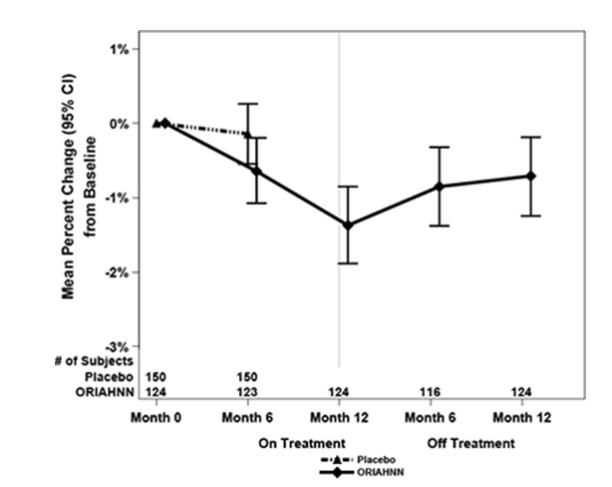
ADVERSE REACTIONS The following serious adverse reactions are discussed elsewhere in labeling: Thromboembolic Disorders and Vascular Events [see Warnings and Precautions ( 5.1 ) ] Bone Loss [see Warnings and Precautions ( 5.2 ) ] Suicidal Ideation, Suicidal Behavior, and Exacerbation of Mood Disorders [see Warnings and Precautions ( 5.4 ) ] Hepatic Transaminase Elevations [see Warnings and Precautions ( 5.5 ) ] Elevated Blood Pressure [see Warnings and Precautions ( 5.6 ) ] Effects on Carbohydrate and Lipid Metabolism [see Warnings and Precautions ( 5.9 ) ] Alopecia [see Warnings and Precautions ( 5.10 ) ] Most common adverse reaction (>5%) in clinical trials were hot flushes, headache, fatigue, metrorrhagia. ( 6.1 ) To report SUSPECTED ADVERSE REACTIONS, contact AbbVie Inc. at 1–800–633–9110 or FDA at 1-800-FDA-1088 or www.fda.gov/medwatch Figure 1. Mean Percent Change From Baseline in Lumbar Spine BMD in Women Who Received 12 Months of ORIAHNN (On-Treatment) and 12 Months of Follow Up (Off Treatment) 6.1 Clinical Trials Experience Because clinical trials are conducted under widely varying conditions, adverse reaction rates observed in the clinical trials of a drug cannot be directly compared to rates in the clinical trials of another drug and may not reflect the rates observed in clinical practice. The safety of ORIAHNN was evaluated in two 6-month, randomized, double-blind, placebo-controlled trials (Studies UF-1 and UF-2), in which 790 premenopausal women received at least 1 dose of ORIAHNN (n=395), elagolix 300 mg twice daily (n=199), or placebo (n=196) [see Clinical Studies ( 14 )] . Women who completed 6-month treatment in either Study UF-1 or Study UF-2 and met eligibility criteria (n=433) entered a 6-month extension study (Study UF-3), receiving either ORIAHNN (n=276) or elagolix 300 mg twice daily (n=157). Elagolix 300 mg twice daily is not an approved dosage but was included as a reference arm. A total of 341 women received ORIAHNN for 6 months and 182 women received ORIAHNN for 12 months. Serious Adverse Events Serious adverse events were reported in three (0.8%) ORIAHNN-treated women in Studies UF-1 and UF-2. Two women had heavy menstrual bleeding and required blood transfusion due to anemia (0.5%) and one woman with history of bariatric surgery had a laparoscopic cholecystectomy due to cholelithiasis. In Study UF-3, two women were diagnosed with breast cancer. One woman had completed 6 months of treatment with ORIAHNN in Study UF-1 and received 34 additional days of ORIAHNN in Study UF-3 when diagnosed. The second woman had received placebo in Study UF-2 and completed 6 months of ORIAHNN in Study UF-3 when diagnosed [see Warnings and Precautions ( 5.3 ) ] . Adverse Reactions Leading to Study Discontinuation In Studies UF-1 and UF-2, the discontinuation rate due to adverse reactions was 10% among ORIAHNN-treated women and 7% among placebo-treated women. The most common adverse reactions leading to study drug discontinuation in the ORIAHNN group were nausea (1%), headache (1%), alopecia (1%), metrorrhagia (1%), menorrhagia (1%), and hot flush (1%). One event each of the following adverse reactions led to study drug discontinuation: affect lability, angina pectoris, depression, hepatic enzyme increased, homicidal ideation, hypertension, irritability, thrombosis. In women who received ORIAHNN in Studies UF-1 or UF-2 and then in Study UF-3, 4% discontinued treatment due to adverse reactions. Three women discontinued due to serious adverse events (one each for breast cancer, menorrhagia with pelvic pain, and hysterectomy). Common Adverse Reactions Adverse reactions reported in ≥5% of ORIAHNN-treated women in Studies UF-1 and UF-2 and at a greater frequency than placebo-treated women are presented in Table 1. Table 1. Adverse Reactions that Occurred in at Least 5% of Women with Uterine Fibroids Who Received ORIAHNN in Studies UF-1 and UF-2 and at a Greater Incidence Than Placebo Adverse Reaction ORIAHNN N=395 Placebo N=196 Hot flush 22% 9% Headache 9% 7% Fatigue 6% 4% Metrorrhagia 5% 1% The most commonly reported adverse reactions in the blinded extension trial (Study UF-3) were consistent with those in the placebo-controlled trials. Less Common Adverse Reactions In Studies UF-1 and UF-2, adverse reactions reported in ≥3% and <5% in the ORIAHNN group and greater incidence than the placebo group included: libido decreased, arthralgia, hypertension, alopecia, mood swings, influenza, abdominal distension, upper respiratory tract infection, menorrhagia, vomiting, and weight increased. Thromboembolic and Vascular Events In the Studies UF-1, UF-2, and UF-3, two (0.4%) thrombotic events occurred in 453 ORIAHNN-treated patients (thrombosis in the calf and pulmonary embolism) [see Warnings and Precautions ( 5.1 ) ] . One obese woman developed thrombosis in the left calf after 30 days of treatment with ORIAHNN. Another woman developed a pulmonary embolism after taking ORIAHNN for approximately 8 months. Bone Loss The effect of ORIAHNN on BMD was assessed by dual-energy X-ray absorptiometry (DXA). In Studies UF-1 and UF-2, there was a greater decrease in BMD in women treated with ORIAHNN for 6 months compared to women treated with placebo. In Study UF-3, continued bone loss was observed in some women who received ORIAHNN for 12 consecutive months. The mean percent change from baseline in lumbar spine BMD at Month 6 (Studies UF-1 and UF-2) and Month 12 (Study UF-3) is presented in Table 2. Table 2. Mean Percent Change (On-Treatment) from Baseline in Lumbar Spine BMD in Women with Fibroids at Month 6 in Studies UF-1 and UF-2 and Month 12 in Study UF-3 Studies UF-1 and UF-2 Treatment Month 6 Study UF-3 Treatment Month 12 Placebo ORIAHNN ORIAHNN Number of Subjects 150 305 175 Percent Change from Baseline -0.1 -0.7 -1.5 Treatment Difference, % (95% CI) -0.6 (-1.0, -0.1) CI: Confidence interval Following 12 months of ORIAHNN treatment in Study UF-3, a decline in lumbar spine BMD of >3% was seen in 27% (48/175) of women and a decline of ≥8% was seen in 1.7% (3/175) of women. To assess for recovery, the change in BMD over time was analyzed for women who received continuous ORIAHNN treatment for up to 12 months and were then followed after cessation of therapy for an additional 12 months in Study UF-3 (Figure 1). The LS mean percent change from baseline in BMD 12 months after cessation of therapy was -0.72 (95% CI -1.2, -0.2), -0.59 (-1.0, -0.2), and -0.95 (-1.6, -0.3) at the lumbar spine, total hip, and femoral neck, respectively. Twelve months after cessation of ORIAHNN, continued bone loss was observed at the lumbar spine, total hip, and femoral neck in 24%, 32%, and 40% of women, respectively. Partial recovery was observed in 46%, 33%, and 38% and full recovery was observed in 30%, 35%, and 22% of women at these same sites. The time to maximum recovery in women who partially recovered is unknown. Figure 1. Mean Percent Change From Baseline in Lumbar Spine BMD in Women Who Received 12 Months of ORIAHNN (On-Treatment) and 12 Months of Follow Up (Off Treatment) Suicidal Ideation, Suicidal Behavior, and Exacerbation of Mood Disorders In the placebo-controlled trials (Studies UF-1 and UF-2), ORIAHNN was associated with adverse mood changes. Depression, depressed mood, and/or tearfulness were reported in 3% of ORIAHNN-treated women compared to 1% of placebo-treated women. One woman treated with lower dose elagolix alone for another disease completed suicide 2 days after elagolix discontinuation. Hepatic Transaminase Elevations In Studies UF-1 and UF-2, elevations of serum ALT and AST with no concurrent elevations of bilirubin were reported. ALT elevations to at least 3 times the upper limit of normal (ULN) occurred in 1.1% (4/379) of ORIAHNN-treated women and no placebo-treated women. Peak elevation of ALT almost 8 times the ULN was reported in 1 ORIAHNN-treated woman. AST elevations to at least 3 times the ULN occurred in 5/379 (1.3%) in ORIAHNN-treated women an
Mechanism of action
Mechanism of Action ORIAHNN combines elagolix and estradiol/norethindrone acetate (E2/NETA), a combination of estrogen and progestin. Elagolix is a GnRH receptor antagonist that inhibits endogenous GnRH signaling by binding competitively to GnRH receptors in the pituitary gland. Administration of elagolix results in dose-dependent suppression of luteinizing hormone (LH) and follicle-stimulating hormone (FSH), leading to decreased blood concentrations of the ovarian sex hormones estradiol and progesterone and reduces bleeding associated with uterine fibroids. E2 acts by binding to nuclear receptors that are expressed in estrogen-responsive tissues. As a component of ORIAHNN, the addition of exogenous estradiol may reduce the increase in bone resorption and resultant bone loss that can occur due to a decrease in circulating estrogen from elagolix alone. Progestins such as NETA act by binding to nuclear receptors that are expressed in progesterone-responsive tissues. As a component of ORIAHNN, NETA may protect the uterus from the potential adverse endometrial effects of unopposed estrogen.
A drug lookup is just the start. Eleplan keeps the whole care plan in one place.
Medications, diagnoses, documents, appointments, and the whole care team — organized and always in sync, with Ellie, your AI care assistant, on top of it. Free to start.