Fecal Microbiota Spores, Live
Managing this medication for someone you care for? Eleplan keeps diagnoses, medications and appointments in one plan.
Start free with EleplanMedication reference
Fecal Microbiota Spores, Live
ORAL
Fecal Microbiota Spores, Live. INDICATIONS AND USAGE VOWST is indicated to prevent the recurrence of Clostridioides difficile infection (CDI) in individuals 18 years of age and…
Brand names
VOWST
Active ingredients
DONOR HUMAN STOOL SPORES (ETHANOL TREATED)
Indications
INDICATIONS AND USAGE VOWST is indicated to prevent the recurrence of Clostridioides difficile infection (CDI) in individuals 18 years of age and older following antibacterial treatment for recurrent CDI (rCDI). VOWST is indicated to prevent the recurrence of Clostridioides difficile infection (CDI) in individuals 18 years of age and older following antibacterial treatment for recurrent CDI (rCDI). ( 1 ) Limitation of Use: VOWST is not indicated for treatment of CDI. Limitation of Use: VOWST is not indicated for treatment of CDI.
Dosage
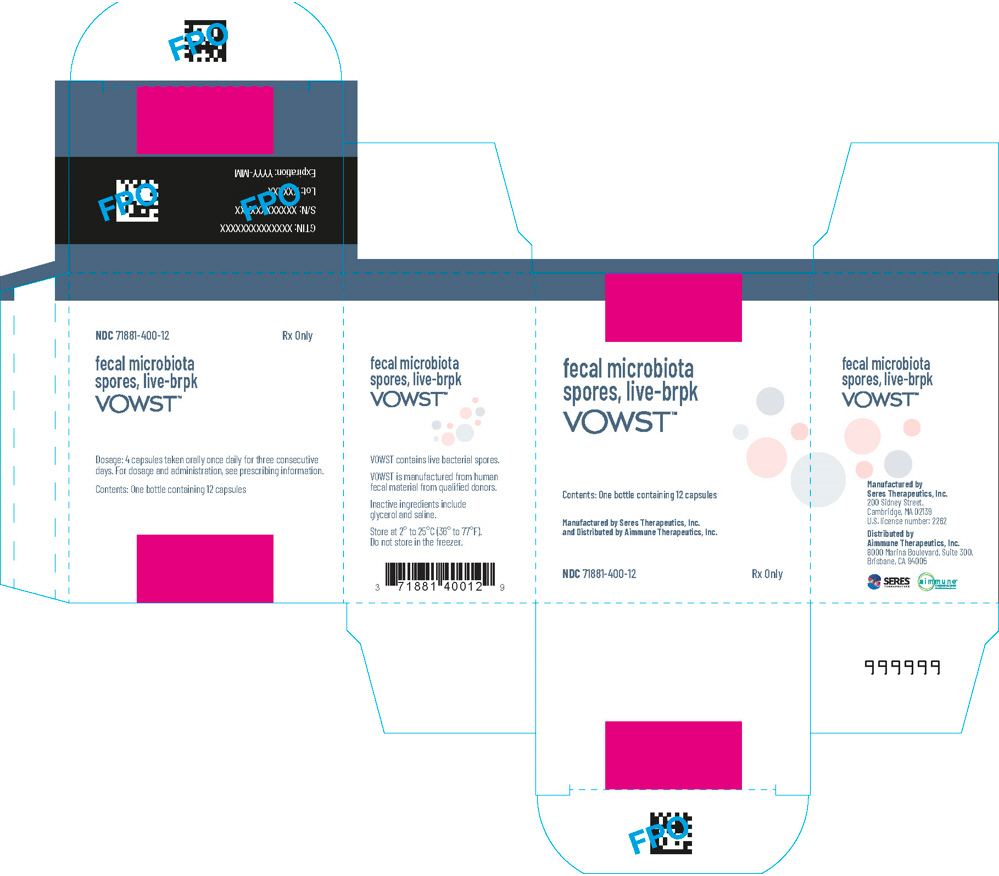
DOSAGE AND ADMINISTRATION For oral administration only. ( 2 ) Prior to taking the first dose: Complete antibacterial treatment for rCDI 2 to 4 days before initiating treatment with VOWST. ( 2.1 ) Drink 296 mL (10 oz) of magnesium citrate on the day before and at least 8 hours prior to taking the first dose of VOWST. In clinical studies, participants with impaired kidney function received polyethylene glycol electrolyte solution (250 mL GoLYTELY, not approved for this use). ( 2.1 ) The dosage of VOWST is 4 capsules taken orally once daily for 3 consecutive days. ( 2.2 ) Take each dose (4 capsules) on an empty stomach prior to the first meal of the day. ( 2.2 ) 2.1 Prior to taking the first dose Complete antibacterial treatment for recurrent CDI 2 to 4 days before initiating treatment with VOWST. Drink 296 mL (10 oz) magnesium citrate, on the day before and at least 8 hours prior to taking the first dose of VOWST. In clinical studies, participants with impaired kidney function received polyethylene glycol electrolyte solution (250 mL GoLYTELY, not approved for this use) [see Clinical Studies (14) ]. Do not eat or drink, except for small amount of water, for at least 8 hours prior to taking the first dose. 2.2 Dosing regimen The dosage of VOWST is 4 capsules taken orally once daily for 3 consecutive days. Take each dose (4 capsules) on an empty stomach prior to the first meal of the day.
Warnings
WARNINGS AND PRECAUTIONS 5.1 Transmissible infectious agents Because VOWST is manufactured from human fecal matter, it may carry a risk of transmitting infectious agents. Any infection suspected by a healthcare provider possibly to have been transmitted by this product should be reported by the healthcare provider to Aimmune Therapeutics, Inc. at 1-833-246-2566. 5.2 Potential presence of food allergens VOWST is manufactured from human fecal matter and may contain food allergens. The potential for VOWST to cause adverse reactions due to food allergens is unknown.
Contraindications
CONTRAINDICATIONS None . None. ( 4 )
Drug interactions
DRUG INTERACTIONS VOWST contains bacterial spores; therefore, antibacterials should not be administered concurrently with VOWST. Antibacterials should not be administered concurrently with VOWST. ( 7 )
Adverse reactions
ADVERSE REACTIONS The most common adverse reactions (reported in ≥5% of participants) were abdominal distension (31.1%), fatigue (22.2%), constipation (14.4%), chills (11.1%), and diarrhea (10.0%). Most common adverse reactions (reported in ≥5% of participants) were abdominal distension (31.1%), fatigue (22.2%), constipation (14.4%), chills (11.1%) and diarrhea (10.0%). ( 6.1 ) To report SUSPECTED ADVERSE REACTIONS, contact Aimmune Therapeutics, Inc. at 1-833-246-2566 or FDA at 1-800-FDA-1088 or www.fda.gov/medwatch. 6.1 Clinical Trials Experience Because clinical trials are conducted under widely varying conditions, adverse reaction rates observed in the clinical trials of a drug cannot be directly compared to rates in the clinical trials of another drug and may not reflect the rates observed in practice. The safety of VOWST was evaluated in one Phase 3, randomized, double-blind clinical study (Study 1: NCT03183128) and one Phase 3, open-label clinical study (Study 2: NCT03183141) conducted in the United States and Canada. Adults with confirmed rCDI were required to have symptoms controlled 48 to 96 hours post-antibacterial treatment to be eligible for enrollment and randomization (1:1) to receive either VOWST or placebo (capsules containing 92 ± 4% glycerol in saline) for 3 consecutive days. Participants with neutropenia (absolute neutrophil count of <500 cells/mm 3 ), toxic megacolon, or small bowel ileus were excluded from these studies. A total of 349 adults 18 years of age and older with rCDI were exposed to VOWST across both Study 1 (n=90) and Study 2 (n=259). Across both Study 1 and Study 2, 99.1% of adults (346/349) received all scheduled doses of VOWST. Overall, across the 2 studies, the median age of VOWST recipients was 66 years (range, 21-100 years). The racial and ethnic distribution was as follows: 92.3% were white and 5.2% were black. In Study 1, females comprised 68.9% of the VOWST arm compared to 51.1% in the placebo arm. Rates of the following comorbidities (at study entry) were similar across the VOWST and placebo arms: cardiac disease (33.3% and 31.5%, respectively), immunocompromise/immunosuppression (28.9% and 30.4%, respectively), diabetes (20.0% and 27.2%, respectively), and renal impairment (14.4% and 15.2%, respectively). In Study 2, 68.4% were females and representation of comorbidities was similar to Study 1. Adverse Reactions In Study 1, participants recorded solicited adverse events in a diary for 7 days after completion of the 3-day regimen of VOWST or placebo. In both Study 1 and Study 2, participants were monitored for unsolicited adverse events by queries during weekly encounters for a period of 8 weeks. Monitoring for serious adverse events and adverse events of special interest (i.e., invasive infections) continued for a period of 6 months after the first dose of study drug. In Study 1, a multi-center, double-blind randomized (1:1), placebo-controlled trial conducted in the United States and Canada, adults 18 years of age and older (range: 18 to 100 years of age) received three daily doses of VOWST (n=90) or placebo (n=92). Overall through the 24 week follow up period, 12 VOWST recipients (13.3%) and 37 placebo recipients (40.2%) did not complete the study. Participants with a recurrence of CDI during the first 8 weeks after receipt of first dose of VOWST or placebo were eligible to enroll into Study 2 and were no longer followed for safety in Study 1. During the first 8 weeks following VOWST or placebo, 5 participants (5.6%) and 28 participants (30.4%) respectively, did not complete 8 weeks of study participation. Of these, 4 VOWST recipients and 25 placebo recipients discontinued Study 1 and enrolled in Study 2. In Study 1, within 8 weeks following VOWST or placebo, the most common solicited adverse reactions reported by ≥5% of VOWST recipients, and at a rate greater than that reported by placebo recipients, were abdominal distension (31.1%), fatigue (22.2%), constipation (14.4%), and chills (11.1%). The most common unsolicited adverse reaction was diarrhea (10.0%) (Table 1). The median duration (days) of these events was 5 days or less; specifically, abdominal distension (3.0), constipation (2.0), fatigue (4.5), chills (1.5), and diarrhea (5.0). Table 1: Adverse Reactions Reported in ≥5% of VOWST-treated Participants and at a Frequency Greater than Placebo within 8 weeks after receipt of VOWST or placebo (Study 1) Safety population, defined as all randomized participants who received a dose of study medication, by treatment received 85/90 participants in the VOWST group and 64/92 participants in the placebo group completed 8 week follow up. Adverse Reaction VOWST N=90 % Placebo N=92 % System Organ Class and Preferred Terms reported by Medical Dictionary for Regulatory Activities (MedDRA) version 20.0 Solicited Solicited adverse events were recorded by participants in a diary for 7 days after completion of the 3-day regimen of VOWST or placebo. Participants were monitored for unsolicited events by queries during visits for a period of 8 weeks after the first dose of study drug. Abdominal distension 31.1 29.3 Fatigue 22.2 21.7 Constipation 14.4 10.9 Chills 11.1 7.6 Unsolicited Diarrhea 10.0 4.3 In Study 1, most adverse reactions occurred within 10 days of starting treatment with VOWST. After this, the proportion of participants with adverse reactions declined through follow-up. The majority of adverse reactions were mild or moderate in severity. In Study 2, the most commonly reported adverse reactions were preferred terms under the system organ class of Gastrointestinal disorders, namely flatulence (4.2%), diarrhea (3.4%) and nausea (3.0%). The majority of adverse reactions were mild to moderate in severity. All adverse events collected in Study 2 were unsolicited. Serious Adverse Events Among 349 VOWST recipients, there were no serious adverse events considered related to VOWST.
Mechanism of action
Mechanism of Action The mechanism of action of VOWST has not been established.
NDC examples
71881-400
Indicated ICD-10 codes
Treats these conditions
Source: openFDA + RxNorm · 2026
Look up another medication