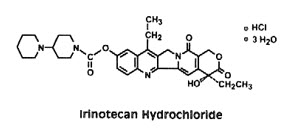
Irinotecan. INDICATIONS AND USAGE • Irinotecan Hydrochloride Injection, USP is indicated as a component of first-line therapy in combination with 5-fluorouracil…
Boxed warning
WARNING: DIARRHEA and MYELOSUPPRESSION • Early and late forms of diarrhea can occur. Early diarrhea may be accompanied by cholinergic symptoms which may be prevented or ameliorated by atropine. Late diarrhea can be life threatening and should be treated promptly with loperamide. Monitor patients with diarrhea and give fluid and electrolytes as needed. Institute antibiotic therapy if patients develop ileus, fever, or severe neutropenia. Interrupt Irinotecan Hydrochloride Injection, USP and reduce subsequent doses if severe diarrhea occurs [see Dosage and Administration (2.2) and Warnings and Precautions (5.1) ]. • Severe myelosuppression may occur [see Warnings and Precautions (5.2) ]. WARNING: DIARRHEA and MYELOSUPPRESSION See full prescribing information for complete boxed warning. • Early and late forms of diarrhea can occur. Early diarrhea may be accompanied by cholinergic symptoms which may be prevented or ameliorated by atropine. Late diarrhea can be life threatening and should be treated promptly with loperamide. Monitor patients with diarrhea and give fluid and electrolytes as needed. Institute antibiotic therapy if patients develop ileus, fever, or severe neutropenia. Interrupt Irinotecan Hydrochloride Injection, USP and reduce subsequent doses if severe diarrhea occurs. ( 2.2 , 5.1 ) • Severe myelosuppression may occur. ( 5.2 )
INDICATIONS AND USAGE • Irinotecan Hydrochloride Injection, USP is indicated as a component of first-line therapy in combination with 5-fluorouracil (5-FU) and leucovorin (LV) for patients with metastatic carcinoma of the colon or rectum. • Irinotecan Hydrochloride Injection, USP is indicated for patients with metastatic carcinoma of the colon or rectum whose disease has recurred or progressed following initial fluorouracil-based therapy. Irinotecan Hydrochloride Injection, USP is a topoisomerase inhibitor indicated for: • First-line therapy in combination with 5-fluorouracil and leucovorin for patients with metastatic carcinoma of the colon or rectum. ( 1 ) • Patients with metastatic carcinoma of the colon or rectum whose disease has recurred or progressed following initial fluorouracil-based therapy. ( 1 )
Dosage
DOSAGE AND ADMINISTRATION Colorectal cancer single agent regimen 1: Irinotecan hydrochloride injection 125 mg/m 2 intravenous infusion over 90 minutes on days 1, 8, 15, 22 then 2-week rest. ( 2.2 ) Colorectal cancer single agent regimen 2: Irinotecan hydrochloride injection 350 mg/m 2 intravenous infusion over 90 minutes on day 1 every 3 weeks. ( 2.2 ) 2.2 Colorectal Single Agent Regimens 1 and 2 Administer irinotecan hydrochloride injection as a 90-minute intravenous infusion. The currently recommended regimens are shown in Table 3. A reduction in the starting dose by one dose level of irinotecan hydrochloride injection may be considered for patients with any of the following conditions: prior pelvic/abdominal radiotherapy, performance status of 2, or increased bilirubin levels. Dosing for patients with bilirubin >2 mg/dL cannot be recommended because there is insufficient information to recommend a dose in these patients. Table 3. Single-Agent Regimens of irinotecan hydrochloride injection and Dose Modifications a Subsequent doses may be adjusted as high as 150 mg/m 2 or to as low as 50 mg/m 2 in 25 to 50 mg/m 2 decrements depending upon individual patient tolerance. b Subsequent doses may be adjusted as low as 200 mg/m 2 in 50 mg/m 2 decrements depending upon individual patient tolerance. c Provided intolerable toxicity does not develop, treatment with additional cycles may be continued indefinitely as long as patients continue to experience clinical benefit. Regimen 1 (weekly) a 125 mg/m 2 intravenous infusion over 90 minutes, days 1,8,15,22 then 2-week rest Starting Dose and Modified Dose Levels c (mg/m 2 ) Starting Dose Dose Level -1 Dose Level -2 125 100 75 Regimen 2 (every 3 weeks) b 350 mg/m 2 intravenous infusion over 90 minutes, once every 3 weeks c Starting Dose and Modified Dose Levels (mg/m 2 ) Starting Dose Dose Level -1 Dose Level -2 350 300 250 Dose Modifications Based on recommended dose-levels described in Table 3, Single-Agent Regimens of irinotecan hydrochloride injection and Dose Modifications, subsequent doses should be adjusted as suggested in Table 4, Recommended Dose Modifications for Single-Agent Schedules. All dose modifications should be based on the worst preceding toxicity. Table 4: Recommended Dose Modifications For Single-Agent Schedules a a All dose modifications should be based on the worst preceding toxicity b National Cancer Institute Common Toxicity Criteria (version 1.0) c Pretreatment d Excludes alopecia, anorexia, asthenia A new cycle of therapy should not begin until the granulocyte count has recovered to ≥1500/mm 3 , and the platelet count has recovered to ≥100,000/mm 3 , and treatment-related diarrhea is fully resolved. Treatment should be delayed 1 to 2 weeks to allow for recovery from treatment-related toxicities. If the patient has not recovered after a 2-week delay, consideration should be given to discontinuing irinotecan hydrochloride injection. Worst Toxicity NCI Grade b (Value) During a Cycle of Therapy At the Start of the Next Cycles of Therapy (After Adequate Recovery), Compared with the Starting Dose in the Previous Cycle a Weekly Weekly Once Every 3 Weeks No toxicity Maintain dose level ↑ 25 mg/m 2 up to a maximum dose of 150 mg/m 2 Maintain dose level Neutropenia 1 (1500 to 1999/mm 3 ) Maintain dose level Maintain dose level Maintain dose level 2 (1000 to 1499/mm 3 ) ↓ 25 mg/m 2 Maintain dose level Maintain dose level 3 (500 to 999/mm 3 ) Omit dose until resolved to ≤ grade 2, then ↓ 25 mg/m 2 ↓ 25 mg/m 2 ↓ 50 mg/m 2 4 (<500/mm 3 ) Omit dose until resolved to ≤ grade 2, then ↓ 50 mg/m 2 ↓ 50 mg/m 2 ↓ 50 mg/m 2 Neutropenic fever Omit dose until resolved, then ↓ 50 mg/m 2 when resolved ↓ 50 mg/m 2 ↓ 50 mg/m 2 Other hematologic toxicities Dose modifications for leukopenia, thrombocytopenia, and anemia during a cycle of therapy and at the start of subsequent cycles of therapy are also based on NCI toxicity criteria and are the same as recommended for neutropenia above. Diarrhea 1 (2–3 stools/day > pretx c ) Maintain dose level Maintain dose level Maintain dose level 2 (4–6 stools/day > pretx) ↓ 25 mg/m 2 Maintain dose level Maintain dose level 3 (7–9 stools/day > pretx) Omit dose until resolved to ≤ grade 2, then ↓ 25 mg/m 2 ↓ 25 mg/m 2 ↓ 50 mg/m 2 4 (≥10 stools/day > pretx) Omit dose until resolved to ≤ grade 2 then ↓ 50 mg/m 2 ↓ 50 mg/m 2 ↓ 50 mg/m 2 Other nonhematologic d toxicities 1 Maintain dose level Maintain dose level Maintain dose level 2 ↓ 25 mg/m 2 ↓ 25 mg/m 2 ↓ 50 mg/m 2 3 Omit dose until resolved to ≤ grade 2, then ↓ 25 mg/m 2 ↓ 25 mg/m 2 ↓ 50 mg/m 2 4 Omit dose until resolved to ≤ grade 2, then ↓ 50 mg/m 2 ↓ 50 mg/m 2 ↓ 50 mg/m 2 2.3 Dosage in Patients with Reduced UGT1A1 Activity When administered as a single-agent, a reduction in the starting dose by at least one level of irinotecan hydrochloride injection should be considered for patients known to be homozygous for the UGT1A1 * 28 allele [see Dosage and Administration ( 2.2 ) and Warnings and Precautions (5.3) ] . However, the precise dose reduction in this patient population is not known, and subsequent dose modifications should be considered based on individual patient tolerance to treatment (see Tables 3-4). 2.4 Premedication It is recommended that patients receive premedication with antiemetic agents. In clinical studies of the weekly dosage schedule, the majority of patients received 10 mg of dexamethasone given in conjunction with another type of antiemetic agent, such as a 5-HT 3 blocker (e.g., ondansetron or granisetron). Antiemetic agents should be given on the day of treatment, starting at least 30 minutes before administration of irinotecan hydrochloride injection. Physicians should also consider providing patients with an antiemetic regimen (e.g., prochlorperazine) for subsequent use as needed. Prophylactic or therapeutic administration of atropine should be considered in patients experiencing cholinergic symptoms. 2.5 Preparation of Infusion Solution Inspect vial contents for particulate matter and discoloration and repeat inspection when drug product is withdrawn from vial into syringe. Irinotecan hydrochloride injection 20 mg/mL is intended for single use only and any unused portion should be discarded. Irinotecan hydrochloride injection must be diluted prior to infusion. Irinotecan hydrochloride injection should be diluted in 5% Dextrose Injection, USP, (preferred) or 0.9% Sodium Chloride Injection, USP, to a final concentration range of 0.12 mg/mL to 2.8 mg/mL. Other drugs should not be added to the infusion solution. The solution is physically and chemically stable for up to 24 hours at room temperature and in ambient fluorescent lighting. Solutions diluted in 5% Dextrose Injection, USP, and stored at refrigerated temperatures (approximately 2° to 8°C, 36° to 46°F), and protected from light are physically and chemically stable for 48 hours. Refrigeration of admixtures using 0.9% Sodium Chloride Injection, USP, is not recommended due to a low and sporadic incidence of visible particulates. Freezing irinotecan hydrochloride injection and admixtures of irinotecan hydrochloride injection may result in precipitation of the drug and should be avoided. The irinotecan hydrochloride injection solution should be used immediately after reconstitution as it contains no antibacterial preservative. Because of possible microbial contamination during dilution, it is advisable to use the admixture prepared with 5% Dextrose Injection, USP, within 24 hours if refrigerated (2° to 8°C, 36° to 46°F). In the case of admixtures prepared with 5% Dextrose Injection, USP, or Sodium Chloride Injection, USP, the solutions should be used within 4 hours if kept at room temperature. If reconstitution and dilution are performed under strict aseptic conditions (e.g., on Laminar Air Flow bench), irinotecan hydrochloride injection solution should be used (infusion completed) within 12 hours at room temperature or 24 hours if refrigerated (2° to 8
Warnings
WARNINGS AND PRECAUTIONS Diarrhea and cholinergic reactions: Early diarrhea (occurring during or shortly after infusion of irinotecan hydrochloride injection) is usually transient and may be accompanied by cholinergic symptoms. Consider prophylactic or therapeutic administration of 0.25 mg to 1 mg of intravenous or subcutaneous atropine (unless clinically contraindicated). Late diarrhea (generally occurring more than 24 hours after administration of irinotecan hydrochloride injection) can occur. Monitor and replace fluid and electrolytes. Treat with loperamide. Use antibiotic support for ileus and fever. Interrupt irinotecan hydrochloride injection and reduce subsequent doses if severe diarrhea occurs.( 5.1 ) Myelosuppression: Manage promptly with antibiotic support. Interrupt irinotecan hydrochloride injection and reduce subsequent doses if necessary. ( 5.2 ) Patients with Reduced UGT1A1 Activity: Individuals who are homozygous for the UGT1A1 * 28 allele are at increased risk for neutropenia following initiation of irinotecan hydrochloride injection treatment. ( 5.3 ) Hypersensitivity: Hypersensitivity reactions including severe anaphylactic or anaphylactoid reactions have been observed. Discontinue irinotecan hydrochloride injection if this occurs. ( 5.4 ) Renal Impairment/Renal Failure: Rare cases of renal impairment and acute renal failure have been identified, usually in patients who became volume depleted from severe vomiting and/or diarrhea. ( 5.5 ) Pulmonary Toxicity: Interstitial Pulmonary Disease (IPD)-like events, including fatalities, have occurred. Interrupt for new or progressive dysnpnea, cough, and fever pending evaluation. If IPD diagnosed, discontinue and institute appropriate treatment as needed. ( 5.6 ) Toxicity of the 5 Day Regimen: Irinotecan hydrochloride injection should not be used in combination with a regimen of 5-FU/LV administered for 4-5 consecutive days every 4 weeks outside of a clinical study. ( 5.7 ) Embryofetal Toxicity: Irinotecan hydrochloride injection can cause fetal harm when administered to a pregnant woman. ( 5.9 ) Patients with Hepatic Impairment: In clinical trials, irinotecan hydrochloride injection has not been administered to patients with serum bilirubin > 2.0 mg/dL, or transaminases > 3 times ULN if no liver metastases, or transaminases > 5 times ULN if liver metastases. With the weekly dosage schedule, patients with total bilirubin levels 1.0-2.0 mg/dL had greater likelihood of grade 3-4 neutropenia. ( 5.10 ) 5.1 Diarrhea and Cholinergic Reactions Early diarrhea (occurring during or shortly after infusion of Irinotecan hydrochloride) is usually transient and infrequently severe. It may be accompanied by cholinergic symptoms of rhinitis, increased salivation, miosis, lacrimation, diaphoresis, flushing, and intestinal hyperperistalsis that can cause abdominal cramping. Bradycardia may also occur. Early diarrhea and other cholinergic symptoms may be prevented or treated. Consider prophylactic or therapeutic administration of 0.25 mg to 1 mg of intravenous or subcutaneous atropine (unless clinically contraindicated). These symptoms are expected to occur more frequently with higher irinotecan doses. Late diarrhea (generally occurring more than 24 hours after administration of irinotecan hydrochloride) can be life threatening since it may be prolonged and may lead to dehydration, electrolyte imbalance, or sepsis. Grade 3-4 late diarrhea occurred in 23-31% of patients receiving weekly dosing. In the clinical studies, the median time to the onset of late diarrhea was 5 days with 3-week dosing and 11 days with weekly dosing. Late diarrhea can be complicated by colitis, ulceration, bleeding, ileus, obstruction, and infection. Cases of megacolon and intestinal perforation have been reported. Patients should have loperamide readily available to begin treatment for late diarrhea. Begin loperamide at the first episode of poorly formed or loose stools or the earliest onset of bowel movements more frequent than normal. One dosage regimen for loperamide is 4 mg at the first onset of late diarrhea and then 2 mg every 2 hours until the patient is diarrhea-free for at least 12 hours. Loperamide is not recommended to be used for more than 48 consecutive hours at these doses, because of the risk of paralytic ileus. During the night, the patient may take 4 mg of loperamide every 4 hours. Monitor and replace fluid and electrolytes. Use antibiotic support for ileus, fever, or severe neutropenia. Subsequent weekly chemotherapy treatments should be delayed in patients until return of pretreatment bowel function for at least 24 hours without anti-diarrhea medication. Patients must not be treated with Irinotecan hydrochloride until resolution of the bowel obstruction. If grade 2, 3, or 4 late diarrhea recurs, subsequent doses of Irinotecan hydrochloride should be decreased [see Dosage and Administration (2) ] . Avoid diuretics or laxatives in patients with diarrhea. 5.2 Myelosuppression Deaths due to sepsis following severe neutropenia have been reported in patients treated with Irinotecan hydrochloride. In the clinical studies evaluating the weekly dosage schedule, neutropenic fever (concurrent NCI grade 4 neutropenia and fever of grade 2 or greater) occurred in 3% of the patients; 6% of patients received G-CSF for the treatment of neutropenia. Manage febrile neutropenia promptly with antibiotic support [see Warnings and Precautions (5.2) ] . Hold Irinotecan hydrochloride if neutropenic fever occurs or if the absolute neutrophil count drops <1000/mm 3 . After recovery to an absolute neutrophil count ≥1000/mm 3 , subsequent doses of irinotecan hydrochloride should be reduced [see Dosage and Administration (2) ] . When evaluated in the trials of weekly administration, the frequency of grade 3 and 4 neutropenia was higher in patients who received previous pelvic/abdominal irradiation than in those who had not received such irradiation (48% [13/27] versus 24% [67/277]; p=0.04). Patients who have previously received pelvic/abdominal irradiation are at increased risk of severe myelosuppression following the administration of Irinotecan hydrochloride. Based on sparse available data, the concurrent administration of Irinotecan hydrochloride with irradiation is not recommended. Patients with baseline serum total bilirubin levels of 1.0 mg/dL or more also had a greater likelihood of experiencing first-cycle grade 3 or 4 neutropenia than those with bilirubin levels that were less than 1.0 mg/dL (50% [19/38] versus 18% [47/266]; p<0.001). Patients with deficient glucuronidation of bilirubin, such as those with Gilbert's syndrome, may be at greater risk of myelosuppression when receiving therapy with Irinotecan hydrochloride. 5.3 Patients With Reduced UGT1A1 Activity Individuals who are homozygous for the UGT1A1 * 28 allele (UGT1A1 7/7 genotype) are at increased risk for neutropenia following initiation of Irinotecan hydrochloride treatment. In a study of 66 patients who received single-agent Irinotecan hydrochloride (350 mg/m 2 once-every-3-weeks), the incidence of grade 4 neutropenia in patients homozygous for the UGT1A1 * 28 allele was 50%, and in patients heterozygous for this allele (UGT1A1 6/7 genotype) the incidence was 12.5%. No grade 4 neutropenia was observed in patients homozygous for the wild-type allele (UGT1A1 6/6 genotype). When administered as a single-agent, a reduction in the starting dose by at least one level of Irinotecan hydrochloride should be considered for patients known to be homozygous for the UGT1A1 * 28 allele. However, the precise dose reduction in this patient population is not known and subsequent dose modifications should be considered based on individual patient tolerance to treatment [see Dosage and Administration (2) ] . UGT1A1 Testing A laboratory test is available to determine the UGT1A1 status of patients. Testing can detect the UGT1A1 6/6, 6/7 and 7/7 genotypes. 5.4 Hypersensitivity Hypersensitivity
Contraindications
CONTRAINDICATIONS • Irinotecan Hydrochloride Injection, USP is contraindicated in patients with a known hypersensitivity to the drug or its excipients. • Hypersensitivity to Irinotecan Hydrochloride Injection, USP or its excipients ( 4 )
Drug interactions
DRUG INTERACTIONS • Strong CYP3A4 Inducers: Do not administer strong CYP3A4 inducers with irinotecan hydrochloride injection. ( 7.2 ) • Strong CYP3A4 Inhibitors: Do not administer strong CYP3A4 inhibitors with irinotecan hydrochloride injection. ( 7.3 ) 7.1 5-Fluorouracil (5-FU) and Leucovorin (LV) In a phase 1 clinical study involving irinotecan, 5-fluorouracil (5-FU), and leucovorin (LV) in 26 patients with solid tumors, the disposition of irinotecan was not substantially altered when the drugs were co-administered. Although the C max and AUC 0-24 of SN-38, the active metabolite, were reduced (by 14% and 8%, respectively) when irinotecan was followed by 5-FU and LV administration compared with when irinotecan was given alone, this sequence of administration was used in the combination trials and is recommended [see Dosage and Administration (2)] . Formal i n vivo or in vitro drug interaction studies to evaluate the influence of irinotecan on the disposition of 5-FU and LV have not been conducted 7.2 Strong CYP3A4 Inducers Exposure to irinotecan or its active metabolite SN-38 is substantially reduced in adult and pediatric patients concomitantly receiving the CYP3A4 enzyme-inducing anticonvulsants phenytoin, phenobarbital, carbamazepine, or St. John's wort. The appropriate starting dose for patients taking these or other strong inducers such as rifampin and rifabutin has not been defined. Consider substituting non-enzyme inducing therapies at least 2 weeks prior to initiation of irinotecan hydrochloride injection therapy. Do not administer strong CYP3A4 inducers with irinotecan hydrochloride injection unless there are no therapeutic alternatives. 7.3 Strong CYP3A4 or UGT1A1 Inhibitors Irinotecan and its active metabolite, SN-38, are metabolized via the human cytochrome P450 3A4 isoenzyme (CYP3A4) and uridine diphosphate-glucuronosyl transferase 1A1 (UGT1A1), respectively, [see Clinical Pharmacology (12.3) ]. Patients receiving concomitant ketoconazole, a CYP3A4 and UGT1A1 inhibitor, have increased exposure to irinotecan and its active metabolite SN-38. Coadministration of irinotecan hydrochloride injection with other inhibitors of CYP3A4 (e.g., clarithromycin, indinavir, itraconazole, lopinavir, nefazodone, nelfinavir, ritonavir, saquinavir, telaprevir, voriconazole) or UGT1A1 (e.g., atazanavir, gemfibrozil, indinavir) may increase systemic exposure to irinotecan or SN-38. Discontinue strong CYP3A4 inhibitors at least 1 week prior to starting irinotecan hydrochloride injection therapy. Do not administer strong CYP3A4 or UGT1A1 inhibitors with irinotecan hydrochloride injection unless there are no therapeutic alternatives.
Adverse reactions
ADVERSE REACTIONS Common adverse reactions ( > 30%) observed in single agent therapy clinical studies are: nausea, vomiting, abdominal pain, diarrhea, constipation, anorexia, neutropenia, leukopenia (including lymphocytopenia), anemia, asthenia, fever, body weight decreasing, alopecia. ( 6.1 ) To report SUSPECTED ADVERSE REACTIONS, contact 1-888-557-1212 or FDA at 1-800-FDA-1088 or www.fda.gov/medwatch. 6.1 Clinical Studies Experience Because clinical trials are conducted under widely varying conditions, adverse reaction rates observed in the clinical trials of a drug cannot be directly compared to rates in the clinical trials of another drug and may not reflect the rates observed in clinical practice. Common adverse reactions ( > 30%) observed in single agent therapy clinical studies are: nausea, vomiting, abdominal pain, diarrhea, constipation, anorexia, neutropenia, leukopenia (including lymphocytopenia), anemia, asthenia, fever, body weight decreasing, and alopecia. Serious opportunistic infections have not been observed, and no complications have specifically been attributed to lymphocytopenia. Second-Line Single-Agent Therapy Weekly Dosage Schedule In three clinical studies evaluating the weekly dosage schedule, 304 patients with metastatic carcinoma of the colon or rectum that had recurred or progressed following 5-FU-based therapy were treated with Irinotecan hydrochloride. Seventeen of the patients died within 30 days of the administration of Irinotecan hydrochloride; in five cases (1.6%, 5/304), the deaths were potentially drug-related. One of the patients died of neutropenic sepsis without fever. Neutropenic fever occurred in nine (3.0%) other patients; these patients recovered with supportive care. One hundred nineteen (39.1%) of the 304 patients were hospitalized because of adverse events; 81 (26.6%) patients were hospitalized for events judged to be related to administration of Irinotecan hydrochloride. The primary reasons for drug-related hospitalization were diarrhea, with or without nausea and/or vomiting (18.4%); neutropenia/leukopenia, with or without diarrhea and/or fever (8.2%); and nausea and/or vomiting (4.9%). The first dose of at least one cycle of Irinotecan hydrochloride was reduced for 67% of patients who began the studies at the 125-mg/m 2 starting dose. Within-cycle dose reductions were required for 32% of the cycles initiated at the 125-mg/m 2 dose level. The most common reasons for dose reduction were late diarrhea, neutropenia, and leukopenia. Thirteen (4.3%) patients discontinued treatment with Irinotecan hydrochloride because of adverse events. The adverse events in Table 7 are based on the experience of the 304 patients enrolled in the three studies described in Clinical Studies (14.1) . Table 7. Adverse Events Occurring in >10% of 304 Previously Treated Patients with Metastatic Carcinoma of the Colon or Rectum a a Severity of adverse events based on NCI CTC (version 1.0) b Occurring >24 hours after administration of Irinotecan hydrochloride c Occurring ≤24 hours after administration of Irinotecan hydrochloride d Primarily upper respiratory infections e Not applicable; complete hair loss = NCI grade 2 Body System & Event % of Patients Reporting NCI Grades 1-4 NCI Grades 3 & 4 GASTROINTESTINAL Diarrhea (late) b 88 31 7–9 stools/day (grade 3) — (16) ≥10 stools/day (grade 4) — (14) Nausea 86 17 Vomiting 67 12 Anorexia 55 6 Diarrhea (early) c 51 8 Constipation 30 2 Flatulence 12 0 Stomatitis 12 1 Dyspepsia 10 0 HEMATOLOGIC Leukopenia 63 28 Anemia 60 7 Neutropenia 54 26 500 to <1000/mm 3 (grade 3) — (15) <500/mm 3 (grade 4) — (12) BODY AS A WHOLE Asthenia 76 12 Abdominal cramping/pain 57 16 Fever 45 1 Pain 24 2 Headache 17 1 Back pain 14 2 Chills 14 0 Minor infection d 14 0 Edema 10 1 Abdominal enlargement 10 0 METABOLIC AND NUTRITIONAL ↓ Body weight 30 1 Dehydration 15 4 ↑ Alkaline phosphatase 13 4 ↑ SGOT 10 1 DERMATOLOGIC Alopecia 60 NA e Sweating 16 0 Rash 13 1 RESPIRATORY Dyspnea 22 4 ↑ Coughing 17 0 Rhinitis 16 0 NEUROLOGIC Insomnia 19 0 Dizziness 15 0 CARDIOVASCULAR Vasodilation (flushing) 11 0 Once-Every-3-Week Dosage Schedule A total of 535 patients with metastatic colorectal cancer whose disease had recurred or progressed following prior 5-FU therapy participated in the two phase 3 studies: 316 received irinotecan, 129 received 5-FU, and 90 received best supportive care. Eleven (3.5%) patients treated with irinotecan died within 30 days of treatment. In three cases (1%, 3/316), the deaths were potentially related to irinotecan treatment and were attributed to neutropenic infection, grade 4 diarrhea, and asthenia, respectively. One (0.8%, 1/129) patient treated with 5-FU died within 30 days of treatment; this death was attributed to grade 4 diarrhea. Hospitalizations due to serious adverse events occurred at least once in 60% (188/316) of patients who received irinotecan, 63% (57/90) who received best supportive care, and 39% (50/129) who received 5-FU-based therapy. Eight percent of patients treated with irinotecan and 7% treated with 5-FU-based therapy discontinued treatment due to adverse events. Of the 316 patients treated with irinotecan, the most clinically significant adverse events (all grades, 1-4) were diarrhea (84%), alopecia (72%), nausea (70%), vomiting (62%), cholinergic symptoms (47%), and neutropenia (30%). Table 8 lists the grade 3 and 4 adverse events reported in the patients enrolled to all treatment arms of the two studies described in Clinical Studies (14.1 ) . Table 8: Percent of Patients Experiencing Grade 3 & 4 Adverse Events in Comparative Studies of Once-Every-3-Week Irinotecan Therapy a a Severity of adverse events based on NCI CTC (version 1.0) b BSC = best supportive care c Hepatic includes events such as ascites and jaundice d Cutaneous signs include events such as rash e Respiratory includes events such as dyspnea and cough f Neurologic includes events such as somnolence g Cardiovascular includes events such as dysrhythmias, ischemia, and mechanical cardiac dysfunction h Other includes events such as accidental injury, hepatomegaly, syncope, vertigo, and weight loss Adverse Event Study 1 Study 2 Irinotecan N=189 BSC b N=90 Irinotecan N=127 5-FU N=129 TOTAL Grade 3/4 Adverse Events 79 67 69 54 GASTROINTESTINAL Diarrhea 22 6 22 11 Vomiting 14 8 14 5 Nausea 14 3 11 4 Abdominal pain 14 16 9 8 Constipation 10 8 8 6 Anorexia 5 7 6 4 Mucositis 2 1 2 5 HEMATOLOGIC Leukopenia/Neutropenia 22 0 14 2 Anemia 7 6 6 3 Hemorrhage 5 3 1 3 Thrombocytopenia 1 0 4 2 Infection without grade 3/4 neutropenia 8 3 1 4 with grade 3/4 neutropenia 1 0 2 0 Fever without grade 3/4 neutropenia 2 1 2 0 with grade 3/4 neutropenia 2 0 4 2 BODY AS A WHOLE Pain 19 22 17 13 Asthenia 15 19 13 12 METABOLIC AND NUTRITIONAL Hepatic c 9 7 9 6 DERMATOLOGIC Hand and foot syndrome 0 0 0 5 Cutaneous signs d 2 0 1 3 RESPIRATORY e 10 8 5 7 NEUROLOGIC f 12 13 9 4 CARDIOVASCULAR g 9 3 4 2 OTHER h 32 28 12 14 The incidence of akathisia in clinical trials of the weekly dosage schedule was greater (8.5%, 4/47 patients) when prochlorperazine was administered on the same day as Irinotecan hydrochloride than when these drugs were given on separate days (1.3%, 1/80 patients). The 8.5% incidence of akathisia, however, is within the range reported for use of prochlorperazine when given as a premedication for other chemotherapies. 6.2 Postmarketing Experience The following adverse reactions have been identified during post approval use of Irinotecan hydrochloride. Because these reactions are reported voluntarily from a population of uncertain size, it is not always possible to reliably estimate their frequency or establish a causal relationship to drug exposure. Myocardial ischemic events have been observed following Irinotecan hydrochloride therapy. Thromboembolic events have been observed in patients receiving Irinotecan hydrochloride. Symptomatic pancreatitis, asymptomatic pancreatic enzyme elevation have been reported. Increases in se
Mechanism of action
CLINICAL PHARMACOLOGY 12.1 Mechanism of Action Irinotecan is a derivative of camptothecin. Camptothecins interact specifically with the enzyme topoisomerase I, which relieves torsional strain in DNA by inducing reversible single-strand breaks. Irinotecan and its active metabolite SN-38 bind to the topoisomerase I-DNA complex and prevent religation of these single-strand breaks. Current research suggests that the cytotoxicity of irinotecan is due to double-strand DNA damage produced during DNA synthesis when replication enzymes interact with the ternary complex formed by topoisomerase I, DNA, and either irinotecan or SN-38. Mammalian cells cannot efficiently repair these double-strand breaks. 12.2 Pharmacodynamics Irinotecan serves as a water-soluble precursor of the lipophilic metabolite SN-38. SN-38 is formed from irinotecan by carboxylesterase-mediated cleavage of the carbamate bond between the camptothecin moiety and the dipiperidino side chain. SN-38 is approximately 1000 times as potent as irinotecan as an inhibitor of topoisomerase I purified from human and rodent tumor cell lines. In vitro cytotoxicity assays show that the potency of SN-38 relative to irinotecan varies from 2- to 2000-fold; however, the plasma area under the concentration versus time curve (AUC) values for SN-38 are 2% to 8% of irinotecan and SN-38 is 95% bound to plasma proteins compared to approximately 50% bound to plasma proteins for irinotecan [see Clinical Pharmacology (12.3) ] . The precise contribution of SN-38 to the activity of Irinotecan Hydrochloride Injection is thus unknown. Both irinotecan and SN-38 exist in an active lactone form and an inactive hydroxy acid anion form. A pH-dependent equilibrium exists between the two forms such that an acid pH promotes the formation of the lactone, while a more basic pH favors the hydroxy acid anion form. Administration of irinotecan has resulted in antitumor activity in mice bearing cancers of rodent origin and in human carcinoma xenografts of various histological types. 12.3 Pharmacokinetics After intravenous infusion of irinotecan in humans, irinotecan plasma concentrations decline in a multiexponential manner, with a mean terminal elimination half-life of about 6 to 12 hours. The mean terminal elimination half-life of the active metabolite SN-38 is about 10 to 20 hours. The half-lives of the lactone (active) forms of irinotecan and SN-38 are similar to those of total irinotecan and SN-38, as the lactone and hydroxy acid forms are in equilibrium. Over the recommended dose range of 50 to 350 mg/m 2 , the AUC of irinotecan increases linearly with dose; the AUC of SN-38 increases less than proportionally with dose. Maximum concentrations of the active metabolite SN-38 are generally seen within 1 hour following the end of a 90-minute infusion of irinotecan. Pharmacokinetic parameters for irinotecan and SN-38 following a 90-minute infusion of irinotecan at dose levels of 125 and 340 mg/m 2 determined in two clinical studies in patients with solid tumors are summarized in Table 9: Table 9. Summary of Mean (±Standard Deviation) Irinotecan and SN-38 Pharmacokinetic Parameters in Patients with Solid Tumors Irinotecan SN-38 Dose C max AUC 0-24 t 1/2 V z CL C max AUC 0-24 t 1/2 (mg/ m 2 ) (ng/mL) (ng·h/mL) (h) L/m 2 ) (L/h/m 2 ) (ng/mL) (ng·h/mL) (h) C max - Maximum plasma concentration AUC 0-24 - Area under the plasma concentration-time curve from time 0 to 24 hours after the end of the 90-minute infusion t 1/2 - Terminal elimination half-life V z - Volume of distribution of terminal elimination phase CL - Total systemic clearance a Plasma specimens collected for 24 hours following the end of the 90-minute infusion. b Plasma specimens collected for 48 hours following the end of the 90-minute infusion. Because of the longer collection period, these values provide a more accurate reflection of the terminal elimination half-lives of irinotecan and SN-38. 125 1,660 10,200 5.8 a 110 13.3 26.3 229 10.4 a (N=64) ±797 ±3,270 ±0.7 ±48.5 ±6.01 ±11.9 ±108 ±3.1 340 3,392 20,604 11.7 b 234 13.9 56.0 474 21.0 b (N=6) ±874 ±6,027 ±1.0 ±69.6 ±4.0 ±28.2 ±245 ±4.3 Distribution Irinotecan exhibits moderate plasma protein binding (30% to 68% bound). SN-38 is highly bound to human plasma proteins (approximately 95% bound). The plasma protein to which irinotecan and SN-38 predominantly binds is albumin. Elimination Metabolism Irinotecan is subject to extensive metabolic conversion by various enzyme systems, including esterases that form an active metabolite SN-38, and UGT1A1 which mediates the glucuronidation of SN-38 to form an inactive metabolite. SN-38 glucuronide had 1/50 to 1/100 the activity of SN-38. Patients who are homozygous for either the UGT1A1*28 or *6 alleles, or who are compound heterozygous for these alleles, have higher SN-38 AUC than patients with the wild-type UGT1A1 alleles [see Dosage and Administration ( 2.3 ), Warnings and Precautions ( 5.3 ), and Clinical Pharmacology ( 12.5 )] . Irinotecan can also undergo CYP3A4-mediated oxidative metabolism to several inactive metabolites, one of which can be hydrolyzed by carboxylesterase to release the active metabolite SN-38. Excretion The disposition of irinotecan has not been fully elucidated in humans. The urinary excretion of irinotecan is 11% to 20%; SN-38, < 1%; and SN-38 glucuronide, 3%. The cumulative biliary and urinary excretion of irinotecan and its metabolites (SN-38 and SN-38 glucuronide) over a period of 48 hours following administration of irinotecan in two patients ranged from approximately 25% (100 mg/m 2 ) to 50% (300 mg/m 2 ). Specific Populations Geriatric Patients The pharmacokinetics of irinotecan administered using the weekly schedule was evaluated in a study of 183 patients that was prospectively designed to investigate the effect of age on irinotecan toxicity. Results from this trial indicate that there are no differences in the pharmacokinetics of irinotecan, SN-38, and SN-38 glucuronide in patients < 65 years of age compared with patients ≥ 65 years of age. In a study of 162 patients that was not prospectively designed to investigate the effect of age, small (less than 18%) but statistically significant differences in dose-normalized irinotecan pharmacokinetic parameters in patients < 65 years of age compared to patients ≥ 65 years of age were observed. Although dose-normalized AUC 0-24 for SN-38 in patients ≥ 65 years of age was 11% higher than in patients < 65 years of age, this difference was not statistically significant. No change in the starting dose is recommended for geriatric patients receiving the weekly dosage schedule of irinotecan [see Dosage and Administration ( 2 )] . Male and Female Patients The pharmacokinetics of irinotecan do not appear to be influenced by gender. Racial and Ethnic Groups The influence of race on the pharmacokinetics of irinotecan has not been evaluated. Patients with Renal Impairment The influence of renal impairment on the pharmacokinetics of irinotecan has not been evaluated. Patients with Hepatic Impairment Irinotecan clearance is diminished in patients with hepatic impairment while exposure to the active metabolite SN-38 is increased relative to that in patients with normal hepatic function. The magnitude of these effects is proportional to the degree of liver impairment as measured by elevations in total bilirubin and transaminase concentrations. However, the tolerability of irinotecan in patients with hepatic dysfunction (bilirubin greater than 2 mg/dl) has not been assessed sufficiently. Drug Interaction Studies Clinical Studies and Model-Informed Approaches Dexamethasone, a moderate CYP3A4 inducer, does not appear to alter the pharmacokinetics of irinotecan. In Vitro Studies Irinotecan and the metabolites SN-38 and aminopentane carboxylic acid (APC) do not inhibit cytochrome P-450 isozymes. 12.5 Pharmacogenomics The active metabolite SN-38 is further metabolized via UGT1A1. Genetic variants of the UGT1A1 gene such as t
A drug lookup is just the start. Eleplan keeps the whole care plan in one place.
Medications, diagnoses, documents, appointments, and the whole care team — organized and always in sync, with Ellie, your AI care assistant, on top of it. Free to start.