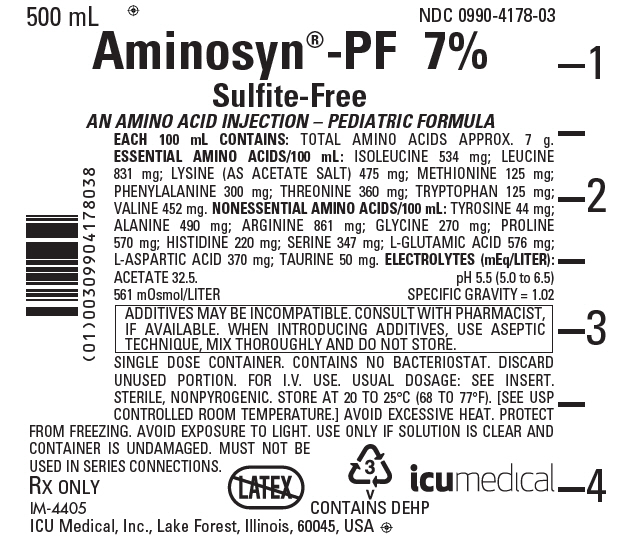
Isoleucine, Leucine, Lysine Acetate, Methionine, Phenylalanine, Threonine, Tryptophan, Valine, Alanine, Arginine, Aspartic Acid, Glutamic Acid, Glycine, Histidine, Proline, Serine, Taurine, and Tyrosine — Amino Acid [EPC]. INDICATIONS AND USAGE Aminosyn-PF 10%, Sulfite-Free, (an amino acid injection — pediatric formula) is indicated for the nutritional support of…
Boxed warning
SPECIAL PRECAUTIONS FOR CENTRAL INFUSIONS ADMINISTRATION BY CENTRAL VENOUS CATHETER SHOULD BE USED ONLY BY THOSE FAMILIAR WITH THIS TECHNIQUE AND ITS COMPLICATIONS.
INDICATIONS AND USAGE Aminosyn-PF 10%, Sulfite-Free, (an amino acid injection — pediatric formula) is indicated for the nutritional support of infants (including those of low birth weight) and young children requiring TPN via either central or peripheral infusion routes. Parenteral nutrition with Aminosyn-PF 10% is indicated to prevent nitrogen and weight loss or treat negative nitrogen balance in infants and young children where (1) the alimentary tract by the oral gastrostomy, or jejunostomy route, cannot or should not be used or adequate protein intake is not feasible by these routes; (2) gastrointestinal absorption of protein is impaired; or (3) protein requirements are substantially increased as with extensive burns. Dosage, route of administration, and concomitant infusion of non-protein calories are dependent on various factors, such as nutritional and metabolic status of the patient, anticipated duration of parenteral nutrition support, and vein tolerance. See DOSAGE AND ADMINISTRATION for additional information. Central Venous Infusion Central venous infusion should be considered when amino acid solutions are to be admixed with hypertonic dextrose to promote protein synthesis in hypercatabolic or severely depleted infants or those requiring long-term parenteral nutrition. Peripheral Parenteral Nutrition For moderately catabolic or depleted patients in whom the central venous route is not indicated, diluted amino acid solutions mixed with 5 to 10% dextrose solutions may be infused by peripheral vein, supplemented, if desired, with fat emulsion.
Dosage
DOSAGE AND ADMINISTRATION Each 100 mL of Aminosyn II contains: Amino Acids Nitrogen Aminosyn II 10% 10 g 1.53 g Aminosyn II 15% 15 g 2.30 g The total daily dose of the solution depends on the daily protein requirements and on the patient’s metabolic and clinical response. In many patients, provision of adequate calories in the form of hypertonic dextrose may require the administration of exogenous insulin to prevent hyperglycemia and glycosuria. To prevent rebound hypoglycemia, a solution containing 5% dextrose should be administered when hypertonic dextrose infusions are abruptly discontinued. Parenteral drug products should be inspected visually for particulate matter and discoloration prior to administration, whenever solution and container permit. COLOR VARIATION FROM PALE YELLOW TO YELLOW IS NORMAL AND DOES NOT ALTER EFFICACY. Some opacity of the plastic due to moisture absorption during the sterilization process may be observed. This is normal and does not affect the solution quality or safety. The opacity will diminish gradually. Aminosyn II in the 2000 mL flexible Pharmacy Bulk Package is designed for use with manual, gravity flow operations and automated gravimetric compounding devices for preparing intravenous nutritional admixtures. Admixtures must be stored under refrigeration and used within 24 hours of admixing. Peripheral Vein Nutritional Maintenance A mixture of Aminosyn II and dextrose diluted to a final concentration of 5% to 10% amino acids and 5% to 10% dextrose is suitable for administration by peripheral vein. This solution is not intended for central vein administration because it does not contain adequate amounts of amino acids or electrolytes. For peripheral intravenous infusion, 1 to 1.5 g/kg/day of total amino acids will reduce protein catabolism. Infusion or ingestion of carbohydrate or lipid will not reduce the nitrogen sparing effect of intravenous amino acid infusions at this dose. As with all intravenous fluid therapy, the primary aim is to provide sufficient water to compensate for insensible, urinary and other (nasogastric suction, fistula drainage, diarrhea) fluid losses. Total fluid requirements, as well as electrolyte and acid-base needs, should be estimated and appropriately administered. For an amino acid solution of specified total concentration, the volume required to meet amino acid requirements per 24 hours can be calculated. After making an estimate of the total daily fluid (water) requirement, the balance of fluid needed beyond the volume of amino acid solution required can be provided either as a noncarbohydrate or a carbohydrate-containing electrolyte solution. I.V. lipid emulsion may be substituted for part of the carbohydrate-containing solution. Vitamins and additional electrolytes as needed for maintenance or to correct imbalances may be added to the amino acid solution. If desired, only one-half of an estimated daily amino acid requirement of 1.5 g/kg can be given on the first day. Amino acids together with dextrose in concentrations of 5% to 10% infused into a peripheral vein can be continued while oral nutrition is impaired. However, if a patient is unable to take oral nourishment for a prolonged period of time, institution of total parenteral nutrition with exogenous calories should be considered. Central Vein Total Parenteral Nutrition For central vein infusion with concentrated dextrose solution, alone or with I.V. lipid, the total daily dose of the amino acid solution depends upon daily protein requirements and the patient’s metabolic and clinical response. The determination of nitrogen balance and accurate daily body weights, corrected for fluid balance, are probably the best means of assessing individual protein requirements. ADULTS Solutions containing 3.5 to 5% amino acids with 5 to 10% glucose may be infused with a fat emulsion by peripheral vein to provide approximately 1400 to 2000 kcal/day. Fat emulsion administration should be considered when prolonged parenteral nutrition is required in order to prevent essential fatty acid deficiency (E.F.A.D.). Serum lipids should be monitored for evidence of E.F.A.D. in patients maintained on fat-free TPN. Aminosyn II solution should only be infused via a central vein when admixed with sufficient dextrose to provide full caloric requirements in patients who require prolonged total parenteral nutrition. I.V. lipid may be administered to provide part of the calories, if desired. Serum lipids should be monitored for evidence of essential fatty acid deficiency in patients maintained on fat-free TPN. Total parenteral nutrition (TPN) may be started with 10% dextrose added to the calculated daily requirement of amino acids (1.5 g/kg for a metabolically stable patient). Dextrose content is gradually increased over the next few days to the estimated daily caloric need as the patient adapts to the increasing amounts of dextrose. Each gram of dextrose provides approximately 3.4 kcal. Each gram of fat provides 9 kcal. The average depleted major surgical patient with complications requires between 2500 and 4000 kcal and between 12 and 24 grams of nitrogen per day. An adult patient in an acceptable weight range with restricted activity who is not hypermetabolic, requires about 30 kcal/kg of body weight/day. Average daily adult fluid requirements are between 2500 and 3000 mL and may be much higher with losses from fistula drainage or severe burns. Typically, a hospitalized patient may lose 12 to 18 grams of nitrogen a day, and in severe trauma the daily loss may be 20 to 25 grams or more. Aminosyn II solutions without electrolytes are intended for patients requiring individualized electrolyte therapy. Sodium, chloride, potassium, phosphate, calcium and magnesium are major electrolytes which should be added to Aminosyn II as required. SERUM ELECTROLYTES SHOULD BE MONITORED AS INDICATED. Electrolytes may be added to the nutrient solution as indicated by the patient’s clinical condition and laboratory determinations of plasma values. Major electrolytes are sodium, chloride, potassium, phosphate, magnesium and calcium. Vitamins, including folic acid and vitamin K, are required additives. The trace element supplements should be given when long-term parenteral nutrition is undertaken. Iron is added to the solution or given intramuscularly in depot form as indicated. Vitamin B 12 , vitamin K and folic acid are given intramuscularly or added to the solution as desired. Calcium and phosphorus additives are potentially incompatible when added to the TPN admixture. In patients with hyperchloremic or other metabolic acidosis, sodium and potassium may be added as the acetate or lactate salts to provide bicarbonate alternates. In adults, hypertonic mixtures of amino acids and dextrose may be safely administered by continuous infusion through a central venous catheter with the tip located in the vena cava. Typically, each liter of central vein TPN solution for adults contains 42.5 to 50 g of Aminosyn II with approximately 250 ± 100 g of dextrose; supplementary nonprotein calories from intravenous fat emulsion may be prescribed, at the discretion of the physician. The rate of intravenous infusion initially should be 2 mL/min and may be increased gradually. If administration should fall behind schedule, no attempt to “catch up” to planned intake should be made. In addition to meeting protein needs, the rate of administration is governed by the patient’s glucose tolerance estimated by glucose levels in blood and urine. Aminosyn II solution, when mixed with an appropriate volume of concentrated dextrose, offers a higher concentration of calories and nitrogen per unit volume. This solution is indicated for patients requiring larger amounts of nitrogen than could otherwise be provided or where total fluid load must be kept to a minimum, for example, patients with renal failure. Provision of adequate calories in the form of hypertonic dextrose may require exogenous insulin to preve
Warnings
WARNINGS Intravenous infusion of amino acids may induce a rise in blood urea nitrogen (BUN), especially in patients with impaired hepatic or renal function. Appropriate laboratory tests should be performed periodically and infusion discontinued if BUN levels exceed normal postprandial limits and continue to rise. It should be noted that a modest rise in BUN normally occurs as a result of increased protein intake. Administration of amino acid solutions to a patient with hepatic insufficiency may result in serum amino acid imbalances, metabolic alkalosis, prerenal azotemia, hyperammonemia, stupor and coma. Administration of amino acid solutions in the presence of impaired renal function may augment an increasing BUN, as does any protein dietary component. Solutions containing sodium ion should be used with great care, if at all, in patients with congestive heart failure, severe renal insufficiency and in clinical states in which there exists edema with sodium retention. Solutions which contain potassium ion should be used with great care, if at all, in patients with hyperkalemia, severe renal failure and in conditions in which potassium retention is present. Solutions containing acetate ion should be used with great care in patients with metabolic or respiratory alkalosis. Acetate should be administered with great care in those conditions in which there is an increased level or an impaired utilization of this ion, such as severe hepatic insufficiency. Hyperammonemia is of special significance in infants, as it can result in mental retardation. Therefore, it is essential that blood ammonia levels be measured frequently in infants. Instances of asymptomatic hyperammonemia have been reported in patients without overt liver dysfunction. The mechanisms of this reaction are not clearly defined, but may involve genetic defects and immature or subclinically impaired liver function. WARNING: This product contains aluminum that may be toxic. Aluminum may reach toxic levels with prolonged parenteral administration if kidney function is impaired. Premature neonates are particularly at risk because their kidneys are immature, and they require large amounts of calcium and phosphate solutions, which contain aluminum. Research indicates that patients with impaired kidney function, including premature neonates, who receive parenteral levels of aluminum at greater than 4 to 5 mcg/kg/day accumulate aluminum at levels associated with central nervous system and bone toxicity. Tissue loading may occur even at lower rates of administration.
Contraindications
CONTRAINDICATIONS Aminosyn-PF 10%, Sulfite-Free, (an amino acid injection — pediatric formula) is contraindicated in patients with untreated anuria, hepatic coma, inborn errors of amino acid metabolism (including those involving branched chain amino acid metabolism such as maple syrup urine disease and isovaleric acidemia), or hypersensitivity to one or more amino acids present in the solution.
Drug interactions
Drug Interactions Because of its antianabolic activity, concurrent administration of tetracycline may reduce the potential effects of amino acids infused with dextrose as part of a parenteral feeding regimen.
Adverse reactions
ADVERSE REACTIONS Local reactions consisting of erythema, phlebitis and thrombosis at the infusion site have occurred with peripheral intravenous infusion of amino acids particularly if other substances, such as antibiotics, are also administered through the same site. In such cases the infusion site should be changed promptly to another vein. Use of large peripheral veins, inline filters, and slowing the rate of infusion may reduce the incidence of local venous irritation. Electrolyte additives should be spread throughout the day. Irritating additive medications may need to be injected at another venous site. Generalized flushing, fever and nausea also have been reported during peripheral infusions of amino acid solutions. If an adverse reaction does occur, discontinue the infusion, evaluate the patient, institute appropriate therapeutic countermeasures and save the remainder of the fluid for examination if deemed necessary.
Mechanism of action
CLINICAL PHARMACOLOGY Aminosyn-PF 10%, Sulfite-Free, (an amino acid injection — pediatric formula) contains a mixture of essential and nonessential amino acids as well as taurine. The amino acid composition has been specifically formulated to provide a well-tolerated nitrogen source for nutritional support and therapy for infants and young children. When administered in conjunction with a cysteine hydrochloride additive, Aminosyn-PF 10% results in plasma amino acid concentrations approximating a profile consistent with that of a breast-fed infant. The rationale for Aminosyn-PF 10% is based on the observation of inadequate levels of essential amino acids in the plasma of infants receiving total parenteral nutrition (TPN) using conventional amino acid solutions. Clinical studies in infants who required TPN therapy showed that infusion of Aminosyn-PF 10% resulted in plasma amino acid concentrations approximating those of normal breast or formula fed infants. In addition, weight gains, nitrogen balance, and serum protein concentrations were consistent with an improving nutritional status. When infused with hypertonic dextrose as a calorie source, supplemented with cysteine hydrochloride, electrolytes, vitamins, and minerals, Aminosyn-PF 10% provides TPN for infants and young children, with the exception of essential fatty acids. It is thought that the acetate from lysine acetate under the conditions of parenteral nutrition, does not impact net acid-base balance when renal and respiratory functions are normal. Clinical evidence seems to support this thinking; however, confirmatory experimental evidence is not available. The amounts of sodium and acetate in Aminosyn-PF 10% are not of clinical significance. The addition of a cysteine hydrochloride additive will contribute to the chloride load. The electrolyte content of any additives that are introduced should be carefully considered and included in input computations. The human newborn conjugates bile with taurine which becomes the primary method of biliary excretion. Taurine deficiency because of its effect on bile salt conjugation and, therefore, on bile salt flow may be of major importance in the genesis of cholestasis. Taurine has also been shown to play a role in central nervous system development.
A drug lookup is just the start. Eleplan keeps the whole care plan in one place.
Medications, diagnoses, documents, appointments, and the whole care team — organized and always in sync, with Ellie, your AI care assistant, on top of it. Free to start.