Lidocaine and Menthol
Managing this medication for someone you care for? Eleplan keeps diagnoses, medications and appointments in one plan.
Start free with EleplanMedication reference
Lidocaine and Menthol
Amide Local Anesthetic [EPC] — TOPICAL
Lidocaine and Menthol — Amide Local Anesthetic [EPC]. INDICATIONS AND USAGE: Lidothol is a formulation used to assist patients in the treatment of mild to moderate acute or chronic aches or pain. Muscle…
Brand names
LIDOTHOLOrvex
Active ingredients
LIDOCAINEMENTHOL
Indications
INDICATIONS AND USAGE: Lidothol is a formulation used to assist patients in the treatment of mild to moderate acute or chronic aches or pain. Muscle or joint pain can be due to muscle or ligament strains, simple backache, tendonitis, osteoarthritis, rheumatoid arthritis, peripheral neuropathies such as diabetic neuropathy or post herpetic neuralgia, and other complex regional pains. It can also be used to help with certain types of headaches, but use with caution when applying in order to avoid eye contact. Other uses may be considered if deemed clinically relevant.
Dosage
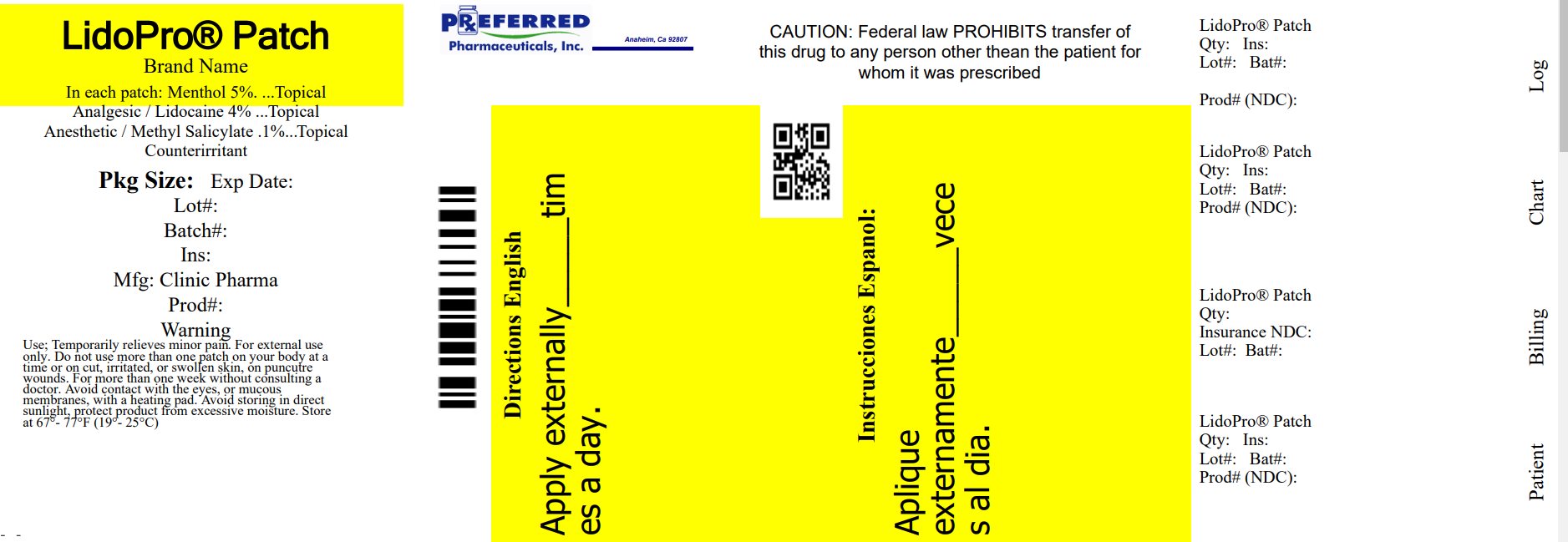
DOSAGE AND ADMINISTRATION Apply lidocaine patch 5% to intact skin to cover the most painful area. Apply the prescribed number of patches (maximum of 3), only once for up to 12 hours within a 24 hour period. Patches may be cut into smaller sizes with scissors prior to removal of the release liner (see HANDLING AND DISPOSAL ). Clothing may be worn over the area of application. Smaller areas of treatment are recommended in a debilitated patient, or a patient with impaired elimination. If irritation or a burning sensation occurs during application, remove the patch(es) and do not reapply until the irritation subsides. When lidocaine patch 5% is used concomitantly with other products containing local anesthetic agents, the amount absorbed from all formulations must be considered. Lidocaine patch 5% may not stick if it gets wet. Avoid contact with water, such as bathing, swimming or showering. Direction: Apply to affectered area not more that 3 to 4 times daily.
Warnings
WARNINGS Risk of Methemoglobinemia Cases of methemoglobinemia have been reported in association with local anesthetic use. Although all patients are at risk for methemoglobinemia, patients with glucose-6-phosphate dehydrogenase deficiency, congenital or idiopathic methemoglobinemia, cardiac or pulmonary compromise, infants under 6 months of age, and concurrent exposure to oxidizing agents or their metabolites are more susceptible to developing clinical manifestations of the condition. If local anesthetics must be used in these patients, close monitoring for symptoms and signs of methemoglobinemia is recommended. Signs of methemoglobinemia may occur immediately or may be delayed some hours after exposure, and are characterized by a cyanotic skin discoloration and/or abnormal coloration of the blood. Methemoglobin levels may continue to rise; therefore, immediate treatment is required to avert more serious central nervous system and cardiovascular adverse effects, including seizures, coma, arrhythmias, and death. Discontinue lidocaine and any other oxidizing agents. Depending on the severity of the signs and symptoms, patients may respond to supportive care, i.e. oxygen therapy, hydration. A more severe clinical presentation may require treatment with methylene blue, exchange transfusion, or hyperbaric oxygen. Accidental Exposure in Children Even a used lidocaine patch contains a large amount of lidocaine (at least 665 mg). The potential exists for a small child or a pet to suffer serious adverse effects from chewing or ingesting a new or used lidocaine patch, although the risk with this formulation has not been evaluated. It is important for patients to store and dispose of lidocaine patch 5% out of the reach of children, pets and others (see HANDLING AND DISPOSAL ). Excessive Dosing Excessive dosing by applying lidocaine patch 5% to larger areas or for longer than the recommended wearing time could result in increased absorption of lidocaine and high blood concentrations, leading to serious adverse effects (see ADVERSE REACTIONS, Systemic Reactions ). Lidocaine toxicity could be expected at lidocaine blood concentrations above 5 mcg/mL. The blood concentration of lidocaine is determined by the rate of systemic absorption and elimination. Longer duration of application, application of more than the recommended number of patches, smaller patients, or impaired elimination may all contribute to increasing the blood concentration of lidocaine. With recommended dosing of lidocaine patch 5%, the average peak blood concentration is about 0.13 mcg/mL, but concentrations higher than 0.25 mcg/mL have been observed in some individuals. For external use only.
Contraindications
CONTRAINDICATIONS Lidocaine patch 5% is contraindicated in patients with a known history of sensitivity to local anesthetics of the amide type, or to any other component of the product.
Drug interactions
DRUG INTERACTIONS Patients that are administered local anesthetics may be at increased risk of developing methemoglobinemia when concurrently exposed to the following oxidizing agents Class Nitrates/Nitrites Local Anesthetics Antineoplastic agents Antibiotics Antimalarials Anticonvulsants Other drugs Examples nitroglycerin, nitroprusside, nitric oxide, nitrous oxide benzocaine, lidocaine, bupivacaine, mepivacaine, tetracaine, prilocaine, procaine, articaine, ropivacaine cyclophosphamide, flutamide, rasburicase, ifosfamide, hydroxyurea dapsone, sulfonamides, nitrofurantoin, para-aminosalicyclic acid chloroquine, primaquine phenytoin, sodium valproate, phenobarbital acetaminophen, metoclopramide, sulfa drugs (i.e., sulfasalazine), quinine
Adverse reactions
ADVERSE REACTIONS Application Site Reactions During or immediately after treatment with lidocaine patch 5%, the skin at the site of application may develop blisters, bruising, burning sensation, depigmentation, dermatitis, discoloration, edema, erythema, exfoliation, irritation, papules, petechia, pruritus, vesicles, or may be the locus of abnormal sensation. These reactions are generally mild and transient, resolving spontaneously within a few minutes to hours. Allergic Reactions Allergic and anaphylactoid reactions associated with lidocaine, although rare, can occur. They are characterized by angioedema, bronchospasm, dermatitis, dyspnea, hypersensitivity, laryngospasm, pruritus, shock, and urticaria. If they occur, they should be managed by conventional means. The detection of sensitivity by skin testing is of doubtful value. Other Adverse Events Due to the nature and limitation of spontaneous reports in postmarketing surveillance, causality has not been established for additional reported adverse events including: Asthenia, confusion, disorientation, dizziness, headache, hyperesthesia, hypoesthesia, lightheadedness, metallic taste, nausea, nervousness, pain exacerbated, paresthesia, somnolence, taste alteration, vomiting, visual disturbances such as blurred vision, flushing, tinnitus, and tremor. Systemic (Dose-Related) Reactions Systemic adverse reactions following appropriate use of lidocaine patch 5% are unlikely, due to the small dose absorbed (see CLINICAL PHARMACOLOGY, Pharmacokinetics ). Systemic adverse effects of lidocaine are similar in nature to those observed with other amide local anesthetic agents, including CNS excitation and/or depression (light-headedness, nervousness, apprehension, euphoria, confusion, dizziness, drowsiness, tinnitus, blurred or double vision, vomiting, sensations of heat, cold or numbness, twitching, tremors, convulsions, unconsciousness, respiratory depression and arrest). Excitatory CNS reactions may be brief or not occur at all, in which case the first manifestation may be drowsiness merging into unconsciousness. Cardiovascular manifestations may include bradycardia, hypotension and cardiovascular collapse leading to arrest.
Mechanism of action
CLINICAL PHARMACOLOGY: Lidocaine is a topical anesthetic and stabilizes the neuronal membrane by inhibiting the ionic fluxes required for the initiation and conduction of impulses, thereby effecting local anesthetic action. Menthol has local anesthetic and counterirritant qualities. It also acts as a weak kappa (ĸ) opioid receptor agonist. Menthol chemically triggers the cold-‐sensitive TRPM-‐8 receptors in the skin, which are responsible for the well-‐documented cooling sensation that occurs when applied to the skin. Menthol’s analgesic properties are not fully understood; however, they are mediated through a selective activation of ĸ-‐opioid receptors. Menthol also blocks voltage-‐sensitive sodium channels, reducing neural activity that may stimulate muscle tissue. Pharmacodynamics Menthol works by targeting the k-‐opiod receptor on the TRPM8 neuron. The TRPM8 neuron is normally activated at temperatures between (8° -‐ 28° C). Menthol causes the neuron to fire at temperatures above normal activation, which triggers the characteristic cooling sensation. Also because of Menthol's specific targeting of the k-‐opioid receptor, it is endowed with analgesic properties. Lidocaine is an amide-‐type local anesthetic agent and is suggested to stabilize neuronal membranes by inhibiting the ionic fluxes required for the initiation and conduction of impulses. The penetration of Lidocaine into intact skin after application of patch is sufficient to produce an analgesic effect, but less than the amount necessary to produce a complete sensory block. Pharmacokinetics Absorption: The amount of Lidocaine and Menthol systemically absorbed is directly related to both the duration of application and the surface area over which it is applied. In a pharmacokinetic study, three Lidocaine 5% patches were applied over an area of 420 cm2 of intact skin on the back of normal volunteers for 12 hours. Blood samples were withdrawn for a determination of Lidocaine concentration during the application and for 12 hours after removal of patches. The results are summarized in table 1. Repeated application of three days indicated that the Lidocaine concentration does not increase with daily use. The mean plasma pharmacokinetic profile for the 15 healthy volunteers is shown in Figure 1.When Lidocaine 5% patch is used according to the recommended dosing instructions, only 3 ± 2% of the dose applied is expected to be absorbed. At least 95% (665 mg) of Lidocaine will remain in a used patch. Mean peak blood concentration of Lidocaine is about 0.13 µg/mL (about 1/10 of the therapeutic concentration required to treat cardiac arrhythmias). Figure 1 Mean Lidocaine blood concentrations after three consecutive daily applications of three Lidocaine 5% patches simultaneously for 12 hours per day in healthy volunteers (n = 15). Distribution: When Lidocaine is administered intravenously to healthy volunteers, the volume of distribution is 0.7 to 2.7 L/kg (mean 1.5 ± 0.6 SD, n = 15). At concentrations produced by application of Lidocaine Patch 5%, Lidocaine is approximately 70% bound to plasma proteins, primarily alpha-‐1-‐acid glycoprotein. At much higher plasma concentrations (1 to 4 µg/mL of free base), the plasma protein binding of Lidocaine is concentration dependent. Lidocaine crosses the placental and blood brain barriers, presumably by passive diffusion. Metabolism: It is not known if Lidocaine is metabolized in the skin. Lidocaine is metabolized rapidly by the liver to a number of metabolites, including menoethylglycinexylidie (MEGX) and glycinexylidide (GX), both of which have pharmacologic activity similar to, but less potent than that of Lidocaine. A minor metabolite, 2,6-‐xylidine, has unknown pharmacologic activity but is carcinogenic in rats. The blood concentration of this metabolite is negligible following application of Lidocaine Patch 5%. Following intravenous administration, MEGX and GX concentrations in serum range from 11% to 36% and from 5% to 11% of Lidocaine concentrations, respectively. Humans rapidly metabolize Menthols primarily in the liver by the microsomes, using the enzyme CYP2A6. Cytochrome P450-‐mediated oxidation occurs in humans, yielding various alcohol and hydroxy acid derivatives. These are eliminated in the urine unchanged or conjugated with glucuronic acid. Excretion: Lidocaine and its metabolites are excreted by the kidneys. Less than 10% of Lidocaine is excreted unchanged. The half-‐life of Lidocaine elimination from plasma following IV administration is 81 to 149 minutes (mean 107 ± 22 SD, n=15). The systemic clearance is 0.33 to 0.90 L/min (mean 0.64 ± 0.18 SD, n=15). Menthols are largely eliminated as glucuronides. In an experiment, 79% of a 1g (Quick, 1928) and 78% of a 10-‐20mg (Atzl et al., 1972) oral dose of Menthol was eliminated as the glucuronic acid conjugate within 6 h after administration to volunteers. Of a dose of 47 mg/kg bw [3-‐3H]-‐(-‐)-‐Menthol, 82% was eliminated in the urine 17 hours after administration. Smaller amounts were distributed in the feces and ileum; only 1% of the activity remained in the liver (Clegg et al., 1982). table1 fig1 mentholpath
NDC examples
83881-44180425-038584460-802
Treats these conditions
Source: openFDA + RxNorm · 2026
Look up another medication