Memantine Hydrochloride Oral
Managing this medication for someone you care for? Eleplan keeps diagnoses, medications and appointments in one plan.
Start free with EleplanMedication reference
Memantine Hydrochloride Oral
ORAL
Memantine Hydrochloride Oral. 1. INDICATIONS AND USAGE Memantine hydrochloride is indicated for the treatment of moderate to severe dementia of the Alzheimer’s type. Memantine…
Brand names
Memantine Hydrochloride
Active ingredients
MEMANTINE HYDROCHLORIDE
Indications
1. INDICATIONS AND USAGE Memantine hydrochloride is indicated for the treatment of moderate to severe dementia of the Alzheimer’s type. Memantine hydrochloride is an N-methyl-D-aspartate (NMDA) receptor antagonist indicated for the treatment of moderate to severe dementia of the Alzheimer’s type. (1)
Dosage
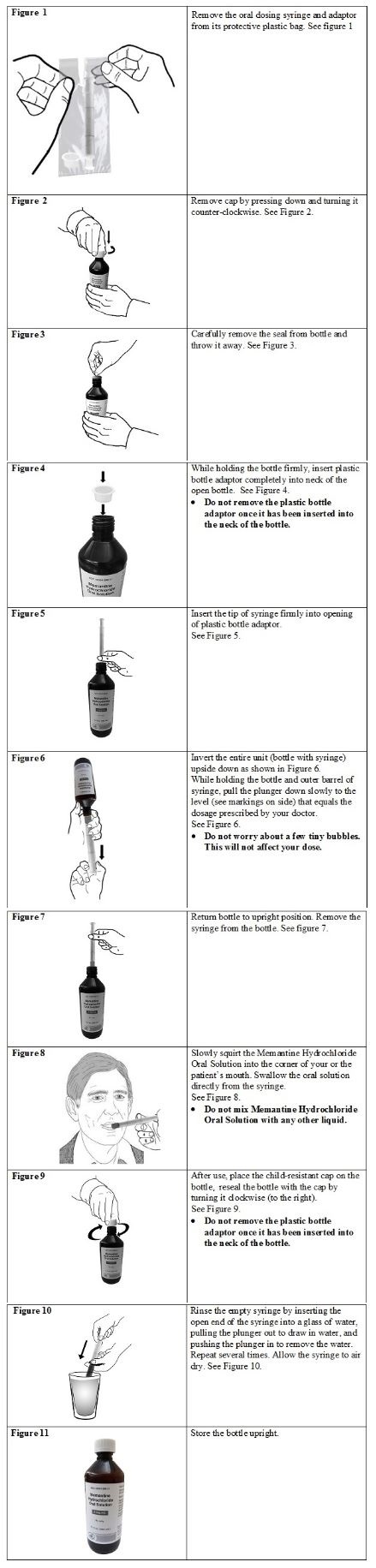
2. DOSAGE AND ADMINISTRATION The recommended starting dose of memantine hydrochloride is 5 mg (2.5 mL) once daily. The dose should be increased in 5 mg increments to 10 mg/day (2.5 mL twice daily), 15 mg/day (2.5 mL and 5 mL as separate doses), and 20 mg/day (5 mL twice daily). The minimum recommended interval between dose increases is one week. The dosage shown to be effective in controlled clinical trials is 20 mg/day (5 mL twice daily). Dosing Titration Schedule Memantine hydrochloride can be taken with or without food. If a patient misses a single dose of memantine hydrochloride, that patient should not double up on the next dose. The next dose should be taken as scheduled. If a patient fails to take memantine hydrochloride for several days, dosing may need to be resumed at lower doses and retitrated as described above. Do not mix memantine hydrochloride oral solution with any other liquid. Memantine hydrochloride is administered with a dosing device that comes with the drug and consists of a syringe, press in bottle adaptor, a patient needs to administer the drug. The supplied syringe should be used to withdraw the correct volume of oral solution and the oral solution should be slowly squirted into the corner of the patient’s mouth. Special Populations Renal Impairment A target dose of 5 mg (2.5 mL) twice daily is recommended in patients with severe renal impairment (creatinine clearance of 5 to 29 mL/min based on the Cockcroft-Gault equation). Hepatic Impairment Memantine hydrochloride should be administered with caution to patients with severe hepatic impairment [see Clinical Pharmacology (12.3)] . May be taken with or without food (2) Initial dose is 5 mg (2.5 mL) once daily. Increase dose in 5 mg increments to a maintenance dose of 10 mg (5 mL) twice daily. A minimum of 1 week of treatment with the previous dose should be observed before increasing the dose. (2) Severe renal impairment: recommended dose is 5 mg (2.5 mL) twice daily. (2) dosing-titration-schedule
Warnings
5. WARNINGS AND PRECAUTIONS Conditions that raise urine pH may decrease the urinary elimination of memantine, resulting in increased plasma levels of memantine. (5.1, 7.1) 5.1 Genitourinary Conditions Conditions that raise urine pH may decrease the urinary elimination of memantine resulting in increased plasma levels of memantine [see Drug Interactions (7.1)].
Contraindications
4. CONTRAINDICATIONS Memantine hydrochloride is contraindicated in patients with known hypersensitivity to memantine hydrochloride or to any excipients used in the formulation. Memantine hydrochloride is contraindicated in patients with known hypersensitivity to memantine hydrochloride or to any excipients used in the formulation. (4)
Drug interactions
DRUG INTERACTIONS 7.1 Drugs that Make the Urine Alkaline The clearance of memantine was reduced by about 80% under alkaline urine conditions at pH 8. Therefore, alterations of urine pH towards the alkaline condition may lead to an accumulation of the drug with a possible increase in adverse effects. Urine pH is altered by diet, drugs (e.g. carbonic anhydrase inhibitors, sodium bicarbonate) and clinical state of the patient (e.g. renal tubular acidosis or severe infections of the urinary tract). Hence, memantine should be used with caution under these conditions. 7.2 Use with Other N-methyl-D-aspartate (NMDA) Antagonists The combined use of memantine hydrochloride with other NMDA antagonists (amantadine, ketamine, and dextromethorphan) has not been systematically evaluated and such use should be approached with caution.
Adverse reactions
6. ADVERSE REACTIONS Most common adverse reactions (≥ 5 % and greater than placebo) are dizziness, headache, confusion and constipation. (6.1) To report SUSPECTED ADVERSE REACTIONS, contact FDA at 1-800-FDA-1088 or www.fda.gov/medwatch 6.1 Clinical Trials Experience Memantine hydrochloride was evaluated in eight double-blind placebo-controlled trials involving a total of 1862 dementia (Alzheimers disease, vascular dementia) patients (940 patients treated with memantine hydrochloride and 922 patients treated with placebo) for a treatment period up to 28 weeks. Because clinical trials are conducted under widely varying conditions, adverse reaction rates observed in the clinical trials of a drug cannot be directly compared to rates in the clinical trials of another drug and may not reflect the rates observed in clinical practice. Adverse Events Leading to Discontinuation In placebo-controlled trials in which dementia patients received doses of memantine hydrochloride up to 20 mg/day, the likelihood of discontinuation because of an adverse reaction was the same in the memantine hydrochloride group (10.1%) as in the placebo group (11.5%). No individual adverse reaction was associated with the discontinuation of treatment in 1% or more of memantine hydrochloride-treated patients and at a rate greater than placebo. Most Common Adverse Reactions In double-blind placebo-controlled trials involving dementia patients, the most common adverse reactions (incidence 5% and higher than placebo) in patients treated with memantine hydrochloride were dizziness, headache, confusion and constipation. Table 1 lists all adverse reactions that occurred in at least 2% of patients treated with memantine hydrochloride and at an incidence greater than placebo. Table 1: Adverse Reactions Reported in Controlled Clinical Trials in at Least 2% of Patients Receiving Memantine Hydrochloride and at a Higher Frequency than Placebo treated Patients. The overall profile of adverse reactions and the incidence rates for individual adverse reactions in the subpopulation of patients with moderate to severe Alzheimer’s disease were not different from the profile and incidence rates described above for the overall dementia population. Seizures Memantine hydrochloride has not been systematically evaluated in patients with a seizure disorder. In clinical trials of memantine hydrochloride, seizures occurred in 0.2% of patients treated with memantine hydrochloride and 0.5% of patients treated with placebo. Table 1 6.2 Postmarketing Experience The following adverse reactions have been identified during post-approval use of memantine. Because these reactions are reported voluntarily from a population of uncertain size, it is not always possible to reliably estimate their frequency or establish a causal relationship to drug exposure. These reactions include: Blood and Lymphatic System Disorders - agranulocytosis, leukopenia (including neutropenia), pancytopenia, thrombocytopenia, thrombotic thrombocytopenic purpura. Cardiac Disorders - cardiac failure congestive. Gastrointestinal Disorders - pancreatitis. Hepatobiliary Disorders – hepatitis. Psychiatric Disorders - suicidal ideation. Renal and Urinary Disorders - acute renal failure (including increased creatinine and renal insufficiency). Skin Disorders - Stevens Johnson syndrome.
Mechanism of action
Mechanism of Action Persistent activation of central nervous system N-methyl-D-aspartate (NMDA) receptors by the excitatory amino acid glutamate has been hypothesized to contribute to the symptomatology of Alzheimer’s disease. Memantine is postulated to exert its therapeutic effect through its action as a low to moderate affinity uncompetitive (open-channel) NMDA receptor antagonist which binds preferentially to the NMDA receptor-operated cation channels. There is no evidence that memantine prevents or slows neurodegeneration in patients with Alzheimer’s disease.
NDC examples
13925-540
Indicated ICD-10 codes
Treats these conditions
Assistance programs
Adult Day Care ProgramConnecticut Statewide Respite ProgramMissing Alzheimer's Disease Patient Assistance ProgramOhio Family Caregiver Support ProgramWashington Family Caregiver Support ProgramAlzheimer’s Care and SupportAlzheimer’s Disease Education and Referral Center (ADEAR)Alzheimer’s Disease & Other Memory Disorders ProgramCare Coordination: Alzheimer’s Resources of AlaskaServices for Alzheimer’s PatientsAABD Cash AssistanceACL Assistive Technology
Source: openFDA + RxNorm · 2026
Look up another medication