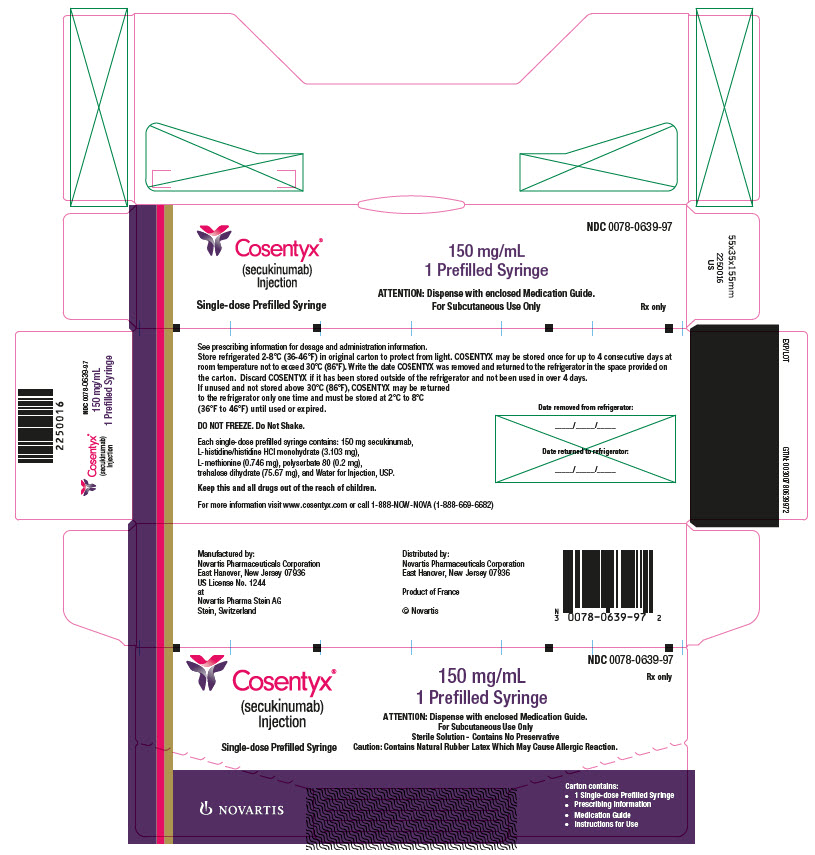
0.5 ML secukinumab 150 MG/ML Prefilled Syringe
Managing this medication for someone you care for? Eleplan keeps diagnoses, medications and appointments in one plan.
Start free with EleplanClinical drug
0.5 ML secukinumab 150 MG/ML Prefilled Syringe
150 MG/ML · Prefilled Syringe · injection
A form of secukinumab →
0.5 ML secukinumab 150 MG/ML Prefilled Syringe — Interleukin inhibitors. INDICATIONS AND USAGE COSENTYX is a human interleukin-17A antagonist indicated for the treatment of: moderate to severe plaque psoriasis (PsO) in…
Active ingredient
Classification
Interleukin inhibitorsInterleukin-17A Antagonist
Drug interactions
Secukinumab may affect the concentrations of certain CYP450 substrates, necessitating monitoring and possible dosage adjustments.
- moderateCYP450 substrates — Increased concentrations of cytokines may suppress the formation of CYP enzymes, affecting substrate effectiveness and adverse reactions.
Indications
INDICATIONS AND USAGE COSENTYX is a human interleukin-17A antagonist indicated for the treatment of: moderate to severe plaque psoriasis (PsO) in adults and pediatric patients 6 years and older who are candidates for systemic therapy or phototherapy. ( 1.1 ) active psoriatic arthritis (PsA) in adults and pediatric patients 2 years of age and older. ( 1.2 ) active ankylosing spondylitis (AS) in adults and pediatric patients 12 years of age and older. ( 1.3 ) active non-radiographic axial spondyloarthritis (nr-axSpA) in adults with objective signs of inflammation. ( 1.4 ) active enthesitis-related arthritis (ERA) in pediatric patients 4 years of age and older. ( 1.5 ) moderate to severe hidradenitis suppurativa (HS) in adults and pediatric patients 12 years of age and older. ( 1.6 ) 1.1 Plaque Psoriasis COSENTYX ® is indicated for the treatment of moderate to severe plaque psoriasis (PsO) in adults and pediatric patients 6 years and older who are candidates for systemic therapy or phototherapy. 1.2 Psoriatic Arthritis COSENTYX is indicated for the treatment of active psoriatic arthritis (PsA) in adults and pediatric patients 2 years of age and older. 1.3 Ankylosing Spondylitis COSENTYX is indicated for the treatment of active ankylosing spondylitis (AS) in adults and pediatric patients 12 years of age and older. 1.4 Non-Radiographic Axial Spondyloarthritis COSENTYX is indicated for the treatment of active non-radiographic axial spondyloarthritis (nr-axSpA) in adult patients with objective signs of inflammation. 1.5 Enthesitis-Related Arthritis COSENTYX is indicated for the treatment of active enthesitis-related arthritis (ERA) in pediatric patients 4 years of age and older. 1.6 Hidradenitis Suppurativa COSENTYX is indicated for the treatment of moderate to severe hidradenitis suppurativa (HS) in adults and pediatric patients 12 years of age and older.
Dosage
DOSAGE AND ADMINISTRATION Prior to COSENTYX initiation, complete all age-appropriate vaccinations, evaluate patients for tuberculosis (TB). ( 2.1 ) See Full Prescribing Information for instructions on preparation and administration of COSENTYX. ( 2.2 , 2.11 , 2.12 ) Administration of Intravenous Formulation: COSENTYX for intravenous use must be diluted prior to administration. Administer as an intravenous infusion after dilution over a period of 30 minutes. ( 2.12 ) Plaque Psoriasis: Subcutaneous Dosage in Adults: Recommended dosage is 300 mg by subcutaneous injection at Weeks 0, 1, 2, 3, and 4 and every 4 weeks thereafter. For some patients, a dose of 150 mg may be acceptable. ( 2.3 ) Subcutaneous Dosage in Pediatric Patients 6 Years and Older: Recommended weight-based dosage is administered by subcutaneous injection at Weeks 0, 1, 2, 3, and 4 and every 4 weeks thereafter. For patients < 50 kg, the dose is 75 mg. For patients ≥ 50 kg, the dose is 150 mg. ( 2.3 ) Psoriatic Arthritis: Adult Patients Subcutaneous Dosage: For PsA patients with coexistent moderate to severe PsO, use the dosage and administration for PsO. ( 2.3 ) For other PsA patients, administer with or without a loading dosage. With a loading dosage : 150 mg at Weeks 0, 1, 2, 3, and 4 and every 4 weeks thereafter Without a loading dosage : 150 mg every 4 weeks If a patient continues to have active PsA, consider a dosage of 300 mg every 4 weeks. ( 2.4 ) Intravenous Dosage: The recommended intravenous dosages are: With a loading dosage : 6 mg/kg given at Week 0 as a loading dose, followed by 1.75 mg/kg every 4 weeks thereafter (max. maintenance dose 300 mg per infusion). Without a loading dosage : 1.75 mg/kg every 4 weeks (max. maintenance dose 300 mg per infusion). ( 2.4 ) Pediatric Patients 2 Years and Older Subcutaneous Dosages : Administer by subcutaneous injection at Weeks 0, 1, 2, 3, and 4 and every 4 weeks thereafter: For patients ≥ 15 kg and < 50 kg the dose is 75 mg. For patients ≥ 50 kg the dose is 150 mg. ( 2.5 ) Ankylosing Spondylitis: Adult Patients Subcutaneous Dosage: Administer with or without a loading dosage. The recommended dosages are: With a loading dosage : 150 mg at Weeks 0, 1, 2, 3, and 4 and every 4 weeks thereafter. Without a loading dosage : 150 mg every 4 weeks. If a patient continues to have active ankylosing spondylitis, consider a dosage of 300 mg every 4 weeks. ( 2.6 ) Intravenous Dosage: The recommended intravenous dosages are: With a loading dosage : 6 mg/kg given at Week 0 as a loading dose, followed by 1.75 mg/kg every 4 weeks thereafter (max. maintenance dose 300 mg per infusion). Without a loading dosage : 1.75 mg/kg every 4 weeks (max. maintenance dose 300 mg per infusion). ( 2.6 ) Pediatric Patients 12 Years and Older Subcutaneous Dosage: Administer by subcutaneous injection at Weeks 0, 1, 2, 3, and 4 and every 4 weeks thereafter. For patients < 50 kg, the dose is 75 mg. For patients ≥ 50 kg, the dose is 150 mg. ( 2.7 ) Non-Radiographic Axial Spondyloarthritis: Subcutaneous Dosage: Administer with or without a loading dosage. The recommended dosage is: With a loading dosage : 150 mg at Weeks 0, 1, 2, 3, and 4 and every 4 weeks thereafter. Without a loading dosage : 150 mg every 4 weeks. ( 2.8 ) Intravenous Dosage: The recommended intravenous dosages are: With a loading dosage : 6 mg/kg given at Week 0 as a loading dose, followed by 1.75 mg/kg every 4 weeks thereafter (max. maintenance dose 300 mg per infusion). Without a loading dosage : 1.75 mg/kg every 4 weeks (max. maintenance dose 300 mg per infusion). ( 2.8 ) Enthesitis-Related Arthritis: Recommended weight-based dosage is administered by subcutaneous injection at Weeks 0, 1, 2, 3, and 4 and every 4 weeks thereafter. For patients ≥ 15 kg and < 50 kg the dose is 75 mg. For patients ≥ 50 kg the dose is 150 mg. ( 2.9 ) Hidradenitis Suppurativa: Subcutaneous Dosage in Adults : Recommended dosage is 300 mg by subcutaneous injection at Weeks 0, 1, 2, 3, and 4 and every 4 weeks thereafter. If a patient does not adequately respond, consider increasing the dosage to 300 mg every 2 weeks. ( 2.10 ) Subcutaneous Dosage in Pediatric Patients 12 Years and Older : Recommended weight-based dosage is administered by subcutaneous injection at Weeks 0, 1, 2, 3, and 4 and every 4 weeks thereafter. For patients ≥ 30 kg and < 90 kg, the dose is 150 mg. For patients ≥ 90 kg, the dose is 300 mg. ( 2.10 ) 2.1 Testing and Procedures Prior to Treatment Initiation Perform the following evaluations prior to COSENTYX initiation: Evaluate for active or latent tuberculosis (TB). COSENTYX initiation is not recommended in patients with active TB infection. Initiate treatment of latent TB prior to initiation of COSENTYX [see Warnings and Precautions (5.3)] . Complete all age-appropriate vaccinations as recommended by current immunization guidelines prior to initiating treatment with COSENTYX [see Warnings and Precautions (5.7)] . 2.2 Important Administration Instructions COSENTYX is for use under the guidance and supervision of a healthcare provider. UnoReady pen, Sensoready pen, and prefilled syringes are for subcutaneous use only. Solution in vials is for intravenous use in adult patients only. Important Subcutaneous Administration Instructions Adult patients may self-administer COSENTYX or be injected by a caregiver after proper training in subcutaneous injection technique. Pediatric patients should not self-administer COSENTYX. An adult caregiver should prepare and inject COSENTYX after proper training in subcutaneous injection technique. Administer each subcutaneous injection at a different anatomic location (such as upper arms, thighs, or any quadrant of abdomen) than the previous injection, and not into areas where the skin is tender, bruised, erythematous, indurated, or affected by psoriasis. Administration of subcutaneous COSENTYX in the upper, outer arm may be performed by a caregiver or healthcare provider. The COSENTYX “Instructions for Use” for each presentation and strength contains more detailed instructions on the preparation and administration of COSENTYX for patients and caregivers [see Instructions for Use] . Important Intravenous Infusion Instructions Intravenous infusion is only for use by a healthcare professional in a healthcare setting. Prepare COSENTYX intravenous infusion by diluting COSENTYX injection in vial(s) and administering based on patient body weight [see Dosage and Administration (2.12)] . Intravenous infusion may be administered only in adults with PsA, AS, and nr-axSpA. 2.3 Recommended Dosage in Plaque Psoriasis Recommended Subcutaneous Dosage in Adults The recommended dosage in adults with PsO is 300 mg by subcutaneous injection at Weeks 0, 1, 2, 3, and 4 and every 4 weeks thereafter. Each 300 mg dosage is given as one subcutaneous injection of 300 mg or as two subcutaneous injections of 150 mg. For some patients, a dosage of 150 mg by subcutaneous injection at Weeks 0, 1, 2, 3, and 4 and every 4 weeks thereafter may be acceptable. Recommended Subcutaneous Dosage in Pediatric Patients 6 Years of Age and Older The recommended weight-based dosage in pediatric patients 6 years of age and older with PsO is administered by subcutaneous injection at Weeks 0, 1, 2, 3, and 4 and every 4 weeks thereafter. For patients < 50 kg, the recommended dose is 75 mg. For patients ≥ 50 kg, the recommended dose is 150 mg. 2.4 Recommended Dosage in Adults with Psoriatic Arthritis COSENTYX may be administered with or without methotrexate. Recommended Subcutaneous Dosage For adult patients with PsA and with coexistent moderate to severe PsO, use the dosage and administration recommendations for adults with PsO [see Dosage and Administration (2.3)] . For other adult patients with PsA, administer COSENTYX with or without a loading dosage by subcutaneous injection. The recommended dosage in adults with PsA: With a loading dosage is 150 mg at Weeks 0, 1, 2, 3, and 4 and every 4 weeks thereafter. Without a loading d
Warnings
WARNINGS AND PRECAUTIONS Infections : Serious infections have occurred. Exercise caution when considering the use of COSENTYX in patients with a chronic infection or a history of recurrent infection. If a serious infection develops, discontinue COSENTYX until the infection resolves. ( 5.1 ) Hypersensitivity Reactions : If an anaphylactic reaction or other serious allergic reaction occurs, discontinue COSENTYX immediately and initiate appropriate therapy. ( 5.2 ) Tuberculosis (TB) : Prior to initiating treatment with COSENTYX, evaluate for TB. ( 5.3 ) Inflammatory Bowel Disease (IBD) : Cases of IBD were observed in clinical trials. Exercise caution when prescribing COSENTYX to patients with IBD. ( 5.4 ) Eczematous Eruptions : Cases of severe eczematous eruptions have occurred in patients receiving COSENTYX. ( 5.5 ) Immunizations : Avoid use of live vaccines in patients treated with COSENTYX. ( 5.7 ) 5.1 Infections COSENTYX may increase the risk of infections. In clinical trials, a higher rate of infections was observed in COSENTYX treated subjects compared to placebo-treated subjects. In placebo-controlled clinical trials in subjects with moderate to severe PsO, higher rates of common infections, such as nasopharyngitis (11.4% versus 8.6%), upper respiratory tract infection (2.5% versus 0.7%) and mucocutaneous infections with candida (1.2% versus 0.3%) were observed in subjects treated with COSENTYX compared to placebo-treated subjects. A similar increase in risk of infection in subjects treated with COSENTYX was seen in placebo-controlled trials in subjects with PsA, AS and nr-axSpA. The incidence of some types of infections, including fungal infections, appeared to be dose-dependent in clinical trials [see Adverse Reactions (6.1)] . In the postmarketing setting, serious bacterial, viral, and fungal opportunistic infections, and some fatal infections have been reported in patients receiving IL-17 inhibitors including COSENTYX. Cases of Hepatitis B virus reactivation have been reported [see Adverse Reactions (6.2)] . Exercise caution when considering the use of COSENTYX in patients with a chronic infection or a history of recurrent infection. Instruct patients to seek medical advice if signs or symptoms suggestive of an infection occur. If a patient develops a serious infection, monitor the patient closely and discontinue COSENTYX until the infection resolves. If signs of Hepatitis B virus reactivation occur, consult a hepatitis specialist. COSENTYX is not recommended for use in patients with active viral hepatitis. 5.2 Hypersensitivity Reactions Serious hypersensitivity reactions including anaphylaxis, angioedema, and urticaria have been reported in COSENTYX treated subjects in clinical trials and in the post-marketing setting [see Adverse Reactions (6.1, 6.2)] . If an anaphylactic or other serious allergic reaction occurs, immediately discontinue administration of COSENTYX and initiate appropriate therapy [see Contraindications (4)] . 5.3 Pre-Treatment Evaluation for Tuberculosis Evaluate patients for active or latent TB infection prior to initiating treatment with COSENTYX. Avoid administration of COSENTYX to patients with active TB infection. Initiate treatment of latent TB prior to administering COSENTYX. Consider anti-TB therapy prior to initiation of COSENTYX in patients with a past history of latent or active TB in whom an adequate course of treatment cannot be confirmed. Monitor patients closely for signs and symptoms of active TB during and after treatment. In the postmarketing setting, cases were reported where patients with a history of latent tuberculosis (TB) who were treated with COSENTYX developed active TB. 5.4 Inflammatory Bowel Disease Inflammatory Bowel Disease (IBD) exacerbations, in some cases serious and/or leading to discontinuation of COSENTYX, occurred in COSENTYX treated subjects during clinical trials in PsO, PsA, AS, nr-axSpA, and HS. In adult subjects with HS, the incidence of IBD was higher in subjects who received COSENTYX 300 mg every 2 weeks (Ulcerative Colitis [UC] 1 case, EAIR 0.2/100 subject-years; Crohn`s Disease [CD] 1 case, EAIR 0.2/100 subject-years) compared to subjects who received COSENTYX 300 mg every 4 weeks (IBD 1 case, EAIR 0.2/100 subject-years). In addition, new onset IBD cases occurred in subjects treated with COSENTYX in clinical trials. In an exploratory trial in 59 subjects with active Crohn’s disease [COSENTYX is not approved for the treatment of Crohn`s disease], there were trends toward greater disease activity and increased adverse reactions in subjects treated with COSENTYX as compared to placebo-treated subjects. Exercise caution when prescribing COSENTYX to patients with IBD. Patients treated with COSENTYX should be monitored for signs and symptoms of IBD [see Adverse Reactions (6.1)] . 5.5 Eczematous Eruptions In postmarketing reports, cases of severe eczematous eruptions, including atopic dermatitis-like eruptions, dyshidrotic eczema, and erythroderma, were reported in patients receiving COSENTYX; some cases resulted in hospitalization. The onset of eczematous eruptions was variable, ranging from days to months after the first dose of COSENTYX. Treatment may need to be discontinued to resolve the eczematous eruption. Some patients were successfully treated for eczematous eruptions while continuing COSENTYX. 5.6 Risk of Hypersensitivity in Latex-Sensitive Individuals The removable cap of the COSENTYX Sensoready pen and prefilled syringes (150 mg/mL, 75 mg/0.5 mL) contains natural rubber latex, which may cause a hypersensitivity reaction in latex-sensitive individuals. The safe use of the COSENTYX Sensoready pen or prefilled syringes (150 mg/mL, 75 mg/0.5 mL) in latex-sensitive individuals has not been studied. 5.7 Immunizations Prior to initiating therapy with COSENTYX, consider completion of all age-appropriate immunizations according to current immunization guidelines. COSENTYX may alter a patient's immune response to live vaccines. Avoid use of live vaccines in patients treated with COSENTYX [see Clinical Pharmacology (12.2)] .
Contraindications
CONTRAINDICATIONS COSENTYX is contraindicated in patients with a previous serious hypersensitivity reaction to secukinumab or to any of the excipients in COSENTYX. Cases of anaphylaxis and angioedema have been reported during treatment with COSENTYX [see Warnings and Precautions (5.2)] . Serious hypersensitivity to secukinumab or any excipients in COSENTYX. ( 4 )
Mechanism of action
Mechanism of Action Secukinumab is a human IgG1 monoclonal antibody that selectively binds to the interleukin-17A (IL-17A) cytokine and inhibits its interaction with the IL-17 receptor. IL-17A is a naturally occurring cytokine that is involved in normal inflammatory and immune responses. Secukinumab inhibits the release of proinflammatory cytokines and chemokines.
Source: RxNorm + openFDA + RxClass + FAERS · 2026
Look up another medication