1.56 ML abaloparatide 2 MG/ML Pen Injector
Managing this medication for someone you care for? Eleplan keeps diagnoses, medications and appointments in one plan.
Start free with EleplanClinical drug
1.56 ML abaloparatide 2 MG/ML Pen Injector
2 MG/ML · Pen Injector · injection
A form of abaloparatide →
1.56 ML abaloparatide 2 MG/ML Pen Injector — Parathyroid hormones and analogues. INDICATIONS AND USAGE TYMLOS is a human parathyroid hormone related peptide [PTHrP(1-34)] analog indicated for the: Treatment of postmenopausal…
Active ingredient
Classification
Parathyroid hormones and analoguesParathyroid Hormone-Related Peptide Analog
Real-world adverse events (FAERS)
Headache4,238Nausea3,281Dizziness3,185Fatigue2,779Heart Rate Increased2,176Product Dose Omission Issue2,175Arthralgia1,859Palpitations1,819
Indications
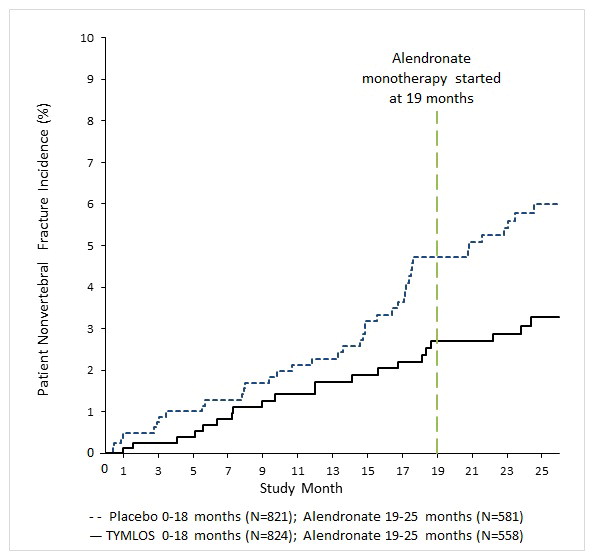
INDICATIONS AND USAGE TYMLOS is a human parathyroid hormone related peptide [PTHrP(1-34)] analog indicated for the: Treatment of postmenopausal women with osteoporosis at high risk for fracture or patients who have failed or are intolerant to other available osteoporosis therapy. ( 1.1 ) Treatment to increase bone density in men with osteoporosis at high risk for fracture or patients who have failed or are intolerant to other available osteoporosis therapy. ( 1.2 ) 1.1 Treatment of Postmenopausal Women with Osteoporosis at High Risk for Fracture TYMLOS is indicated for the treatment of postmenopausal women with osteoporosis at high risk for fracture (defined as a history of osteoporotic fracture or multiple risk factors for fracture), or patients who have failed or are intolerant to other available osteoporosis therapy. In postmenopausal women with osteoporosis, TYMLOS reduces the risk of vertebral fractures and nonvertebral fractures. 1.2 Treatment to Increase Bone Density in Men with Osteoporosis at High Risk for Fracture TYMLOS is indicated to increase bone density in men with osteoporosis at high risk for fracture (defined as a history of osteoporotic fracture or multiple risk factors for fracture), or patients who have failed or are intolerant to other available osteoporosis therapy.
Dosage
DOSAGE AND ADMINISTRATION Recommended dosage is 80 mcg subcutaneously once daily; patients should receive supplemental calcium and vitamin D if dietary intake is inadequate. ( 2.1 ) Administer as a subcutaneous injection into periumbilical region of abdomen. ( 2.2 ) Administer initially where the patient can sit or lie down in case symptoms of orthostatic hypotension occur. ( 2.2 , 5.2 ) 2.1 Recommended Dosage The recommended dosage of TYMLOS is 80 mcg administered subcutaneously once daily. Patients should receive supplemental calcium and vitamin D if dietary intake is inadequate. 2.2 Administration Instructions Administer TYMLOS as a subcutaneous injection into the periumbilical region of the abdomen. Rotate the site of the injection every day and administer at approximately the same time every day. Do not administer intravenously or intramuscularly. Administer the first several doses where the patient can sit or lie down if necessary, in case symptoms of orthostatic hypotension occur [see Warnings and Precautions ( 5.2 ) and Adverse Reactions ( 6.1 )] . Visually inspect TYMLOS for particulate matter and discoloration prior to administration. TYMLOS is a clear and colorless solution. Do not use if solid particles appear or if the solution is cloudy or colored. Provide appropriate training and instruction to patients and caregivers on the proper use of the TYMLOS pen. 2.3 Treatment Duration The safety and efficacy of TYMLOS have not been evaluated beyond 2 years of treatment. Use of the drug for more than 2 years during a patient's lifetime is not recommended.
Warnings
WARNINGS AND PRECAUTIONS Osteosarcoma: Avoid use in patients with increased risk of osteosarcoma including patients with open epiphyses, metabolic bone diseases including Paget's disease, bone metastases or history of skeletal malignancies, prior external beam or implant radiation therapy involving the skeleton, and hereditary disorders predisposing to osteosarcoma. ( 5.1 ) Orthostatic Hypotension: Instruct patients to sit or lie down if symptoms develop after dose administration. ( 5.2 ) Hypercalcemia: Avoid use in patients with pre-existing hypercalcemia and those known to have an underlying hypercalcemic disorder, such as primary hyperparathyroidism. ( 5.3 ) Hypercalciuria and Urolithiasis: Monitor urine calcium if pre-existing hypercalciuria or active urolithiasis are suspected. ( 5.4 ) 5.1 Risk of Osteosarcoma Abaloparatide caused a dose-dependent increase in the incidence of osteosarcoma in male and female rats after subcutaneous administration at exposures 4 to 28 times the human exposure at the clinical dose of 80 mcg [see Nonclinical Toxicology ( 13.1 )] . It is unknown whether TYMLOS will cause osteosarcoma in humans. Osteosarcoma has been reported in patients treated with a PTH-analog in the post marketing setting; however, an increased risk of osteosarcoma has not been observed in observational studies in humans. There are limited data assessing the risk of osteosarcoma beyond 2 years of TYMLOS and/or use of a PTH-analog [see Dosage and Administration ( 2.3 ) and Nonclinical Toxicology ( 13.1 )] . Avoid TYMLOS use in patients with (these patients are at increased baseline risk of osteosarcoma): Open epiphyses (pediatric and young adult patients) (TYMLOS is not approved in pediatric patients) [see Use in Specific Populations ( 8.4 )] . Metabolic bone diseases other than osteoporosis, including Paget's disease of the bone. Bone metastases or a history of skeletal malignancies. Prior external beam or implant radiation therapy involving the skeleton. Hereditary disorders predisposing to osteosarcoma. 5.2 Orthostatic Hypotension Orthostatic hypotension may occur with TYMLOS, typically within 4 hours of injection. Associated symptoms may include dizziness, palpitations, tachycardia, or nausea, and may resolve by having the patient lie down. For the first several doses, TYMLOS should be administered where the patient can sit or lie down if necessary [see Adverse Reactions ( 6.1 )] . 5.3 Hypercalcemia TYMLOS may cause hypercalcemia. TYMLOS is not recommended in patients with pre-existing hypercalcemia or in patients who have an underlying hypercalcemic disorder, such as primary hyperparathyroidism, because of the possibility of exacerbating hypercalcemia [see Adverse Reactions ( 6.1 )] . 5.4 Hypercalciuria and Urolithiasis TYMLOS may cause hypercalciuria. It is unknown whether TYMLOS may exacerbate urolithiasis in patients with active or a history of urolithiasis. If active urolithiasis or pre-existing hypercalciuria is suspected, measurement of urinary calcium excretion should be considered [see Adverse Reactions ( 6.1 )] .
Contraindications
CONTRAINDICATIONS TYMLOS is contraindicated in patients with a history of systemic hypersensitivity to abaloparatide or to any component of the product formulation. Reactions have included anaphylaxis, dyspnea, and urticaria [see Adverse Reactions ( 6.2 )] . Known hypersensitivity to TYMLOS. ( 4 )
Mechanism of action
Mechanism of Action Abaloparatide is a PTHrP(1-34) analog which acts as an agonist at the PTH1 receptor (PTH1R). This results in activation of the cAMP signaling pathway in target cells. Once-daily administration of abaloparatide stimulates new bone formation on trabecular and cortical bone surfaces by stimulation of osteoblastic activity. In rats and monkeys, abaloparatide had an anabolic effect on bone, demonstrated by increases in BMD and bone mineral content (BMC) that correlated with increases in bone strength at vertebral and/or nonvertebral sites [see Nonclinical Toxicology ( 13.2 )] .
Indicated ICD-10 codes
Source: RxNorm + openFDA + RxClass + FAERS · 2026
Look up another medication