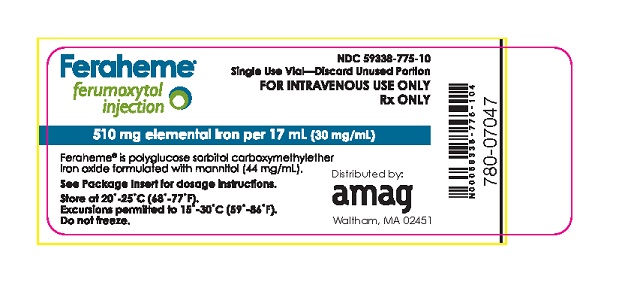
17 ML ferumoxytol 30 MG/ML Injection. INDICATIONS AND USAGE Feraheme is indicated for the treatment of iron deficiency anemia (IDA) in adult patients: • who have intolerance to oral iron…
Boxed warning
WARNING: RISK FOR SERIOUS HYPERSENSITIVITY/ANAPHYLAXIS REACTIONS Fatal and serious hypersensitivity reactions including anaphylaxis have occurred in patients receiving Feraheme. Initial symptoms may include hypotension, syncope, unresponsiveness, cardiac/cardiorespiratory arrest. • Only administer Feraheme as an intravenous infusion over at least 15 minutes and only when personnel and therapies are immediately available for the treatment of anaphylaxis and other hypersensitivity reactions [see Warnings and Precautions ( 5.1 )] . • Observe for signs or symptoms of hypersensitivity reactions during and for at least 30 minutes following Feraheme infusion including monitoring of blood pressure and pulse during and after Feraheme administration [see Warnings and Precautions ( 5.1 )]. • Hypersensitivity reactions have occurred in patients in whom a previous Feraheme dose was tolerated [see Warnings and Precautions ( 5.1 )]. WARNING: RISK FOR SERIOUS HYPERSENSITIVITY/ANAPHYLAXIS REACTIONS See full prescribing information for complete boxed warning. Fatal and serious hypersensitivity reactions including anaphylaxis have occurred in patients receiving Feraheme. Initial symptoms may include hypotension, syncope, unresponsiveness, cardiac/cardiorespiratory arrest. • Only administer Feraheme as an intravenous infusion over at least 15 minutes and only when personnel and therapies are immediately available for the treatment of anaphylaxis and other hypersensitivity reactions. ( 5.1 ) • Observe for signs or symptoms of hypersensitivity reactions during and for at least 30 minutes following Feraheme infusion including monitoring of blood pressure and pulse during and after Feraheme administration. ( 5.1 ) • Hypersensitivity reactions have occurred in patients in whom a previous Feraheme dose was tolerated. ( 5.1 )
Ferumoxytol may reduce the absorption of oral iron preparations when administered together.
moderateoral iron preparations — reduced absorption
Indications
INDICATIONS AND USAGE Feraheme is indicated for the treatment of iron deficiency anemia (IDA) in adult patients: • who have intolerance to oral iron or have had unsatisfactory response to oral iron or • who have chronic kidney disease (CKD). Feraheme is an iron replacement product indicated for the treatment of iron deficiency anemia (IDA) in adult patients: • who have intolerance to oral iron or have had unsatisfactory response to oral iron ( 1 ) or • who have chronic kidney disease (CKD). ( 1 )
Dosage
DOSAGE AND ADMINISTRATION The recommended dose of FERABRIGHT is based on patient weight: 50 kg or less: 300 mg of elemental iron administered as a single intravenous infusion over at least 15 minutes. 51 kg or more: 510 mg of elemental iron administered as a single intravenous infusion over at least 15 minutes. ( 2.1 ) FERABRIGHT must be diluted before administration in either 0.9% sodium chloride injection or 5% dextrose injection to achieve concentrations of 2 mg/mL to 8 mg/mL of elemental iron. ( 2.2 ) Obtain post-contrast T1-weighted images approximately 24 hours after administration. ( 2.3 ) 2.1 Recommended Dosage and Administration Instructions The recommended dose of FERABRIGHT is based on patient body weight as follows: 50 kg or less: 300 mg of elemental iron diluted in 0.9% sodium chloride injection or 5% dextrose injection [see Dosage and Administration ( 2.2 )] . 51 kg or more: 510 mg of elemental iron diluted in 0.9% sodium chloride injection or 5% dextrose injection [see Dosage and Administration ( 2.2 )]. Administer diluted FERABRIGHT by intravenous infusion over at least 15 minutes while the patient is in a reclined or semi-reclined position approximately 24 hours prior to imaging [see Clinical Pharmacology ( 12.1 )] . Allow at least 30 minutes after FERABRIGHT infusion for administration of any other medications that may cause serious hypersensitivity reactions or hypotension (e.g., chemotherapeutic agents or monoclonal antibodies) [see Warnings and Precautions ( 5.1 , 5.2 )]. 2.2 Dilution Instructions To achieve a final concentration of 2 mg/mL to 8 mg/mL of elemental iron, add the recommended dose of FERABRIGHT to 0.9% sodium chloride injection or 5% dextrose injection as follows: For a 300 mg dose, add 10 mL of FERABRIGHT to 50 mL to 140 mL diluent. For a 510 mg dose, add 17 mL of FERABRIGHT to 50 mL to 200 mL diluent. Inspect diluted FERABRIGHT visually for the absence of particulate matter and discoloration prior to administration. Use diluted FERABRIGHT solution immediately. If not used immediately, store the diluted FERABRIGHT solution at controlled room temperature (25°C ± 2°C) for up to 4 hours or refrigerated (2°C to 8°C) for up to 48 hours. Each vial of FERABRIGHT is for a single dose. Discard any unused portion. 2.3 Imaging Obtain post-contrast T1-weighted images approximately 24 hours after FERABRIGHT administration.
Warnings
WARNINGS AND PRECAUTIONS Hypotension: Monitor for signs and symptoms of hypotension following administration. ( 5.2 ) Iron Overload: Avoid use of FERABRIGHT in patients with iron overload. ( 5.3 ) Magnetic Resonance Imaging Test Interference: Conduct anticipated MRI studies (other than the intended FERABRIGHT brain imaging) prior to the administration of FERABRIGHT or use T1- or proton density-weighted pulse sequences if MRI is required within 3 months after administration. ( 5.4 ) Differences in Magnetic Resonance Imaging Appearance Compared to Gadolinium-Based Contrast: Be aware of the potentially limited interpretability of changes in lesion contrast appearance if prior images were not obtained with FERABRIGHT. ( 5.5 ) 5.1 Anaphylaxis and Other Serious Hypersensitivity Reactions Fatal and serious hypersensitivity reactions, including anaphylaxis presenting with cardiac/cardiorespiratory arrest, clinically significant hypotension, syncope, or unresponsiveness, have occurred in patients receiving ferumoxytol products, which contain the same active ingredient as FERABRIGHT. Other adverse reactions potentially associated with hypersensitivity have occurred, including pruritus, rash, urticaria, and wheezing. These reactions have occurred in patients who had no prior exposure to ferumoxytol as well as in patients who previously tolerated ferumoxytol. Patients with a history of multiple drug allergies may have a greater risk of anaphylaxis with FERABRIGHT. Elderly patients with multiple or serious co-morbidities who experience hypersensitivity reactions and/or hypotension following administration of ferumoxytol including FERABRIGHT may have more severe outcomes. Carefully consider the potential risks and benefits before administering FERABRIGHT to these patients. FERABRIGHT is contraindicated in patients with known hypersensitivity to ferumoxytol, any of FERABRIGHT’s components, or any other intravenous iron products [see Contraindications ( 4 )] . Only administer FERABRIGHT as an intravenous infusion over at least 15 minutes and only when personnel and therapies are immediately available for the treatment of anaphylaxis and other hypersensitivity reactions. Closely observe patients for signs and symptoms of hypersensitivity including monitoring of blood pressure and pulse during and after FERABRIGHT administration for at least 30 minutes and until clinically stable following completion of infusion. Allow at least 30 minutes after FERABRIGHT infusion for administration of any other medications that may cause serious hypersensitivity reactions or hypotension [see Dosage and Administration ( 2.1 )] . In a clinical study in patients with iron deficiency anemia (IDA) (FERABRIGHT is not approved to treat IDA), regardless of etiology, hypersensitivity reactions were reported in 0.4% (4/997) of patients administered ferumoxytol as an intravenous infusion over at least 15 minutes. These included one patient with severe hypersensitivity reaction and three patients with moderate hypersensitivity reactions. In clinical studies predominantly in patients with IDA and chronic kidney disease (CKD) (FERABRIGHT is not approved to treat IDA or CKD), serious hypersensitivity reactions were reported in 0.2% (4/1,806) of patients administered ferumoxytol as a rapid intravenous injection (not an approved method of administration for FERABRIGHT). Other adverse reactions potentially associated with hypersensitivity (e.g., pruritus, rash, urticaria, or wheezing) were reported in 3.5% (63/1,806) of these patients. In postmarketing experience with ferumoxytol, fatal and serious anaphylactic type reactions presenting with cardiac/cardiorespiratory arrest, clinically significant hypotension, syncope, and unresponsiveness have been reported [see Adverse Reactions ( 6.2 )] . 5.2 Hypotension FERABRIGHT may cause clinically significant hypotension. Monitor patients for signs and symptoms of hypotension following FERABRIGHT administration [see Dosage and Administration ( 2.1 ) and Warnings and Precautions ( 5.1 )] . In a clinical study in patients with IDA (FERABRIGHT is not approved to treat IDA), moderate hypotension was reported in 0.2% (2/997) of patients administered ferumoxytol as an intravenous infusion over 15 minutes. In clinical studies in patients with IDA and CKD (FERABRIGHT is not approved to treat IDA or CKD), hypotension was reported in 1.9% (35/1,806) of patients, including three patients with serious hypotensive reactions, who were administered ferumoxytol as a rapid intravenous injection (not an approved method of administration for FERABRIGHT). Hypotension has also been reported in postmarketing experience [see Adverse Reactions ( 6.2 )] . 5.3 Iron overload Use of FERABRIGHT can lead to excess storage of iron with the possibility of iatrogenic hemosiderosis. Avoid use of FERABRIGHT in patients with iron overload. 5.4 Magnetic Resonance Imaging Test Interference Administration of FERABRIGHT may transiently affect the diagnostic ability of MRI. Conduct anticipated MRI studies (other than the intended FERABRIGHT brain imaging) prior to the administration of FERABRIGHT. Alteration of MRI studies may persist for up to 3 months following the FERABRIGHT dose. If MRI is required within 3 months after FERABRIGHT administration, use T1- or proton density-weighted pulse sequences to minimize the FERABRIGHT effects. MRI imaging using T2-weighted pulse sequences should not be performed earlier than 4 weeks after the administration of FERABRIGHT. Maximum alteration of vascular MRI signal is evident for 1 to 2 days following FERABRIGHT administration [see Clinical Pharmacology ( 12.3 )] . FERABRIGHT will not interfere with X-ray, computed tomography (CT), positron emission tomography (PET), single photon emission computed tomography (SPECT), planar nuclear medicine imaging, or ultrasound. 5.5 Differences in Magnetic Resonance Imaging Appearance Compared to Gadolinium-Based Contrast MRI obtained with FERABRIGHT may demonstrate different size, intensity, and pattern of contrast signal in lesions compared to images obtained with gadolinium-based contrast [see Clinical Studies ( 14 )] . Be aware of the potentially limited interpretability of changes in lesion contrast appearance if prior images were not obtained with FERABRIGHT.
Contraindications
CONTRAINDICATIONS Feraheme is contraindicated in patients with: • Known hypersensitivity to Feraheme or any of its components [see Warnings and Precautions ( 5.1 )] • History of allergic reaction to any intravenous iron product [see Warnings and Precautions ( 5.1 )] • Known hypersensitivity to Feraheme or any of its components. ( 4 ) • History of allergic reaction to any intravenous iron product. ( 4 )
Mechanism of action
Mechanism of Action Ferumoxytol is a superparamagnetic iron oxide coated with a carbohydrate shell that develops a magnetic moment when placed in a magnetic field. The magnetic moment alters the relaxation rates of water protons in its vicinity in the body, leading to an increase in signal intensity (brightness) of tissues on T1-weighted MRI. Disruption of the blood-brain barrier allows distribution of ferumoxytol into lesions such as neoplasms. Since extravasation of the large ferumoxytol molecules is slow, parenchymal enhancement is seen in the delayed phase, approximately 24 hours post-administration of FERABRIGHT.
A drug lookup is just the start. Eleplan keeps the whole care plan in one place.
Medications, diagnoses, documents, appointments, and the whole care team — organized and always in sync, with Ellie, your AI care assistant, on top of it. Free to start.