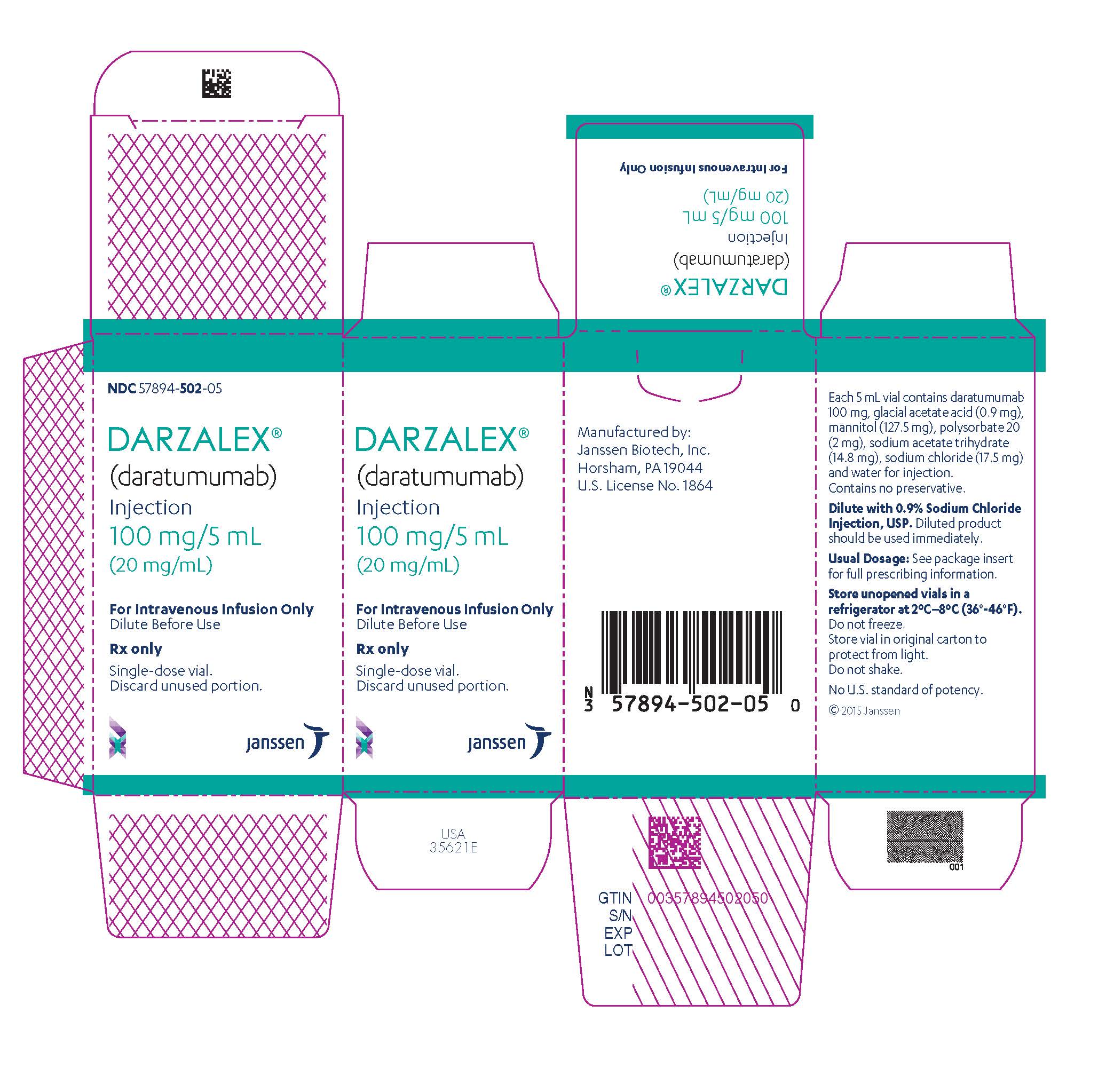
20 ML daratumumab 20 MG/ML Injection
Managing this medication for someone you care for? Eleplan keeps diagnoses, medications and appointments in one plan.
Start free with EleplanClinical drug
20 ML daratumumab 20 MG/ML Injection
20 MG/ML · Injection · injection
A form of daratumumab →
20 ML daratumumab 20 MG/ML Injection — CD38 (Clusters of Differentiation 38) inhibitors. INDICATIONS AND USAGE DARZALEX is indicated for the treatment of adult patients with multiple myeloma: in combination with lenalidomide and…
Active ingredient
Classification
CD38 (Clusters of Differentiation 38) inhibitorsCD38-directed Cytolytic Antibody
Drug interactions
Daratumumab can interfere with certain laboratory tests, affecting the accuracy of results.
- unknownindirect antiglobulin tests — interference with compatibility testing
- moderateserum protein electrophoresis and immunofixation tests — false positive assay results
Indications
INDICATIONS AND USAGE DARZALEX is indicated for the treatment of adult patients with multiple myeloma: in combination with lenalidomide and dexamethasone in newly diagnosed patients who are ineligible for autologous stem cell transplant and in patients with relapsed or refractory multiple myeloma who have received at least one prior therapy. in combination with bortezomib, melphalan and prednisone in newly diagnosed patients who are ineligible for autologous stem cell transplant. in combination with bortezomib, thalidomide, and dexamethasone in newly diagnosed patients who are eligible for autologous stem cell transplant. in combination with bortezomib and dexamethasone in patients who have received at least one prior therapy. in combination with carfilzomib and dexamethasone in patients with relapsed or refractory multiple myeloma who have received one to three prior lines of therapy. in combination with pomalidomide and dexamethasone in patients who have received at least two prior therapies including lenalidomide and a proteasome inhibitor. as monotherapy, in patients who have received at least three prior lines of therapy including a proteasome inhibitor (PI) and an immunomodulatory agent or who are double-refractory to a PI and an immunomodulatory agent. DARZALEX is a CD38-directed cytolytic antibody indicated for the treatment of adult patients with multiple myeloma: in combination with lenalidomide and dexamethasone in newly diagnosed patients who are ineligible for autologous stem cell transplant and in patients with relapsed or refractory multiple myeloma who have received at least one prior therapy in combination with bortezomib, melphalan and prednisone in newly diagnosed patients who are ineligible for autologous stem cell transplant in combination with bortezomib, thalidomide, and dexamethasone in newly diagnosed patients who are eligible for autologous stem cell transplant in combination with bortezomib and dexamethasone in patients who have received at least one prior therapy in combination with carfilzomib and dexamethasone in patients with relapsed or refractory multiple myeloma who have received one to three prior lines of therapy in combination with pomalidomide and dexamethasone in patients who have received at least two prior therapies including lenalidomide and a proteasome inhibitor as monotherapy, in patients who have received at least three prior lines of therapy including a proteasome inhibitor (PI) and an immunomodulatory agent or who are double-refractory to a PI and an immunomodulatory agent. ( 1 )
Dosage
DOSAGE AND ADMINISTRATION Pre-medicate with corticosteroids, antipyretics and antihistamines. ( 2.3 ) Dilute and administer as an intravenous infusion. ( 2.5 ) Recommended dose is 16 mg/kg actual body weight. See full prescribing information for drugs used in combination and schedule. ( 2.2 ) Administer post-infusion medications. ( 2.3 ) 2.1 Important Dosing Information Administer pre-infusion and post-infusion medications [see Dosage and Administration (2.3) ] . Administer only as an intravenous infusion after dilution in 0.9% Sodium Chloride Injection [see Dosage and Administration (2.5) ]. DARZALEX should be administered by a healthcare provider, with immediate access to emergency equipment and appropriate medical support to manage infusion-related reactions if they occur [see Warnings and Precautions (5.1) ]. Type and screen patients prior to starting DARZALEX [see Warnings and Precautions (5.2) ] . 2.2 Recommended Dosage Monotherapy and In Combination with Lenalidomide (D-Rd) or Pomalidomide (D-Pd) and Dexamethasone The DARZALEX dosing schedule in Table 1 is for combination therapy (4-week cycle regimens) and monotherapy as follows: - combination therapy with lenalidomide and low-dose dexamethasone for newly diagnosed patients ineligible for autologous stem cell transplant (ASCT) and in patients with relapsed/refractory multiple myeloma - combination therapy with pomalidomide and low-dose dexamethasone for patients with relapsed/refractory multiple myeloma - monotherapy for patients with relapsed/refractory multiple myeloma. The recommended dose of DARZALEX is 16 mg/kg actual body weight administered as an intravenous infusion according to the following dosing schedule: Table 1: DARZALEX Dosing Schedule in Combination With Lenalidomide or Pomalidomide (4-Week Cycle) and Low-Dose Dexamethasone and for Monotherapy Weeks Schedule Weeks 1 to 8 weekly (total of 8 doses) Weeks 9 to 24 First dose of the every-2-week dosing schedule is given at Week 9 every two weeks (total of 8 doses) Week 25 onwards until disease progression First dose of the every-4-week dosing schedule is given at Week 25 every four weeks For dosing instructions of combination agents administered with DARZALEX, see Clinical Studies (14) and manufacturer's prescribing information. In Combination with Bortezomib, Melphalan and Prednisone (D-VMP) The DARZALEX dosing schedule in Table 2 is for combination therapy with bortezomib, melphalan and prednisone (6-week cycle regimen) for patients with newly diagnosed multiple myeloma ineligible for ASCT. The recommended dose of DARZALEX is 16 mg/kg actual body weight administered as an intravenous infusion according to the following dosing schedule: Table 2: DARZALEX Dosing Schedule in Combination With Bortezomib, Melphalan and Prednisone ([VMP], 6-Week Cycle) Weeks Schedule Weeks 1 to 6 weekly (total of 6 doses) Weeks 7 to 54 First dose of the every-3-week dosing schedule is given at Week 7 every three weeks (total of 16 doses) Week 55 onwards until disease progression First dose of the every-4-week dosing schedule is given at Week 55 every four weeks For dosing instructions of combination agents administered with DARZALEX see Clinical Studies (14.1) . In Combination with Bortezomib, Thalidomide and Dexamethasone (D-VTd) The DARZALEX dosing schedule in Table 3 is for combination therapy with bortezomib, thalidomide, and dexamethasone (4-week cycle regimen) for patients with newly diagnosed multiple myeloma eligible for ASCT. The recommended dose of DARZALEX is 16 mg/kg actual body weight administered as an intravenous infusion according to the following dosing schedule: Table 3: DARZALEX Dosing Schedule in Combination With Bortezomib, Thalidomide and Dexamethasone ([VTd]; 4-Week Cycle) Treatment phase Weeks Schedule Induction Weeks 1 to 8 weekly (total of 8 doses) Weeks 9 to 16 First dose of the every-2-week dosing schedule is given at Week 9 every two weeks (total of 4 doses) Stop for high dose chemotherapy and ASCT Consolidation Weeks 1 to 8 First dose of the every-2-week dosing schedule is given at Week 1 upon re-initiation of treatment following ASCT every two weeks (total of 4 doses) For dosing instructions of combination agents administered with DARZALEX, see Clinical Studies (14.1) and the manufacturer's prescribing information. In Combination with Bortezomib and Dexamethasone (D-Vd) The DARZALEX dosing schedule in Table 4 is for combination therapy with bortezomib and dexamethasone (3-week cycle) for patients with relapsed/refractory multiple myeloma. The recommended dose of DARZALEX is 16 mg/kg actual body weight administered as an intravenous infusion according to the following dosing schedule: Table 4: DARZALEX Dosing Schedule With Bortezomib and Dexamethasone (3-Week Cycle) Weeks Schedule Weeks 1 to 9 weekly (total of 9 doses) Weeks 10 to 24 First dose of the every-3-week dosing schedule is given at Week 10 every three weeks (total of 5 doses) Week 25 onwards until disease progression First dose of the every-4-week dosing schedule is given at Week 25 every four weeks For dosing instructions of combination agents administered with DARZALEX see Clinical Studies (14.2) and manufacturer's prescribing information . In Combination with Carfilzomib and Dexamethasone (DKd) The recommended dosage for DARZALEX when administered in combination with carfilzomib and dexamethasone (4-week cycle) for patients with relapsed/refractory multiple myeloma is provided in Table 5. Table 5: DARZALEX Dosing Schedule With Carfilzomib and Dexamethasone (4-Week Cycle) Weeks DARZALEX Dose Based on actual body weight Schedule Week 1 8 mg/kg days 1 and 2 (total 2 doses) Weeks 2 to 8 16 mg/kg weekly (total of 7 doses) Weeks 9 to 24 First dose of the every-2-week dosing schedule is given at Week 9 16 mg/kg every two weeks (total of 8 doses) Week 25 onwards until disease progression First dose of the every-4-week dosing schedule is given at Week 25 16 mg/kg every four weeks For dosing instructions of combination agents administered with DARZALEX see Clinical Studies (14.2) and manufacturer's prescribing information . Infusion Rates Administer DARZALEX intravenously at the infusion rate described below in Table 6. Consider incremental escalation of the infusion rate only in the absence of infusion-related reactions. The recommended dose of 16 mg/kg to be administered on Day 1 when DARZALEX is administered as monotherapy or in combination may be split over two consecutive days, such that an 8 mg/kg dose is administered on Day 1 and Day 2, respectively. Table 6: Infusion Rates for DARZALEX (16 mg/kg) Administration Dilution volume Initial rate (first hour) Rate increment Consider incremental escalation of the infusion rate only in the absence of infusion-related reactions. Maximum rate Week 1 Infusion Option 1 (Single dose infusion) Week 1 Day 1 (16 mg/kg) 1,000 mL 50 mL/hour 50 mL/hour every hour 200 mL/hour Option 2 (Split dose infusion) Week 1 Day 1 (8 mg/kg) 500 mL 50 mL/hour 50 mL/hour every hour 200 mL/hour Week 1 Day 2 (8 mg/kg) 500 mL 50 mL/hour 50 mL/hour every hour 200 mL/hour Week 2 (16 mg/kg) Use a dilution volume of 500 mL for the 16 mg/kg dose only if there were no infusion-related reactions the previous week. Otherwise, use a dilution volume of 1,000 mL. 500 mL 50 mL/hour 50 mL/hour every hour 200 mL/hour Week 3 onwards (16 mg/kg) Use a modified initial rate (100 mL/hour) for subsequent infusions (i.e. Week 3 onwards) only if there were no infusion-related reactions during the previous infusion. Otherwise, continue to use instructions indicated in the table for the Week 2 infusion rate. 500 mL 100 mL/hour 50 mL/hour every hour 200 mL/hour Missed DARZALEX Doses If a dose of DARZALEX is missed, administer the dose as soon as possible and adjust the dosing schedule to maintain the dosing interval. 2.3 Recommended Concomitant Medications Pre-infusion Medication Administer the following pre-infusion medications 1 hour to 3 hours before every DARZALEX inf
Warnings
WARNINGS AND PRECAUTIONS Infusion-related reactions : Interrupt DARZALEX infusion for infusion-related reactions of any severity. Permanently discontinue the infusion in case of anaphylactic reactions or life-threatening infusion-related reactions and institute appropriate emergency care. ( 2.4 , 5.1 ) Interference with cross-matching and red blood cell antibody screening : Type and screen patients prior to starting treatment. Inform blood banks that a patient has received DARZALEX. ( 5.2 , 7.1 ) Infections : DARZALEX can cause serious and fatal infections. Monitor patients for signs and symptoms of infection and treat appropriately. ( 5.3 ) Neutropenia : Monitor complete blood cell counts periodically during treatment. Monitor patients with neutropenia for signs of infection. Dose delay may be required to allow recovery of neutrophils. ( 5.4 ) Thrombocytopenia : Monitor complete blood cell counts periodically during treatment. Dose delay may be required to allow recovery of platelets. ( 5.5 ) Embryo-Fetal Toxicity : Can cause fetal harm. Advise pregnant women of the potential risk to a fetus and advise females of reproductive potential to use effective contraception. ( 5.7 , 8.1 , 8.3 ) 5.1 Infusion-Related Reactions DARZALEX can cause severe and/or serious infusion-related reactions including anaphylactic reactions. These reactions can be life-threatening and fatal outcomes have been reported [see Adverse Reactions (6.2) ] . In clinical trials (monotherapy and combination: N=2,066), infusion-related reactions occurred in 37% of patients with the Week 1 (16 mg/kg) infusion, 2% with the Week 2 infusion, and cumulatively 6% with subsequent infusions. Less than 1% of patients had a Grade 3/4 infusion-related reaction at Week 2 or subsequent infusions. The median time to onset was 1.5 hours (range: 0 to 73 hours). The incidence of infusion modification due to reactions was 36%. Median durations of 16 mg/kg infusions for the Week 1, Week 2, and subsequent infusions were approximately 7, 4, and 3 hours respectively. Nearly all reactions occurred during infusion or within 4 hours of completing DARZALEX. Prior to the introduction of post-infusion medication in clinical trials, infusion-related reactions occurred up to 48 hours after infusion. Severe reactions have occurred, including bronchospasm, hypoxia, dyspnea, hypertension, tachycardia, headache, laryngeal edema, pulmonary edema, and ocular adverse reactions, including choroidal effusion, acute myopia, and acute angle closure glaucoma. Signs and symptoms may include respiratory symptoms, such as nasal congestion, cough, throat irritation, as well as chills, vomiting and nausea. Less common signs and symptoms were wheezing, allergic rhinitis, pyrexia, chest discomfort, pruritus, hypotension, and blurred vision [see Adverse Reactions (6.1) ] . When DARZALEX dosing was interrupted in the setting of ASCT (CASSIOPEIA) for a median of 3.75 months (range: 2.4 to 6.9 months), upon re-initiation of DARZALEX, the incidence of infusion-related reactions was 11% for the first infusion following ASCT. Infusion rate/dilution volume used upon re-initiation was that used for the last DARZALEX infusion prior to interruption for ASCT. Infusion-related reactions occurring at re-initiation of DARZALEX following ASCT were consistent in terms of symptoms and severity (Grade 3 or 4: <1%) with those reported in previous studies at Week 2 or subsequent infusions. In EQUULEUS, patients receiving combination treatment (n=97) were administered the first 16 mg/kg dose at Week 1 split over two days i.e. 8 mg/kg on Day 1 and Day 2, respectively. The incidence of any grade infusion-related reactions was 42%, with 36% of patients experiencing infusion-related reactions on Day 1 of Week 1, 4% on Day 2 of Week 1, and 8% with subsequent infusions. The median time to onset of a reaction was 1.8 hours (range: 0.1 to 5.4 hours). The incidence of infusion interruptions due to reactions was 30%. Median durations of infusions were 4.2 hours for Week 1-Day 1, 4.2 hours for Week 1-Day 2, and 3.4 hours for the subsequent infusions. Pre-medicate patients with antihistamines, antipyretics and corticosteroids. Frequently monitor patients during the entire infusion [see Dosage and Administration (2.3) ] . Interrupt DARZALEX infusion for reactions of any severity and institute medical management as needed. Permanently discontinue DARZALEX therapy if an anaphylactic reaction or life-threatening (Grade 4) reaction occurs and institute appropriate emergency care. For patients with Grade 1, 2, or 3 reactions, reduce the infusion rate when re-starting the infusion [see Dosage and Administration (2.4) ] . To reduce the risk of delayed infusion-related reactions, administer oral corticosteroids to all patients following DARZALEX infusions [see Dosage and Administration (2.3) ] . Patients with a history of chronic obstructive pulmonary disease may require additional post-infusion medications to manage respiratory complications. Consider prescribing short- and long-acting bronchodilators and inhaled corticosteroids for patients with chronic obstructive pulmonary disease [see Dosage and Administration (2.3) ] . Ocular adverse reactions, including acute myopia and narrowing of the anterior chamber angle due to ciliochoroidal effusions with potential for increased intraocular pressure or glaucoma, have occurred with DARZALEX infusion. If ocular symptoms occur, interrupt DARZALEX infusion and seek immediate ophthalmologic evaluation prior to restarting DARZALEX. 5.2 Interference with Serological Testing Daratumumab binds to CD38 on red blood cells (RBCs) and results in a positive Indirect Antiglobulin Test (Indirect Coombs test). Daratumumab-mediated positive indirect antiglobulin test may persist for up to 6 months after the last daratumumab infusion. Daratumumab bound to RBCs masks detection of antibodies to minor antigens in the patient's serum [see References (15) ] . The determination of a patient's ABO and Rh blood type are not impacted [see Drug Interactions (7.1) ] . Notify blood transfusion centers of this interference with serological testing and inform blood banks that a patient has received DARZALEX. Type and screen patients prior to starting DARZALEX [see Dosage and Administration (2.1) ] . 5.3 Infections DARZALEX can cause serious, life-threatening, or fatal infections. In patients who received DARZALEX in a pooled safety population (N=2066), serious infections, including opportunistic infections, occurred in 22.6% of patients, Grade 3 or 4 infections occurred in 24.3%, and fatal infections occurred in 1.2%. The most common (≥2%) types of serious infection reported were pneumonia (11%), upper respiratory tract infection (4%), sepsis (3%), and bronchitis (2%). Monitor patients for signs and symptoms of infection prior to and during treatment with DARZALEX and treat appropriately. Administer prophylactic antimicrobials according to guidelines [see Dosage and Administration (2.3) ] . 5.4 Neutropenia DARZALEX may increase neutropenia induced by background therapy [see Adverse Reactions (6.1) ]. Monitor complete blood cell counts periodically during treatment according to manufacturer's prescribing information for background therapies. Monitor patients with neutropenia for signs of infection. Consider withholding DARZALEX until recovery of neutrophils. 5.5 Thrombocytopenia DARZALEX may increase thrombocytopenia induced by background therapy [see Adverse Reactions (6.1) ]. Monitor complete blood cell counts periodically during treatment according to manufacturer's prescribing information for background therapies. Consider withholding DARZALEX until recovery of platelets. 5.6 Interference with Determination of Complete Response Daratumumab is a human IgG kappa monoclonal antibody that can be detected on both, the serum protein electrophoresis (SPE) and immunofixation (IFE) assays used for the clinical monitoring of endogenous M-protein [see Drug Interacti
Contraindications
CONTRAINDICATIONS DARZALEX is contraindicated in patients with a history of severe hypersensitivity (e.g. anaphylactic reactions) to daratumumab or any of the components of the formulation [see Warnings and Precautions (5.1) ] . Patients with a history of severe hypersensitivity to daratumumab or any of the components of the formulation. ( 4 )
Mechanism of action
Mechanism of Action CD38 is a transmembrane glycoprotein (48 kDa) expressed on the surface of hematopoietic cells, including multiple myeloma and other cell types and tissues and has multiple functions, such as receptor mediated adhesion, signaling, and modulation of cyclase and hydrolase activity. Daratumumab is an IgG1κ human monoclonal antibody (mAb) that binds to CD38 and inhibits the growth of CD38 expressing tumor cells by inducing apoptosis directly through Fc mediated cross linking as well as by immune-mediated tumor cell lysis through complement dependent cytotoxicity (CDC), antibody dependent cell mediated cytotoxicity (ADCC) and antibody dependent cellular phagocytosis (ADCP). A subset of myeloid derived suppressor cells (CD38+MDSCs), regulatory T cells (CD38+T regs ) and B cells (CD38+B regs ) are decreased by daratumumab.
Indicated ICD-10 codes
Source: RxNorm + openFDA + RxClass + FAERS · 2026
Look up another medication