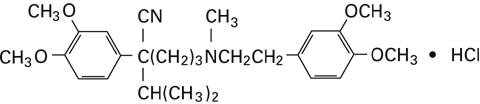
24 HR verapamil hydrochloride 200 MG Extended Release Oral Capsule — Phenylalkylamine derivatives. INDICATIONS AND USAGE Verapamil hydrochloride tablets, USP are indicated for the treatment of the following: Angina 1. Angina at rest including…
Boxed warning
WARNING: FETAL TOXICITY • When pregnancy is detected, discontinue trandolapril and verapamil hydrochloride extended-release tablets as soon as possible. • Drugs that act directly on the renin-angiotensin system can cause injury and death to the developing fetus (see WARNINGS: Fetal Toxicity ) .
unknowndisopyramide — should not be administered within 48 hours before or 24 hours after verapamil administration
moderateflecainide — additive negative inotropic effect and prolongation of atrioventricular conduction
unknownquinidine — potential interactions not fully established
Indications
INDICATIONS AND USAGE Verapamil hydrochloride tablets, USP are indicated for the treatment of the following: Angina 1. Angina at rest including: - Vasospastic (Prinzmetal's variant) angina - Unstable (crescendo, pre-infarction) angina 2. Chronic stable angina (classic effort-associated angina) Arrhythmias In association with digitalis for the control of ventricular rate at rest and during stress in patients with chronic atrial flutter and/or atrial fibrillation (see WARNINGS : Accessory bypass tract) Prophylaxis of repetitive paroxysmal supraventricular tachycardia Essential hypertension Verapamil hydrochloride is indicated for the treatment of hypertension, to lower blood pressure. Lowering blood pressure reduces the risk of fatal and nonfatal cardiovascular events, primarily strokes and myocardial infarctions. These benefits have been seen in controlled trials of antihypertensive drugs from a wide variety of pharmacologic classes, including this drug. Control of high blood pressure should be part of comprehensive cardiovascular risk management, including, as appropriate, lipid control, diabetes management, antithrombotic therapy, smoking cessation, exercise, and limited sodium intake. Many patients will require more than one drug to achieve blood pressure goals. For specific advice on goals and management, see published guidelines, such as those of the National High Blood Pressure Education Program's Joint National Committee on Prevention, Detection, Evaluation, and Treatment of High Blood Pressure (JNC). Numerous antihypertensive drugs, from a variety of pharmacologic classes and with different mechanisms of action, have been shown in randomized controlled trials to reduce cardiovascular morbidity and mortality, and it can be concluded that it is blood pressure reduction, and not some other pharmacologic property of the drugs, that is largely responsible for those benefits. The largest and most consistent cardiovascular outcome benefit has been a reduction in the risk of stroke, but reductions in myocardial infarction and cardiovascular mortality also have been seen regularly. Elevated systolic or diastolic pressure causes increased cardiovascular risk, and the absolute risk increase per mmHg is greater at higher blood pressures, so that even modest reductions of severe hypertension can provide substantial benefit. Relative risk reduction from blood pressure reduction is similar across populations with varying absolute risk, so the absolute benefit is greater in patients who are at higher risk independent of their hypertension (for example, patients with diabetes or hyperlipidemia), and such patients would be expected to benefit from more aggressive treatment to a lower blood pressure goal. Some antihypertensive drugs have smaller blood pressure effects (as monotherapy) in black patients, and many antihypertensive drugs have additional approved indications and effects (e.g., on angina, heart failure, or diabetic kidney disease). These considerations may guide selection of therapy.
Dosage
DOSAGE AND ADMINISTRATION THE CONTENTS OF THE Verapamil Hydrochloride Extended-release Capsules (PM) CAPSULE SHOULD NOT BE CRUSHED OR CHEWED. Verapamil Hydrochloride Extended-release Capsules (PM) CAPSULES ARE TO BE SWALLOWED WHOLE OR THE ENTIRE CONTENTS OF THE CAPSULE SPRINKLED ONTO APPLESAUCE. Do not crush or chew capsule contents; swallow capsule whole or sprinkle entire contents onto applesauce ( 2.2 , 17 ) Usual dosage: 200 mg once daily at bedtime; if inadequate response, titrate upward to 300 mg, then 400 mg once daily at bedtime ( 2.1 ) Initial dose of 100 mg once daily at bedtime in patients with renal or hepatic impairment, elderly or low-weight patients ( 2.1 ) 2.1 Essential Hypertension Administer Verapamil Hydrochloride Extended-release Capsules (PM) once daily at bedtime. Clinical trials studied doses of 100 mg, 200 mg, 300 mg, and 400 mg. The usual daily dose of extended-release Verapamil Hydrochloride Extended-release Capsules (PM) in clinical trials has been 200 mg given by mouth once daily at bedtime. In rare instances, initial doses of 100 mg a day may be warranted in patients who have an increased response to verapamil [e.g. patients with impaired renal function, impaired hepatic function, elderly, low-weight patients, etc. ( see Use in Specific Populations ( 8.5 , 8.6 , 8.7 ) )]. Base upward titration on therapeutic efficacy and safety evaluated approximately 24 hours after dosing. The antihypertensive effects of Verapamil Hydrochloride Extended-release Capsules (PM) are evident within the first week of therapy. If an adequate response is not obtained with 200 mg of Verapamil Hydrochloride Extended-release Capsules (PM), the dose may be titrated upward in the following manner: a) 300 mg each evening b) 400 mg each evening (2 × 200 mg) When Verapamil Hydrochloride Extended-release Capsules (PM) is administered at bedtime, office evaluation of blood pressure during morning and early afternoon hours is essentially a measure of peak effect. The usual evaluation of trough effect, which sometimes might be needed to evaluate the appropriateness of any given dose of Verapamil Hydrochloride Extended-release Capsules (PM), would be just prior to bedtime. 2.2 Sprinkling the Capsule Contents on Food Verapamil Hydrochloride Extended-release Capsules (PM) capsules may also be administered by carefully opening the capsule and sprinkling the pellets onto one tablespoonful of applesauce. Swallow the applesauce immediately without chewing and follow with a glass of cool water to ensure complete swallowing of the pellets. The applesauce used should not be hot and it should be soft enough to be swallowed without chewing. Use any pellet/applesauce mixture immediately and do not store for future use. Absorption of the pellets sprinkled onto other foods has not been tested. This method of administration may be beneficial for patients who have difficulty swallowing whole capsules. Subdividing the contents of a Verapamil Hydrochloride Extended-release Capsules (PM) capsule is not recommended.
Warnings
WARNINGS Heart Failure Verapamil Component Verapamil has a negative inotropic effect which, in most patients, is compensated by its afterload reduction (decreased systemic vascular resistance) properties without a net impairment of ventricular performance. In clinical experience with 4,954 patients, 87 (1.8%) developed congestive heart failure or pulmonary edema. Verapamil should be avoided in patients with severe left ventricular dysfunction (e.g., ejection fraction less than 30%, pulmonary wedge pressure above 20 mmHg, or severe symptoms of cardiac failure) and in patients with any degree of ventricular dysfunction if they are receiving a beta adrenergic blocker (see PRECAUTIONS - Drug Interactions ). Patients with milder ventricular dysfunction should, if possible, be controlled with optimum doses of digitalis and/or diuretics before verapamil treatment (Note interactions with digoxin under: PRECAUTIONS ). Trandolapril Component Trandolapril, as an ACE inhibitor, may cause excessive hypotension in patients with congestive heart failure (see WARNINGS - Hypotension ). Hypotension Verapamil Component Occasionally, the pharmacologic action of verapamil may produce a decrease in blood pressure below normal levels which may result in dizziness or symptomatic hypotension. Trandolapril Component Trandolapril can cause symptomatic hypotension. Like other ACE inhibitors, trandolapril has only rarely been associated with symptomatic hypotension in uncomplicated hypertensive patients. Symptomatic hypotension is most likely to occur in patients who are salt- or volume-depleted as a result of prolonged treatment with diuretics, dietary salt restriction, dialysis, diarrhea, or vomiting. Volume and/or salt depletion should be corrected before initiating treatment with trandolapril (see PRECAUTIONS - Drug Interactions and ADVERSE REACTIONS ). In controlled studies, hypotension was observed in 0.6% of patients receiving any combination of trandolapril and verapamil hydrochloride extended-release. In patients with concomitant congestive heart failure, with or without associated renal insufficiency, ACE inhibitor therapy may cause excessive hypotension, which may be associated with oliguria or azotemia, and, rarely, with acute renal failure and death (see DOSAGE AND ADMINISTRATION ). If symptomatic hypotension occurs, the patient should be placed in the supine position and, if necessary, normal saline may be administered intravenously. A transient hypotensive response is not a contraindication to further doses; however, lower doses of verapamil HCl extended-release and/or trandolapril or reduced concomitant diuretic therapy should be considered. Elevated Liver Enzymes/Hepatic Failure Verapamil Component Elevations of transaminases with and without concomitant elevations in alkaline phosphatase and bilirubin have been reported. Such elevations have sometimes been transient and may disappear even in the face of continued verapamil treatment. Several cases of hepatocellular injury related to verapamil have been proven by rechallenge; half of these had clinical symptoms (malaise, fever, and/or right upper quadrant pain) in addition to elevations of SGOT, SGPT, and alkaline phosphatase. Trandolapril Component ACE inhibitors rarely have been associated with a syndrome of cholestatic jaundice, fulminant hepatic necrosis, and death. The mechanism of this syndrome is not understood. Patients receiving ACE inhibitors who develop jaundice should discontinue the ACE inhibitor and receive appropriate medical follow-up. Liver abnormalities were noted in 3.2% of patients taking any of several combinations of trandolapril/verapamil doses. Periodic monitoring of liver function in patients taking trandolapril and verapamil hydrochloride extended-release tablets is therefore prudent. Accessory Bypass Tract (Wolff-Parkinson-White or Lown-Ganong-Levine Syndromes) Verapamil Component Some patients with paroxysmal and/or chronic atrial fibrillation or atrial flutter and a coexisting accessory AV pathway have developed increased antegrade conduction across the accessory pathway bypassing the AV node, producing a very rapid ventricular response or ventricular fibrillation after receiving intravenous verapamil (or digitalis). Although a risk of this occurring with oral verapamil has not been established, such patients receiving oral verapamil may be at risk and its use in these patients is contraindicated (see CONTRAINDICATIONS ). Treatment is usually DC-cardioversion. Cardioversion has been used safely and effectively after oral verapamil. Atrioventricular Block Verapamil Component The effect of verapamil on AV conduction and the SA node may lead to asymptomatic first-degree AV block and transient bradycardia, sometimes accompanied by nodal escape rhythms. PR interval prolongation is correlated with verapamil plasma concentrations, especially during the early titration phases of therapy. Higher degrees of AV block, however, were infrequently (0.8%) observed. Marked first-degree block or progressive development to second- or third-degree AV block requires a reduction in dosage or, in rare instances, discontinuation of verapamil hydrochloride and institution of appropriate therapy depending upon the clinical situation. Patients with Hypertrophic Cardiomyopathy (IHSS) Verapamil Component In 120 patients with hypertrophic cardiomyopathy (most of them refractory or intolerant to propranolol) who received therapy with verapamil at doses up to 720 mg/day, a variety of serious adverse effects were seen. Three patients died in pulmonary edema; all had severe left ventricular outflow obstruction and a past history of left ventricular dysfunction. Eight other patients had pulmonary edema and/or severe hypotension; abnormally high (over 20 mmHg) capillary wedge pressure and a marked left ventricular outflow obstruction were present in most of these patients. Sinus bradycardia occurred in 11% of the patients, second-degree AV block in 4% and sinus arrest in 2%. It must be appreciated that this group of patients had a serious disease with a high mortality rate. Most adverse effects responded well to dose reduction and only rarely did verapamil have to be discontinued. Anaphylactoid and Possibly Related Reactions Presumably because angiotensin-converting enzyme inhibitors affect the metabolism of eicosanoids and polypeptides, including endogenous bradykinin, patients receiving ACE inhibitors, including trandolapril may be subject to a variety of adverse reactions, some of them serious. Angioedema Angioedema of the face, extremities, lips, tongue, glottis, and larynx has been reported in patients treated with ACE inhibitors including trandolapril. Symptoms suggestive of angioedema or facial edema occurred in 0.13% of trandolapril-treated patients. Two of the four cases were life-threatening and resolved without treatment or with medication (corticosteroids). Angioedema associated with laryngeal edema can be fatal. If laryngeal stridor or angioedema of the face, tongue or glottis occurs, treatment with trandolapril and verapamil hydrochloride extended-release tablets should be discontinued immediately, the patient treated in accordance with accepted medical care and carefully observed until the swelling disappears. In instances where swelling is confined to the face and lips, the condition generally resolves without treatment; antihistamines may be useful in relieving symptoms. Where there is involvement of the tongue, glottis, or larynx, likely to cause airway obstruction, emergency therapy, including but not limited to subcutaneous epinephrine solution 1:1,000 (0.3 to 0.5 mL) should be promptly administered (see PRECAUTIONS and ADVERSE REACTIONS ). Patients receiving coadministration of an ACE inhibitor with an mTOR (mammalian target of rapamycin) inhibitor (e.g., temsirolimus, sirolimus, everolimus) or a neprilysin inhibitor (e.g., sacubitril) may be at increased risk for angioedema. Anaphylactoid React
Contraindications
CONTRAINDICATIONS Trandolapril and verapamil hydrochloride extended-release tablets are contraindicated in patients who are hypersensitive to any ACE inhibitor or verapamil. Because of the verapamil component, trandolapril and verapamil hydrochloride extended-release tablets are contraindicated in: 1. Severe left ventricular dysfunction (see WARNINGS ). 2. Hypotension (systolic pressure less than 90 mmHg) or cardiogenic shock. 3. Sick sinus syndrome (except in patients with a functioning artificial ventricular pacemaker). 4. Second- or third-degree AV block (except in patients with a functioning artificial ventricular pacemaker). 5. Patients with atrial flutter or atrial fibrillation and an accessory bypass tract (e.g. Wolff-Parkinson-White, Lown-Ganong-Levine syndromes) (see WARNINGS ). 6. Patients taking flibanserin (see PRECAUTIONS - Drug Interactions ). Because of the trandolapril component, trandolapril and verapamil hydrochloride extended-release tablets are contraindicated in patients with a history of angioedema related to previous treatment with an angiotensin converting enzyme (ACE) inhibitor. Do not co-administer aliskiren with trandolapril and verapamil hydrochloride extended-release tablets in patients with diabetes (see PRECAUTIONS - Drug Interactions ). Trandolapril and verapamil hydrochloride extended-release tablets are contraindicated in combination with a neprilysin inhibitor (e.g., sacubitril). Do not administer trandolapril and verapamil hydrochloride extended-release tablets within 36 hours of switching to or from sacubitril/valsartan, a neprilysin inhibitor (see WARNINGS ).
Mechanism of action
CLINICAL PHARMACOLOGY Verapamil HCl is a calcium ion influx inhibitor (slow-channel blocker or calcium ion antagonist) that exerts its pharmacologic effects by modulating the influx of ionic calcium across the cell membrane of the arterial smooth muscle as well as in conductile and contractile myocardial cells. Mechanism of action Essential hypertension: Verapamil exerts antihypertensive effects by decreasing systemic vascular resistance, usually without orthostatic decreases in blood pressure or reflex tachycardia; bradycardia (rate less than 50 beats/min) is uncommon (1.4%). During isometric or dynamic exercise, verapamil hydrochloride does not alter systolic cardiac function in patients with normal ventricular function. Verapamil hydrochloride does not alter total serum calcium levels. However, one report suggested that calcium levels above the normal range may alter the therapeutic effect of verapamil hydrochloride. Other pharmacologic actions of verapamil hydrochloride include the following: Verapamil hydrochloride dilates the main coronary arteries and coronary arterioles, both in normal and ischemic regions, and is a potent inhibitor of coronary artery spasm, whether spontaneous or ergonovine-induced. This property increases myocardial oxygen delivery in patients with coronary artery spasm and is responsible for the effectiveness of verapamil hydrochloride in vasospastic (Prinzmetal's or variant) as well as unstable angina at rest. Whether this effect plays any role in classical effort angina is not clear, but studies of exercise tolerance have not shown an increase in the maximum exercise rate–pressure product, a widely accepted measure of oxygen utilization. This suggests that, in general, relief of spasm or dilation of coronary arteries is not an important factor in classical angina. Verapamil hydrochloride regularly reduces the total systemic resistance (afterload) against which the heart works both at rest and at a given level of exercise by dilating peripheral arterioles. Electrical activity through the AV node depends, to a significant degree, upon calcium influx through the slow channel. By decreasing the influx of calcium, verapamil hydrochloride prolongs the effective refractory period within the AV node and slows AV conduction in a rate-related manner. Normal sinus rhythm is usually not affected, but in patients with sick sinus syndrome, verapamil hydrochloride may interfere with sinus-node impulse generation and may induce sinus arrest or sinoatrial block. Atrioventricular block can occur in patients without preexisting conduction defects (see WARNINGS ). Verapamil hydrochloride does not alter the normal atrial action potential or intraventricular conduction time, but depresses amplitude, velocity of depolarization, and conduction in depressed atrial fibers. Verapamil hydrochloride may shorten the antegrade effective refractory period of the accessory bypass tract. Acceleration of ventricular rate and/or ventricular fibrillation has been reported in patients with atrial flutter or atrial fibrillation and a coexisting accessory AV pathway following administration of verapamil (see WARNINGS ). Verapamil hydrochloride has a local anesthetic action that is 1.6 times that of procaine on an equimolar basis. It is not known whether this action is important at the doses used in man. Ph armaco kinetics and metabolism: With the immediate-release formulation, more than 90% of the orally administered dose of verapamil hydrochloride is absorbed. Because of rapid biotransformation of verapamil during its first pass through the portal circulation, bioavailability ranges from 20% to 35%. Peak plasma concentrations are reached between 1 and 2 hours after oral administration. Chronic oral administration of 120 mg of verapamil HCl every 6 hours resulted in plasma levels of verapamil ranging from 125 to 400 ng/mL, with higher values reported occasionally. A nonlinear correlation between the verapamil dose administered and verapamil plasma level does exist. In early dose titration with verapamil, a relationship exists between verapamil plasma concentration and prolongation of the PR interval. However, during chronic administration this relationship may disappear. The mean elimination half-life in single-dose studies ranged from 2.8 to 7.4 hours. In these same studies, after repetitive dosing, the half-life increased to a range from 4.5 to 12.0 hours (after less than 10 consecutive doses given 6 hours apart). Half-life of verapamil may increase during titration. No relationship has been established between the plasma concentration of verapamil and a reduction in blood pressure. Aging may affect the pharmacokinetics of verapamil. Elimination half-life may be prolonged in the elderly. In multiple-dose studies under fasting conditions, the bioavailability, measured by AUC, of verapamil hydrochloride extended-release tablets was similar to verapamil hydrochloride tablets (immediate release); rates of absorption were of course different. In a randomized, single-dose, crossover study using healthy volunteers, administration of 240 mg verapamil hydrochloride extended-release tablets with food produced peak plasma verapamil concentrations of 79 ng/mL; time to peak plasma verapamil concentration of 7.71 hours; and AUC (0–24 hr) of 841 ng∙hr/mL. When verapamil hydrochloride extended-release tablets was administered to fasting subjects, peak plasma verapamil concentration was 164 ng/mL; time to peak plasma verapamil concentration was 5.21 hours; and AUC (0–24 hr) was 1,478 ng∙hr/mL. Similar results were demonstrated for plasma norverapamil. Food thus produces decreased bioavailability (AUC) but a narrower peak-to-trough ratio. Good correlation of dose and response is not available, but controlled studies of verapamil hydrochloride extended-release tablets have shown effectiveness of doses similar to the effective doses of verapamil hydrochloride tablets (immediate release). In healthy men, orally administered verapamil hydrochloride undergoes extensive metabolism in the liver. Twelve metabolites have been identified in plasma; all except norverapamil are present in trace amounts only. Norverapamil can reach steady-state plasma concentrations approximately equal to those of verapamil itself. The cardiovascular activity of norverapamil appears to be approximately 20% that of verapamil. Approximately 70% of an administered dose is excreted as metabolites in the urine and 16% or more in the feces within 5 days. About 3% to 4% is excreted in the urine as unchanged drug. Approximately 90% is bound to plasma proteins. In patients with hepatic insufficiency, metabolism of immediate-release verapamil is delayed and elimination half-life prolonged up to 14 to 16 hours (see PRECAUTIONS ); the volume of distribution is increased and plasma clearance reduced to about 30% of normal. Verapamil clearance values suggest that patients with liver dysfunction may attain therapeutic verapamil plasma concentrations with one third of the oral daily dose required for patients with normal liver function. After four weeks of oral dosing (120 mg q.i.d.), verapamil and norverapamil levels were noted in the cerebrospinal fluid with estimated partition coefficient of 0.06 for verapamil and 0.04 for norverapamil. In ten healthy males, administration of oral verapamil (80 mg every 8 hours for 6 days) and a single oral dose of ethanol (0.8 g/kg) resulted in a 17% increase in mean peak ethanol concentrations (106.45 ± 21.40 to 124.23 ± 24.74 mg∙hr/dL) compared to placebo. The area under the blood ethanol concentration versus time curve (AUC over 12 hours) increased by 30% (365.67 ± 93.52 to 475.07 ± 97.24 mg∙hr/dL). Verapamil AUCs were positively correlated (r=0.71) to increased ethanol blood AUC values (see PRECAUTIONS , Drug interactions ). Hemodynamics and myocardial metabolism: Verapamil hydrochloride reduces afterload and myocardial contractility. Improved left ventricular diastolic functio
A drug lookup is just the start. Eleplan keeps the whole care plan in one place.
Medications, diagnoses, documents, appointments, and the whole care team — organized and always in sync, with Ellie, your AI care assistant, on top of it. Free to start.