500 ML dopamine hydrochloride 0.8 MG/ML Injection
Managing this medication for someone you care for? Eleplan keeps diagnoses, medications and appointments in one plan.
Start free with EleplanClinical drug
500 ML dopamine hydrochloride 0.8 MG/ML Injection
0.8 MG/ML · Injection · injection
A form of dopamine →
500 ML dopamine hydrochloride 0.8 MG/ML Injection — Adrenergic and dopaminergic agents. INDICATIONS AND USAGE Dopamine hydrochloride is indicated for the correction of hemodynamic imbalances present in the shock syndrome due to…
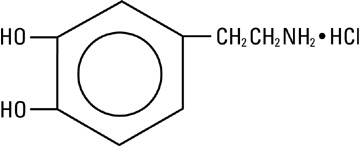
Active ingredient
Classification
Adrenergic and dopaminergic agentsCatecholamine
Drug interactions
Dopamine has several clinically significant drug interactions that may lead to severe cardiovascular effects.
- majorhalogenated anesthetics — may increase cardiac autonomic irritability and lead to ventricular arrhythmias and hypertension
- majorMAO inhibitors — may result in severe hypertension and cardiac arrhythmia
- moderatetricyclic antidepressants — may potentiate the cardiovascular effects of dopamine, such as hypertension
- majorvasopressors — may result in severe hypertension
Indications
INDICATIONS AND USAGE Dopamine hydrochloride is indicated for the correction of hemodynamic imbalances present in the shock syndrome due to myocardial infarctions, trauma, endotoxic septicemia, open heart surgery, renal failure and chronic cardiac decompensation as in congestive failure. Where appropriate, restoration of blood volume with a suitable plasma expander or whole blood should be instituted or completed prior to administration of dopamine hydrochloride. Patients most likely to respond adequately to dopamine hydrochloride are those in whom physiological parameters, such as urine flow, myocardial function and blood pressure have not undergone profound deterioration. Reports indicate that the shorter the time interval between onset of signs and symptoms and initiation of therapy with volume correction and dopamine hydrochloride, the better the prognosis. Poor Perfusion of Vital Organs Urine flow appears to be one of the better diagnostic signs by which adequacy of vital organ perfusion can be monitored. Nevertheless, the physician should also observe the patient for signs of reversal of confusion or comatose condition. Loss of pallor, increase in toe temperature and/or adequacy of nail bed capillary filling may also be used as indices of adequate dosage. Reported studies indicate that when dopamine hydrochloride is administered before urine flow has diminished to levels of approximately 0.3 mL/minute, prognosis is more favorable. Nevertheless, in a number of oliguric or anuric patients, administration of dopamine hydrochloride has resulted in an increase in urine flow which in some cases reached normal levels. Dopamine hydrochloride may also increase urine flow in patients whose output is within normal limits and thus may be of value in reducing the degree of preexisting fluid accumulation. It should be noted that at doses above those optimal for the individual patient, urine flow may decrease, necessitating reduction of dosage. Concurrent administration of dopamine hydrochloride and diuretic agents may produce an additive or potentiating effect. Low Cardiac Output Increased cardiac output is related to dopamine hydrochloride’s direct inotropic effect on the myocardium. Increased cardiac output at low or moderate doses appears to be related to a favorable prognosis. Increase in cardiac output has been associated with either static or decreased systemic vascular resistance (SVR). Static or decreased SVR associated with low or moderate increments in cardiac output is believed to be a reflection of differential effects on specific vascular beds with increased resistance in peripheral beds (e.g., femoral) and concomitant decreases in mesenteric and renal vascular beds. Redistribution of blood flow parallels these changes so that an increase in cardiac output is accompanied by an increase in mesenteric and renal blood flow. In many instances the renal fraction of the total cardiac output has been found to increase. Increase in cardiac output produced by dopamine hydrochloride is not associated with substantial decreases in systemic vascular resistance as may occur with isoproterenol. Hypotension Hypotension due to inadequate cardiac output can be managed by administration of low to moderate doses of dopamine hydrochloride, which have little effect on SVR. At high therapeutic doses, dopamine hydrochloride’s alpha-adrenergic activity becomes more prominent and thus may correct hypotension due to diminished SVR. As in the case of other circulatory decompensation states, prognosis is better in patients whose blood pressure and urine flow have not undergone profound deterioration. Therefore, it is suggested that the physician administer dopamine hydrochloride as soon as a definite trend toward decreased systolic and diastolic pressure becomes evident.
Dosage
DOSAGE & ADMINISTRATION Do NOT administer if solution is darker than slightly yellow or discolored in any other way. Do NOT administer unless solution is clear and container is undamaged. Discard unused portion. Dextrose solutions without electrolytes should not be administered simultaneously with blood through the same infusion set because of the possibility that pseudoagglutination of red cells may occur. Do NOT add sodium bicarbonate or other alkalinizing substance, since dopamine is inactivated in alkaline solution. Dopamine Hydrochloride in 5% Dextrose Injection should be infused into a large vein whenever possible to prevent the infiltration of perivascular tissue adjacent to the infusion site. Extravasation may cause necrosis and sloughing of the surrounding tissue. Large veins of the antecubital fossa are preferred to veins of the dorsum of the hand or ankle. Less suitable infusion sites should be used only when larger veins are unavailable and the patient's condition requires immediate attention. The physician should switch to a more suitable site as soon as possible and the infusion site in use should be continuously monitored for free flow. The less concentrated 800 mcg/mL solution may be preferred when fluid expansion is not a problem. The more concentrated 1600 mcg/mL or 3200 mcg/mL solutions, may be preferred in patients with fluid retention or when a slower rate of infusion is desired. Rate of Administration: Administration into an umbilical artery catheter is not recommended. Dopamine in 5% Dextrose Injection should not be infused through ordinary intravenous apparatus, regulated only by gravity and mechanical clamps. Only an infusion pump, preferably a volumetric pump, should be used. Each patient must be individually titrated to the desired hemodynamic or renal response to dopamine. In titrating to the desired increase in systolic blood pressure, the optimum dosage rate for renal response may be exceeded, thus necessitating a reduction in rate after the hemodynamic condition is stabilized. If a disproportionate rise in diastolic pressure (i.e., a marked decrease in pulse pressure) is observed in patients receiving dopamine, the infusion rate should be decreased and the patient observed carefully for further evidence of predominant vasoconstrictor activity, unless such an effect is desired. Administration rates greater than 50 mcg/kg/min have safely been used in adults in advanced circulatory decompensation states. If unnecessary fluid expansion is of concern, adjustment of drug concentration may be preferred over increasing the flow rate of a less concentrated dilution. When discontinuing the infusion, it may be necessary to gradually decrease the dose of dopamine HCl while expanding the blood volume with intravenous fluids to prevent the development of marked hypotension. Suggested Regimen: 1. When appropriate, increase blood volume with whole blood or plasma until central venous pressure is 10 to 15 cm H 2O or pulmonary wedge pressure is 14 to 18 mm Hg. 2. Begin infusion of dopamine hydrochloride solution at doses of 2 to 5 mcg/kg/min in adult or pediatric patients who are likely to respond to modest increments of heart force and renal perfusion. In more seriously ill patients, begin infusion of dopamine hydrochloride at doses of 5 mcg/kg/min and increase gradually, using 5 to 10 mcg/kg/min increments, up to a rate of 20 to 50 mcg/kg/min as needed. If doses in excess of 50 mcg/kg/min are required, check urine output frequently. Should urinary flow begin to decrease in the absence of hypotension, reduction of dopamine dosage should be considered. More than 50% of adult patients have been satisfactorily maintained on doses less than 20 mcg/kg/min. In patients who do not respond to these doses with adequate arterial pressures or urine flow, additional increments of dopamine may be given in an effort to produce an appropriate arterial pressure and central perfusion. 3. Treatment of all patients requires constant evaluation of therapy in terms of blood volume, augmentation of cardiac contractility, urine flow, cardiac output, blood pressure, and distribution of peripheral perfusion. Dosage of dopamine should be adjusted according to the patient's response. Diminution of established urine flow rate, increasing tachycardia or development of new dysrhythmias are reasons to consider decreasing or temporarily suspending the dosage. 4. As with all potent intravenously administered drugs, care should be taken to control the rate of infusion so as to avoid inadvertent administration of a bolus of the drug. 800 mcg/mL Dosing Chart for Dopamine (mL/hr) Infusion Rate 1600 mcg/mL Dosing Chart for Dopamine (mL/hr) Infusion Rate 3200 mcg/mL Dosing Chart for Dopamine (mL/hr) Infusion Rate Parenteral drug products should be visually inspected for particulate matter and discoloration prior to administration, whenever solution and container permit. DOSAGE 1 DOSAGE 2 DOSAGE 3
Warnings
WARNINGS AND PRECAUTIONS • Tissue ischemia: Severe peripheral and visceral vasoconstriction can occur. Address hypovolemia prior to use, monitor extremities, and infuse into large vein. ( 5.1 ) • Cardiac arrhythmias: Monitor closely. ( 5.2 ) • Hypotension after abrupt discontinuation: Gradually reduce infusion rate while expanding blood volume with intravenous fluids. ( 5.3 ) • Severe hypersensitivity reactions due to sodium metabisulfite excipient: May cause anaphylaxis including life‑threatening or less severe asthmatic episodes in susceptible individuals. ( 5.4 ) 5.1 Tissue Ischemia Administration of dopamine to patients who are hypotensive from hypovolemia can result in severe peripheral and visceral vasoconstriction, decreased renal perfusion and hypouresis, tissue hypoxia, lactic acidosis, and poor systemic blood flow despite “normal” blood pressure. Address hypovolemia prior to initiating Dopamine HCl Injection [see Dosage and Administration (2.2) ] . Gangrene of the extremities has occurred in patients with occlusive vascular disease or who received prolonged or high dose infusions. Monitor for changes to the skin of the extremities in susceptible patients. Extravasation of Dopamine HCl Injection may cause necrosis and sloughing of surrounding tissue. To reduce the risk of extravasation, infuse into a large vein [see Dosage and Administration (2.1) ] , check the infusion site frequently for free flow, and monitor for signs of extravasation. Emergency Treatment of Extravasation To prevent sloughing and necrosis in areas in which extravasation has occurred, infiltrate the ischemic area as soon as possible, using a syringe with a fine hypodermic needle with: • 5 to 10 mg of phentolamine mesylate in 10 to 15 mL of 0.9% Sodium Chloride Injection in adults • 0.1 to 0.2 mg/kg of phentolamine mesylate up to a maximum of 10 mg per dose in pediatric patients. Sympathetic blockade with phentolamine causes immediate and conspicuous local hyperemic changes if the area is infiltrated within 12 hours. 5.2 Cardiac Arrhythmias Dopamine may cause arrhythmias. Monitor patients with arrhythmias and treat appropriately. 5.3 Hypotension after Abrupt Discontinuation Sudden cessation of the infusion may result in marked hypotension. Gradually reduce the infusion rate while expanding blood volume with intravenous fluids. 5.4 Severe Hypersensitivity Reactions due to Sodium Metabisulfite Excipient Dopamine HCl Injection contains sodium metabisulfite, a sulfite that may cause allergic-type reactions including anaphylactic symptoms and life-threatening or less severe asthmatic episodes in certain susceptible people. The overall prevalence of sulfite sensitivity in the general population is unknown and probably low. Sulfite sensitivity is seen more frequently in asthmatic than in nonasthmatic people.
Contraindications
CONTRAINDICATIONS Dopamine hydrochloride should not be used in patients with pheochromocytoma. Dopamine hydrochloride should not be administered in the presence of uncorrected tachyarrhythmias or ventricular fibrillation. Solutions containing dextrose may be contraindicated in patients with known allergy to corn or corn products.
Mechanism of action
CLINICAL PHARMACOLOGY Dopamine is a natural catecholamine formed by the decarboxylation of 3,4-dihydroxyphenylalanine (DOPA). It is a precursor to norepinephrine in noradrenergic nerves and is also a neurotransmitter in certain areas of the central nervous system, especially in the nigrostriatal tract, and in a few peripheral sympathetic nerves. Dopamine produces positive chronotropic and inotropic effects on the myocardium, resulting in increased heart rate and cardiac contractility. This is accomplished directly by exerting an agonist action on beta-adrenoceptors and indirectly by causing release of norepinephrine from storage sites in sympathetic nerve endings. Dopamine’s onset of action occurs within five minutes of intravenous administration, and with dopamine’s plasma half-life of about two minutes, the duration of action is less than ten minutes. If monoamine oxidase (MAO) inhibitors are present, however, the duration may increase to one hour. The drug is widely distributed in the body but does not cross the blood-brain barrier to a significant extent. Dopamine is metabolized in the liver, kidney, and plasma by MAO and catechol-O-methyltransferase to the inactive compounds homovanillic acid (HVA) and 3,4-dihydroxyphenylacetic acid. About 25% of the dose is taken up into specialized neurosecretory vesicles (the adrenergic nerve terminals), where it is hydroxylated to form norepinephrine. It has been reported that about 80% of the drug is excreted in the urine within 24 hours, primarily as HVA and its sulfate and glucuronide conjugates and as 3,4-dihydroxyphenylacetic acid. A very small portion is excreted unchanged. The predominant effects of dopamine are dose-related, although actual response of an individual patient will largely depend on the clinical status of the patient at the time the drug is administered. At low rates of infusion (0.5-2 mcg/kg/min) dopamine causes vasodilation that is presumed to be due to a specific agonist action on dopamine receptors (distinct from alpha- and beta-adrenoceptors) in the renal, mesenteric, coronary, and intracerebral vascular beds. At these dopamine receptors, haloperidol is an antagonist. The vasodilation in these vascular beds is accompanied by increased glomerular filtration rate, renal blood flow, sodium excretion, and urine flow. Hypotension sometimes occurs. An increase in urinary output produced by dopamine is usually not associated with a decrease in osmolarity of the urine. At intermediate rates of infusion (2-10 mcg/kg/min) dopamine acts to stimulate the beta 1 -adrenoceptors, resulting in improved myocardial contractility, increased SA rate and enhanced impulse conduction in the heart. There is little, if any, stimulation of the beta 2 -adrenoceptors (peripheral vasodilation). Dopamine causes less increase in myocardial oxygen consumption than isoproterenol, and its use is not usually associated with a tachyarrhythmia. Clinical studies indicate that it usually increases systolic and pulse pressure with either no effect or a slight increase in diastolic pressure. Blood flow to the peripheral vascular beds may decrease while mesenteric flow increased due to increased cardiac output. At low and intermediate doses, total peripheral resistance (which would be raised by alpha activity) is usually unchanged. At higher rates of infusion (10-20 mcg/kg/min) there is some effect on alpha-adrenoceptors, with consequent vasoconstrictor effects and a rise in blood pressure. The vasoconstrictor effects are first seen in the skeletal muscle vascular beds, but with increasing doses they are also evident in the renal and mesenteric vessels. At very high rates of infusion (above 20 mcg/kg/min), stimulation of alpha-adrenoceptors predominates and vasoconstriction may compromise the circulation of the limbs and override the dopaminergic effects of dopamine, reversing renal dilation and natriuresis. Dextrose provides a source of calories. Dextrose is readily metabolized, may decrease losses of body protein and nitrogen, promotes glycogen deposition and decreases or prevents ketosis if sufficient doses are provided.
Source: RxNorm + openFDA + RxClass + FAERS · 2026
Look up another medication