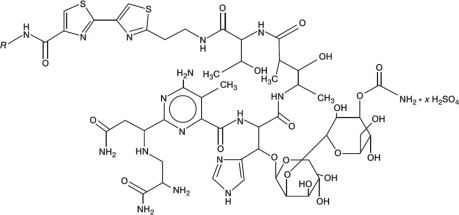
bleomycin 30 UNT Injection — Other cytotoxic antibiotics. INDICATIONS AND USAGE Bleomycin for Injection, USP should be considered a palliative treatment. It has been shown to be useful in the management of…
Boxed warning
WARNING It is recommended that Bleomycin for Injection be administered under the supervision of a qualified physician experienced in the use of cancer chemotherapeutic agents. Appropriate management of therapy and complications is possible only when adequate diagnostic and treatment facilities are readily available. Pulmonary fibrosis is the most severe toxicity associated with Bleomycin for Injection. The most frequent presentation is pneumonitis occasionally progressing to pulmonary fibrosis. Its occurrence is higher in elderly patients and in those receiving greater than 400 units total dose, but pulmonary toxicity has been observed in young patients and those treated with low doses. A severe idiosyncratic reaction consisting of hypotension, mental confusion, fever, chills, and wheezing has been reported in approximately 1% of lymphoma patients treated with Bleomycin for Injection.
Bleomycin may have altered clearance when administered with nephrotoxic drugs such as cisplatin.
majorcisplatin — decreased renal clearance of bleomycin
Indications
INDICATIONS AND USAGE Bleomycin for Injection, USP should be considered a palliative treatment. It has been shown to be useful in the management of the following neoplasms either as a single agent or in proven combinations with other approved chemotherapeutic agents: Squamous Cell Carcinoma: Head and neck (including mouth, tongue, tonsil, nasopharynx, oropharynx, sinus, palate, lip, buccal mucosa, gingivae, epiglottis, skin, larynx), penis, cervix, and vulva. The response to Bleomycin for Injection, USP is poorer in patients with previously irradiated head and neck cancer. Lymphomas: Hodgkin's disease, non-Hodgkin's lymphoma. Testicular Carcinoma: Embryonal cell, choriocarcinoma, and teratocarcinoma. Bleomycin for Injection, USP has also been shown to be useful in the management of: Malignant Pleural Effusion: Bleomycin for Injection, USP is effective as a sclerosing agent for the treatment of malignant pleural effusion and prevention of recurrent pleural effusions.
Dosage
DOSAGE AND ADMINISTRATION Because of the possibility of an anaphylactoid reaction, lymphoma patients should be treated with 2 units or less for the first 2 doses. If no acute reaction occurs, then the regular dosage schedule may be followed. The following dose schedule is recommended: Squamous cell carcinoma, non-Hodgkin's lymphoma, testicular carcinoma - 0.25 to 0.50 units/kg (10 to 20 units/m 2 ) given intravenously, intramuscularly, or subcutaneously weekly or twice weekly. Hodgkin's Disease - 0.25 to 0.50 units/kg (10 to 20 units/m 2 ) given intravenously, intramuscularly, or subcutaneously weekly or twice weekly. After a 50% response, a maintenance dose of 1 unit daily or 5 units weekly intravenously or intramuscularly should be given. Pulmonary toxicity of bleomycin appears to be dose-related with a striking increase when the total dose is over 400 units. Total doses over 400 units should be given with great caution. Note: When Bleomycin for Injection is used in combination with other antineoplastic agents, pulmonary toxicities may occur at lower doses. Improvement of Hodgkin's disease and testicular tumors is prompt and noted within 2 weeks. If no improvement is seen by this time, improvement is unlikely. Squamous cell cancers respond more slowly, sometimes requiring as long as 3 weeks before any improvement is noted. Malignant Pleural Effusion —60 units administered as a single-dose bolus intrapleural injection (see Administration: Intrapleural ). Use in Patients with Renal Insufficiency The following dosing reductions are proposed for patients with creatinine clearance (CrCL) values of less than 50 mL/min: CrCL can be estimated from the individual patient's measured serum creatinine (Scr) values using the Cockcroft and Gault formula: Males CrCL = [weight x (140 - Age)]/(72 x Scr) Females CrCL = 0.85 x [weight x (140 - Age)]/(72 x Scr) Where CrCL in mL/min/1.73m 2 , weight in kg, age in years, and Scr in mg/dL. Patient CrCL (mL/min) Bleomycin for Injection, USP Dose (%) 50 and above 100 40 to 50 70 30 to 40 60 20 to 30 55 10 to 20 45 5 to 10 40 Administration Bleomycin for Injection may be given by the intramuscular, intravenous, subcutaneous or intrapleural routes. Administration Precautions Caution should be exercised when handling Bleomycin for injection. Procedures for proper handling and disposal of anticancer drugs should be utilized. Several guidelines on this subject have been published. 1-4 To minimize the risk of dermal exposure, always wear impervious gloves when handling vials containing Bleomycin for injection. If Bleomycin for injection contacts the skin, immediately wash the skin thoroughly with soap and water. If contact with mucous membranes occurs, the membranes should be flushed immediately and thoroughly with water. More information is available in the references listed below. Intramuscular or Subcutaneous The Bleomycin for Injection, USP 15 units vial should be reconstituted with 1 to 5 mL of Sterile Water for Injection, USP, Sodium Chloride for Injection, 0.9%, USP, or Sterile Bacteriostatic Water for Injection, USP. The Bleomycin for Injection, USP 30 units vial should be reconstituted with 2 to 10 mL of the above diluents. Intravenous The contents of the 15 units or 30 units vial should be dissolved in 5 mL or 10 mL, respectively of Sodium Chloride for Injection, 0.9%, USP, and administered slowly over a period of 10 minutes. Intrapleural Sixty units of Bleomycin are dissolved in 50 to 100 mL Sodium Chloride for Injection, 0.9%, USP, and administered through a thoracostomy tube following drainage of excess pleural fluid and confirmation of complete lung expansion. The literature suggests that successful pleurodesis is, in part, dependent upon complete drainage of the pleural fluid and reestablishment of negative intrapleural pressure prior to instillation of a sclerosing agent. Therefore, the amount of drainage from the chest tube should be as minimal as possible prior to instillation of Bleomycin. Although there is no conclusive evidence to support this contention, it is generally accepted that chest tube drainage should be less than 100 mL in a 24-hour period prior to sclerosis. However, Bleomycin instillation may be appropriate when drainage is between 100 to 300 mL under clinical conditions that necessitate sclerosis therapy. The thoracostomy tube is clamped after Bleomcyin instillation. The patient is moved from the supine to the left and right lateral positions several times during the next four hours. The clamp is then removed and suction reestablished. The amount of time the chest tube remains in place following sclerosis is dictated by the clinical situation. The intrapleural injection of topical anesthetics or systemic narcotic analgesia is generally not required. Parenteral drug products should be inspected visually for particulate matter and discoloration prior to administration, whenever solution and container permit.
Warnings
WARNINGS Patients receiving bleomycin must be observed carefully and frequently during and after therapy. It should be used with extreme caution in patients with significant impairment of renal function or compromised pulmonary function. Pulmonary toxicities occur in 10% of treated patients. In approximately 1%, the nonspecific pneumonitis induced by bleomycin progresses to pulmonary fibrosis and death. Although this is age and dose related, the toxicity is unpredictable. Frequent roentgenograms are recommended (see ADVERSE REACTIONS : Pulmonary ). A severe idiosyncratic reaction (similar to anaphylaxis) consisting of hypotension, mental confusion, fever, chills, and wheezing has been reported in approximately 1% of lymphoma patients treated with bleomycin. Since these reactions usually occur after the first or second dose, careful monitoring is essential after these doses (see ADVERSE REACTIONS : Idiosyncratic Reactions ). Renal or hepatic toxicity, beginning as a deterioration in renal or liver function tests, have been reported. These toxicities may occur at any time after initiation of therapy. Usage in Pregnancy Bleomycin can cause fetal harm when administered to a pregnant woman. It has been shown to be teratogenic in rats. Administration of intraperitoneal doses of 1.5 mg/kg/day to rats (about 1.6 times the recommended human dose on a unit/m 2 basis) on days 6 to 15 of gestation caused skeletal malformations, shortened innominate artery and hydroureter. Bleomycin is abortifacient but not teratogenic in rabbits at intravenous doses of 1.2 mg/kg/day (about 2.4 times the recommended human dose on a unit/m 2 basis) given on gestation days 6 to 18. There have been no studies in pregnant women. If Bleomycin for Injection is used during pregnancy, or if the patient becomes pregnant while receiving this drug, the patient should be apprised of the potential hazard to the fetus. Women of childbearing potential should be advised to avoid becoming pregnant during therapy with Bleomycin for Injection.
Contraindications
CONTRAINDICATIONS Bleomycin for injection is contraindicated in patients who have demonstrated a hypersensitive or an idiosyncratic reaction to it.
Mechanism of action
CLINICAL PHARMACOLOGY Mechanism of Action Although the exact mechanism of action of bleomycin is unknown, available evidence indicates that the main mode of action is the inhibition of DNA synthesis with some evidence of lesser inhibition of RNA and protein synthesis. Bleomycin is known to cause single, and to a lesser extent, double-stranded breaks in DNA. In in vitro and in vivo experiments, bleomycin has been shown to cause cell cycle arrest in G2 and in mitosis. When administered into the pleural cavity in the treatment of malignant pleural effusion, Bleomycin acts as a sclerosing agent. Pharmacokinetics Absorption Bleomycin is rapidly absorbed following either intramuscular, subcutaneous, intraperitoneal, or intrapleural administration reaching peak plasma concentrations in 30 to 60 minutes. Systemic bioavailability of bleomycin is 100% and 70% following intramuscular and subcutaneous administrations, respectively, and 45% following both intraperitoneal and intrapleural administrations, compared to intravenous and bolus administration. Following intramuscular doses of 1 to 10 units/m 2 , both peak plasma concentration and AUC increased in proportion with the increase of dose. Following intravenous bolus administration of 30 units of bleomycin to one patient with a primary germ cell tumor of the brain, a peak CSF level was 40% of the simultaneously-obtained plasma level and was attained in two hours after drug administration. The area under the bleomycin CSF concentration x time curve was 25% of the area of the bleomycin plasma concentration x time curve. Distribution Bleomycin is widely distributed throughout the body with a mean volume of distribution of 17.5 L/m 2 in patients following a 15 units/m 2 intravenous bolus dose. Protein binding of bleomycin has not been studied. Metabolism Bleomycin is inactivated by a cytosolic cysteine proteinase enzyme, bleomycin hydrolase. The enzyme is widely distributed in normal tissues with the exception of the skin and lungs, both targets of bleomycin toxicity. Systemic elimination of the drug by enzymatic degradation is probably only important in patients with severely compromised renal function. Excretion The primary route of elimination is via the kidneys. About 65% of the administered intravenous dose is excreted in urine within 24 hours. In patients with normal renal function, plasma concentrations of bleomycin decline biexponentially with a mean terminal half-life of 2 hours following intravenous bolus administration. Total body clearance and renal clearance averaged 51 mL/min/m 2 and 23 mL/min/m 2 , respectively. Following intrapleural administration to patients with normal renal function, a lower percentage of drug (40%) is recovered in the urine, as compared to that found in the urine after intravenous administration. Special Populations Age, Gender, and Race The effects of age, gender, and race on the pharmacokinetics of bleomycin have not been evaluated. Pediatric Children of less than 3 years of age have higher total body clearance than in adults, 71 mL/min/m 2 versus 51 mL/min/m 2 , respectively, following intravenous bolus administration. Children of more than 8 years of age have comparable clearance as in adults. In children with normal renal function, plasma concentrations of bleomycin decline biexponentially as in adults. The volume of distribution and terminal half-life of bleomycin in children appears comparable to that in adults. Renal Insufficiency Renal insufficiency markedly alters bleomycin elimination. The terminal elimination half-life increases exponentially as the creatinine clearance decreases. Dosing reductions were proposed for patients with creatinine clearance values of <50 mL/min (see PRECAUTIONS and DOSAGE AND ADMINISTRATION ). Hepatic Insufficiency The effect of hepatic insufficiency on the pharmacokinetics of bleomycin has not been evaluated. Drug Interactions Drugs that Can Affect Renal Clearance Because bleomycin is eliminated predominantly through renal excretion, the administration of nephrotoxic drugs with bleomycin may affect its renal clearance. Specifically, in one report of 2 children receiving concomitant cisplatin with bleomycin, total body clearance of bleomycin decreased from 39 to 18 mL/min/m 2 as the cumulative dose of cisplatin exceeded 300 mg/m 2 . Terminal half-life of bleomycin also increased from 4.4 to 6.0 hours. Fatal bleomycin pulmonary toxicity has been reported in a patient with unrecognized cisplatin-induced oliguric renal failure. Clinical Studies Malignant Pleural Effusion The safety and efficacy of bleomycin 60 units and tetracycline (1 g) as treatment for malignant pleural effusion were evaluated in a multicenter, randomized trial. Patients were required to have cytologically positive pleural effusion, good performance status (0,1,2), lung re-expansion following tube thoracostomy with drainage rates of 100 mL/24 hours or less, no prior intrapleural therapy, no prior systemic bleomycin therapy, no chest irradiation, and no recent change in systemic therapy. Overall survival did not differ between the bleomycin (n=44) and tetracycline treatment (n=41) groups. Of patients evaluated within 30 days of instillation, the recurrence rate was 36% (10/28) with bleomycin and 67% (18/27) with tetracycline (p=0.023). Toxicity was similar between groups.
A drug lookup is just the start. Eleplan keeps the whole care plan in one place.
Medications, diagnoses, documents, appointments, and the whole care team — organized and always in sync, with Ellie, your AI care assistant, on top of it. Free to start.