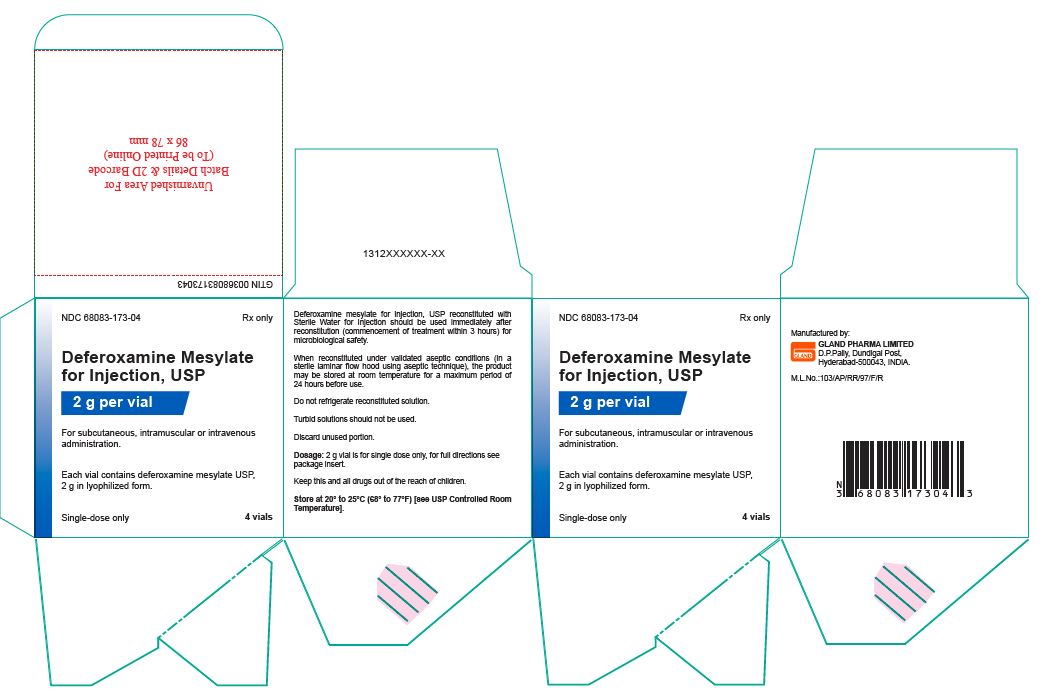
deferoxamine mesylate 500 MG Injection
Managing this medication for someone you care for? Eleplan keeps diagnoses, medications and appointments in one plan.
Start free with EleplanClinical drug
deferoxamine mesylate 500 MG Injection
500 MG · Injection · injection
A form of deferoxamine →
deferoxamine mesylate 500 MG Injection — Iron chelating agents. INDICATIONS AND USAGE Deferoxamine mesylate for injection is an iron-chelating agent indicated: • As an adjunct to standard measures for the…
Active ingredient
Classification
Iron chelating agentsIron Chelator
Indications
INDICATIONS AND USAGE Deferoxamine mesylate for injection is an iron-chelating agent indicated: • As an adjunct to standard measures for the treatment of acute iron intoxication. ( 1.1 ) • For the treatment of transfusional iron overload in patients with chronic anemia. ( 1.2 ) Limitations of Use Deferoxamine mesylate for injection is not indicated for the treatment of primary hemochromatosis (since phlebotomy is the method of choice for removing excess iron in this disorder). 1.1 Acute Iron Intoxication Deferoxamine mesylate for injection is indicated as an adjunct to standard measures for the treatment of acute iron intoxication. 1.2 Chronic Iron Overload Deferoxamine mesylate for injection is indicated for the treatment of transfusional iron overload in patients with chronic anemia. 1.3 Limitations of Use Deferoxamine mesylate for injection is not indicated for the treatment of primary hemochromatosis (since phlebotomy is the method of choice for removing excess iron in this disorder).
Dosage
DOSAGE AND ADMINISTRATION The dosage (based on body weight in mg/kg/day), rates of administration, and mode of administration for both adults and pediatric patients are individually determined and adapted during the course of therapy based on the severity of the patient’s iron overload. The minimum daily dose of deferoxamine mesylate for injection is 20 mg/kg/day for both adults and pediatric patients. The maximum daily dose is 40 mg/kg/day for pediatric patients and 60 mg/kg/day for adults. Acute Iron Intoxication: ( 2.1 ) • Intramuscular Administration: Use for all patients not in shock. Initial dose is 1,000 mg. Depending upon the clinical response, subsequent doses of 500 mg may be administered every 4 hours to 12 hours. Maximum dose is 6,000 mg in 24 hours. • Intravenous Administration: Only for patients in a state of cardiovascular collapse. Initial dose is 1,000 mg at a rate not to exceed 15 mg/kg/hr. Depending upon the clinical response, subsequent doses of 500 mg may be administered every 4 hours to 12 hours at a rate of up to 125 mg/hr. Maximum dose is 6,000 mg in 24 hours. Chronic Iron Overload: ( 2.2 ) • Subcutaneous Infusion: Average daily dose is between 20 and 60 mg/kg. In patients with serum ferritin level below 2,000 ng/mL require about 25 mg/kg/day. Patients with serum ferritin level between 2,000 and 3,000 ng/mL require about 35 mg/kg/day. Patients with higher serum ferritin may require up to 55 mg/kg/day. • Intravenous Administration: 20 mg/kg/day to 40 mg/kg/day for pediatric patients and 40 mg/kg/day to 50 mg/kg/day over 8 hours to 12 hours in adults for 5 days to 7 days per week. In pediatric patients and adults, maximum dose should not exceed 40 mg/kg/day and 60 mg/kg/day, respectively. • Intramuscular Administration: 500 mg to maximum daily dose of 1,000 mg. See Full Prescribing Information for instructions on preparation of deferoxamine mesylate for injection for administration. ( 2.3 ) Vitamin C (up to 200 mg) increases availability of iron for chelation and may be given as an adjuvant to iron chelation therapy. ( 2.4 ) 2.1 Recommended Dosage for Treatment of Acute Iron Intoxication for Adults and Pediatric Patients Intramuscular (IM) Administration Use for all patients not in shock. The initial recommended dose of deferoxamine mesylate for injection is 1,000 mg intramuscularly (IM) once. If needed based on the clinical response, administer subsequent doses of 500 mg every 4 hours to 12 hours. The maximum recommended daily dose is 6,000 mg in 24 hours. Intravenous (IV) Administration Administer deferoxamine mesylate for injection intravenously (IV) to patients in a state of cardiovascular collapse and then only by slow infusion. As soon as the clinical condition of the patient permits, intravenous administration should be discontinued, and the drug should be administered intramuscularly. The initial recommended IV dose of deferoxamine mesylate for injection is 1,000 mg administered at an infusion rate of up to 15 mg/kg/hr. If needed based on the clinical response administer additional doses of 500 mg over 4 hours to 12 hours at a slower infusion rate of up to 125 mg/hr. The maximum recommended daily dose is 6,000 mg in 24 hours. 2.2 Recommended Dosage for Treatment of Chronic Iron Overload for Adults and Pediatric Patients Subcutaneous Infusion Administration The average daily dose of deferoxamine mesylate for injection is usually between 20 and 60 mg/kg. In general patients with serum ferritin level below 2,000 ng/mL require about 25 mg/kg/day. Patients with serum ferritin level between 2,000 and 3,000 ng/mL require about 35 mg/kg/day. Patients with higher serum ferritin may require up to 55 mg/kg/day. It is not advisable to regularly exceed an average daily dose of 50 mg/kg/day except when very intensive chelation is needed in patients who have completed growth. If ferritin levels fall below 1,000 ng/mL, the risk of deferoxamine mesylate for injection toxicity increases; it is important to monitor these patients particularly carefully and perhaps to consider lowering the total weekly dose. The doses specified here are the average daily doses. Since most patients use deferoxamine mesylate for injection less than 7 days a week, the actual dose per infusion usually differs from the average daily dose; e.g. if an average daily dose of 40 mg/kg/day is required and the patient wears the pump 5 nights a week, each infusion should contain 56 mg/kg. Slow subcutaneous infusion using a portable, light-weight infusion pump over a period of 8 to 12 hours is regarded as effective and especially convenient for ambulatory patients, but may also be given over a 24-hour period. Deferoxamine mesylate for injection should normally be used with the pump 5 to 7 times a week. Deferoxamine mesylate for injection is not formulated to support subcutaneous bolus injection. Intravenous Administration Deferoxamine mesylate for injection can be administered intravenously if needed in patients with intravenous access. The recommended dose of deferoxamine mesylate for injection in adults is 40 mg/kg/day to 50 mg/kg/day over 8 hours to 12 hours at a rate of up to 15 mg/kg/hour for 5 days to 7 days per week. Maximum dose is 60 mg/kg/day. The recommended dose of deferoxamine mesylate for injection in pediatric patients is 20 mg/kg/day to 40 mg/kg/day over 8 hours to 12 hours for 5 days to 7 days per week. The maximum recommended daily dose is 40 mg/kg/day until growth (body weight and linear growth) has ceased. In case of missed doses, deferoxamine mesylate for injection may be administered prior to or following same day blood transfusion (for example, 1 gram over 4 hours on the day of transfusion); however, the contribution of this mode of administration to iron balance is limited. Deferoxamine mesylate for injection should not be administered concurrently with the blood transfusion as this can lead to errors in interpreting side effects such as rash, anaphylaxis and hypotension. Intramuscular Administration If given intramuscularly, the recommended dose of deferoxamine mesylate for injection is 500 mg to 1,000 mg per day. The maximum recommended daily dose is 1,000 mg per day. 2.3 Preparation Reconstitute deferoxamine mesylate for injection prior to administration. Deferoxamine mesylate for injection should be further diluted for intravenous infusion. Use appropriate aseptic technique. Reconstitute each vial of Deferoxamine mesylate for injection with Sterile Water for Injection, USP per Table 1. Parenteral drug products should be inspected visually for particulate matter and discoloration prior to administration, whenever solution and container permit. Do not use if visibly opaque particles, discoloration or foreign particles are observed. The reconstituted deferoxamine mesylate for injection solution is an isotonic, clear and colorless to slightly-yellowish solution. Discard unused portion. Table 1. Preparation of Deferoxamine Mesylate for injection Prior to Administration Vial Size Route of Administration Amount of Sterile Water for Injection, USP for Reconstitution Concentration After Reconstitution 500 mg Intramuscular 2 mL 213 mg/mL 500 mg Intravenous* 5 mL 95 mg/mL † 500 mg Subcutaneous 5 mL 95 mg/mL 2 g Intramuscular 8 mL 213 mg/mL 2 g Intravenous 20 mL 95 mg/mL 2 g Subcutaneous 20 mL 95 mg/mL *Intravenous route of administration requires further dilution with 150 mL of 0.9% Sodium Chloride Injection, USP or 0.45% Sodium Chloride Injection, USP or 5% Dextrose Injection, USP or Lactated Ringers Injection, USP † Final concentration for intravenous administration is between 3 mg/mL to 3.5 mg/mL If not used immediately, store at room temperature between 20° to 25°C (68° to 77°F), for a maximum period of 24 hours. Do not refrigerate reconstituted solution. 2.4 Management of Vitamin C Deficiency Patients with iron overload usually become vitamin C deficient, probably because iron oxidizes the vitamin. As an adjuvant to iron chelation therapy, vitamin
Warnings
WARNINGS AND PRECAUTIONS • Hypersensitivity Reactions: More common with rapid intravenous infusion. Administer intramuscularly or by slow subcutaneous or intravenous infusion. ( 5.1 ) • Auditory and Ocular Toxicity: Have been reported when administered over prolonged periods of time, at high doses, or in patients with low ferritin levels. ( 5.2 ) • Renal Toxicity: Cases of acute renal failure, renal tubular disorders and increase in serum creatinine have occurred. Monitor patients for changes in renal function. ( 5.3 ) • Respiratory Toxicity: Acute respiratory distress syndrome has occurred. Risk increased with high intravenous doses. Recommended daily dose should not be exceeded. ( 5.4 ) • Growth Suppression: Has occurred in pediatric patients treated with high doses and concomitant low ferritin levels. Dose reduction may partially resume growth velocity to pre-treatment rates. ( 5.5 ) • Serious Infections: Cases of mucormycosis and Yersinia infections, some fatal, have occurred. Discontinue deferoxamine mesylate and initiate appropriate treatment immediately. ( 5.6 ) • Cardiac Dysfunction with Concomitant Use of Vitamin C: Avoid coadministration in patients with cardiac failure. Delay Vitamin C for one month after start of deferoxamine mesylate. Avoid exceeding 200 mg daily in adults. Monitor cardiac function with combined treatment. ( 5.7 ) • Risks of Deferoxamine Mesylate Treatment in Patients with Aluminum Overload: Risks include neurological dysfunction (including seizures), dialysis dementia, and aggravation of hyperparathyroidism. ( 5.8 ) • Effects on Ability to Drive and Use Machines: May cause dizziness. ( 5.9 ) • Embryo-Fetal Toxicity: Can cause fetal harm. Advise females of reproductive potential of the potential risk to a fetus and use effective contraception. ( 5.10 , 8.1 , 8.3 ) 5.1 Hypersensitivity Reactions Hypersensitivity reactions, including anaphylaxis, have occurred in deferoxamine mesylate-treated patients. Reactions have included flushing of the skin, urticaria, hypotension, and shock. These reactions typically occur when deferoxamine mesylate was administered by rapid intravenous injection. Therefore, administer deferoxamine mesylate intramuscularly or by slow subcutaneous or intravenous infusion. 5.2 Auditory and Ocular Toxicity Ocular and auditory toxicities have been reported in deferoxamine mesylate-treated patients. The ocular toxicities observed have included blurring of vision; cataracts after prolonged administration in chronic iron overload; decreased visual acuity, including visual loss, visual defects, scotoma; impaired peripheral, color, and night vision; optic neuritis, cataracts, corneal opacities, and retinal pigmentary abnormalities. The auditory toxicities reported have been tinnitus and hearing loss, including high frequency sensorineural hearing loss. Risk factors for both ocular and auditory disturbances include prolonged treatment duration, higher doses, or low ferritin levels. In most cases, both ocular and auditory disturbances were reversible upon immediate cessation of treatment [see Adverse Reactions ( 6 )] . Visual acuity tests, slit-lamp examinations, funduscopy and audiometry are recommended periodically in patients treated for prolonged periods of time. Toxicity is more likely to be reversed if symptoms or test abnormalities are detected early. 5.3 Renal Toxicity Renal toxicity, including increases in serum creatinine (possibly dose-related), acute renal failure and renal tubular disorders has occurred in deferoxamine mesylate-treated patients. Deferoxamine mesylate is contraindicated in patients with severe renal disease [see Contraindications ( 4 )] . Monitor serum creatinine to assess for changes in renal function. 5.4 Respiratory Toxicity Acute respiratory distress syndrome has occurred in deferoxamine mesylate-treated patients following treatment with excessively high intravenous doses of deferoxamine mesylate in patients with acute iron intoxication or thalassemia. The recommended daily doses should therefore not be exceeded. 5.5 Growth Suppression High doses of deferoxamine mesylate and concomitant low ferritin levels have also been associated with growth suppression in pediatric patients. After reduction of deferoxamine mesylate dose, growth velocity may partially resume to pre-treatment rates. Monitor growth (weight and height) in pediatric patients treated with deferoxamine mesylate every 3 months. 5.6 Serious Infections Yersinia Infections Deferoxamine mesylate may increase the risk of Yersinia enterocolitica and Yersinia pseudotuberculosis infections. Avoid starting deferoxamine mesylate treatment in patients with active Yersinia infections. Should Yersinia infection develop, interrupt deferoxamine mesylate treatment until the infection is resolved. Mucormycosis Cases of mucormycosis, some with a fatal outcome, have occurred in deferoxamine mesylate-treated patients. Signs or symptoms are specific to the site of infection. If mucormycosis is suspected, discontinue deferoxamine mesylate, conduct mycological testing, and treat immediately. 5.7 Cardiac Dysfunction with Concomitant Use of Vitamin C Cardiac dysfunction has occurred in deferoxamine mesylate-treated patients with severe chronic iron overload following concomitant treatment with high doses of vitamin C (more than 500 mg daily in adults). The cardiac dysfunction was reversible when vitamin C was discontinued. The following precautions should be taken when vitamin C and deferoxamine mesylate are to be used concomitantly: • Vitamin C supplements should not be given to patients with cardiac failure. • Start supplemental vitamin C only after an initial month of regular treatment with deferoxamine mesylate. • Give vitamin C only if the patient is receiving deferoxamine mesylate regularly, ideally soon after setting up the infusion pump. • Do not exceed a daily vitamin C dose of 200 mg in adults, given in divided doses. In general, 50 mg daily suffices for pediatric patients under 10 years old and 100 mg for older pediatric patients. • Clinical monitoring of cardiac function is advisable during such combined therapy. 5.8 Risks of Deferoxamine Mesylate Treatment in Patients with Aluminum Overload Deferoxamine mesylate may cause neurological dysfunction (including seizures) in patients with aluminum-related encephalopathy and receiving dialysis, possibly due to an acute increase in circulating aluminum [see Adverse Reactions ( 6 )] . Deferoxamine mesylate may precipitate the onset of dialysis dementia. Treatment with deferoxamine mesylate in the presence of aluminum overload may result in decreased serum calcium and aggravation of hyperparathyroidism. 5.9 Effects on Ability to Drive and Use Machines Deferoxamine mesylate may cause dizziness, which may impair the ability to drive a car or operate machinery. Patients should not drive or operate machinery until they know how deferoxamine mesylate will affect their ability to engage in these activities. 5.10 Embryo-Fetal Toxicity Based on findings in animals, deferoxamine mesylate can cause fetal harm when administered to a pregnant woman. In animal reproduction studies, administration of deferoxamine to pregnant mice and rabbits during the period of organogenesis caused adverse developmental outcomes including decreased fetal body weights and malformations at maternal doses less than those in patients at maximum recommended human dose (MRHD). Advise pregnant women of the potential risk to a fetus. Advise females of reproductive potential and males with female partners of reproductive potential to use effective contraception during treatment with deferoxamine mesylate and for one month after the last dose [see Use in Specific Populations ( 8.1 , 8.3 ), Nonclinical Toxicology ( 13.1 )] .
Contraindications
CONTRAINDICATIONS Deferoxamine mesylate for injection is contraindicated in patients with: • A history of a hypersensitivity reaction to deferoxamine or any of its inactive ingredients [see Description ( 11 )] . Reactions have included anaphylaxis [see Warnings and Precautions ( 5.1 )] . • Severe renal disease or anuria since the drug and the iron chelate are excreted primarily by the kidney [see Warnings and Precautions ( 5.3 )] . • Known hypersensitivity to the active substance. ( 4 ) • Patients with severe renal disease or anuria. ( 4 )
Mechanism of action
Mechanism of Action Deferoxamine mesylate chelates iron by forming a stable complex that prevents the iron from entering into further chemical reactions. It readily chelates iron from ferritin and hemosiderin but not readily from transferrin; it does not combine with the iron from cytochromes and hemoglobin. Deferoxamine mesylate does not cause any demonstrable increase in the excretion of electrolytes or trace metals. Theoretically, 100 parts by weight of deferoxamine mesylate is capable of binding approximately 8.5 parts by weight of ferric iron.
Source: RxNorm + openFDA + RxClass + FAERS · 2026
Look up another medication