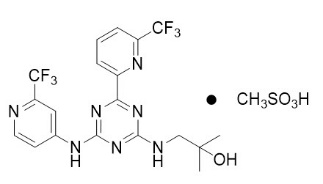
enasidenib 50 MG Oral Tablet — Isocitrate dehydrogenase (IDH) inhibitors. INDICATIONS AND USAGE IDHIFA is an isocitrate dehydrogenase-2 inhibitor indicated for the treatment of adult patients with relapsed or refractory…
Boxed warning
WARNING: DIFFERENTIATION SYNDROME Patients treated with IDHIFA have experienced symptoms of differentiation syndrome, which can be fatal if not treated. Symptoms may include fever, dyspnea, acute respiratory distress, pulmonary infiltrates, pleural or pericardial effusions, rapid weight gain or peripheral edema, lymphadenopathy, bone pain, and hepatic, renal, or multi-organ dysfunction. If differentiation syndrome is suspected, initiate corticosteroid therapy and hemodynamic monitoring until symptom resolution [see Warnings and Precautions (5.1) and Adverse Reactions (6.1) ] . WARNING: DIFFERENTIATION SYNDROME See full prescribing information for complete boxed warning. Patients treated with IDHIFA have experienced symptoms of differentiation syndrome, which can be fatal if not treated. If differentiation syndrome is suspected, initiate corticosteroid therapy and hemodynamic monitoring until symptom resolution ( 5.1 , 6.1 ).
INDICATIONS AND USAGE IDHIFA is an isocitrate dehydrogenase-2 inhibitor indicated for the treatment of adult patients with relapsed or refractory acute myeloid leukemia (AML) with an isocitrate dehydrogenase-2 (IDH2) mutation as detected by an FDA-approved test ( 1.1 ). 1.1 Acute Myeloid Leukemia IDHIFA is indicated for the treatment of adult patients with relapsed or refractory acute myeloid leukemia (AML) with an isocitrate dehydrogenase-2 (IDH2) mutation as detected by an FDA-approved test.
Dosage
DOSAGE AND ADMINISTRATION 100 mg orally once daily until disease progression or unacceptable toxicity ( 2.2 ). 2.1 Patient Selection Select patients for the treatment of AML with IDHIFA based on the presence of IDH2 mutations in the blood or bone marrow [see Indications and Usage (1.1) and Clinical Studies (14.1) ] . Information on FDA-approved tests for the detection of IDH2 mutations in AML is available at http://www.fda.gov/CompanionDiagnostics . 2.2 Recommended Dosage The recommended dosage of IDHIFA is 100 mg taken orally once daily with or without food until disease progression or unacceptable toxicity. For patients without disease progression or unacceptable toxicity, treat for a minimum of 6 months to allow time for clinical response. Swallow tablets whole. Do not chew, split, or crush IDHIFA tablets. Administer IDHIFA tablets orally about the same time each day. If a dose of IDHIFA is vomited, missed, or not taken at the usual time, administer the dose as soon as possible on the same day, and return to the normal schedule the following day. 2.3 Monitoring and Dosage Modifications for Toxicities Assess blood counts and blood chemistries for leukocytosis and tumor lysis syndrome prior to the initiation of IDHIFA and monitor at a minimum of every 2 weeks for at least the first 3 months during treatment. Manage any abnormalities promptly [see Adverse Reactions (6.1) ] . Interrupt dosing or reduce dose for toxicities. See Table 1 for dosage modification guidelines. Table 1: Dosage Modifications for IDHIFA-Related Toxicities *Grade 1 is mild, Grade 2 is moderate, Grade 3 is serious, Grade 4 is life-threatening. Adverse Reaction Recommended Action • Differentiation syndrome • If differentiation syndrome is suspected, administer systemic corticosteroids and initiate hemodynamic monitoring [see Warnings and Precautions (5.1) ] . • Interrupt IDHIFA if severe pulmonary symptoms requiring intubation or ventilator support, and/or renal dysfunction persist for more than 48 hours after initiation of corticosteroids [see Warnings and Precautions (5.1) ] . • Resume IDHIFA when signs and symptoms improve to Grade 2* or lower. • Noninfectious leukocytosis (white blood cell [WBC] count greater than 30 × 10 9 /L) • Initiate treatment with hydroxyurea, as per standard institutional practices. • Interrupt IDHIFA if leukocytosis is not improved with hydroxyurea, and then resume IDHIFA at 100 mg daily when WBC is less than 30 × 10 9 /L. • Elevation of bilirubin greater than 3 times the upper limit of normal (ULN) sustained for ≥2 weeks without elevated transaminases or other hepatic disorders • Reduce IDHIFA dose to 50 mg daily. • Resume IDHIFA at 100 mg daily if bilirubin elevation resolves to less than 2 × ULN. • Other Grade 3* or higher toxicity considered related to treatment including tumor lysis syndrome • Interrupt IDHIFA until toxicity resolves to Grade 2* or lower. • Resume IDHIFA at 50 mg daily; may increase to 100 mg daily if toxicities resolve to Grade 1* or lower. • If Grade 3* or higher toxicity recurs, discontinue IDHIFA.
Warnings
WARNINGS AND PRECAUTIONS Embryo-Fetal Toxicity : IDHIFA can cause fetal harm. Advise patients of the potential risk to a fetus and use effective contraception ( 5.2 , 8.1 , 8.3 ). 5.1 Differentiation Syndrome In the clinical trial, 14% of patients treated with IDHIFA experienced differentiation syndrome, which may be life-threatening or fatal if not treated. Differentiation syndrome is associated with rapid proliferation and differentiation of myeloid cells. While there is no diagnostic test for differentiation syndrome, symptoms in patients treated with IDHIFA included acute respiratory distress represented by dyspnea and/or hypoxia (68%) and need for supplemental oxygen (76%); pulmonary infiltrates (73%) and pleural effusion (45%); renal impairment (70%); fever (36%); lymphadenopathy (33%); bone pain (27%); peripheral edema with rapid weight gain (21%); and pericardial effusion (18%). Hepatic, renal, and multi-organ dysfunction have also been observed. Differentiation syndrome has been observed with and without concomitant hyperleukocytosis, in as early as 1 day and up to 5 months after IDHIFA initiation. If differentiation syndrome is suspected, initiate oral or intravenous corticosteroids (e.g., dexamethasone 10 mg every 12 hours) and hemodynamic monitoring until improvement. Taper corticosteroids only after resolution of symptoms. Symptoms of differentiation syndrome may recur with premature discontinuation of corticosteroid treatment. If severe pulmonary symptoms requiring intubation or ventilator support, and/or renal dysfunction persist for more than 48 hours after initiation of corticosteroids, interrupt IDHIFA until signs and symptoms are no longer severe [see Dosage and Administration (2.3) ] . Hospitalization for close observation and monitoring of patients with pulmonary and/or renal manifestation is recommended. 5.2 Embryo-Fetal Toxicity Based on animal embryo-fetal toxicity studies, IDHIFA can cause embryo-fetal harm when administered to a pregnant woman. In animal embryo-fetal toxicity studies, enasidenib caused embryo-fetal toxicities starting at 0.1 times the steady state clinical exposure based on the area under the concentration-time curve (AUC) at the recommended human dose. Advise pregnant women of the potential risk to the fetus. Advise females of reproductive potential to use effective non‑hormonal contraception during treatment with IDHIFA and for 2 months after the last dose. Advise males with female partners of reproductive potential to use effective contraception during treatment with IDHIFA and for 2 months after the last dose [see Use in Specific Populations (8.1 , 8.3) ] .
Contraindications
CONTRAINDICATIONS None. None ( 4 ).
Mechanism of action
Mechanism of Action Enasidenib is a small molecule inhibitor of the isocitrate dehydrogenase 2 (IDH2) enzyme. Enasidenib targets the mutant IDH2 variants R140Q, R172S, and R172K at approximately 40-fold lower concentrations than the wild-type enzyme in vitro. Inhibition of the mutant IDH2 enzyme by enasidenib led to decreased 2-hydroxyglutarate (2-HG) levels and induced myeloid differentiation in vitro and in vivo in mouse xenograft models of IDH2 mutated AML. In blood samples from patients with AML with mutated IDH2, enasidenib decreased 2-HG levels, reduced blast counts and increased percentages of mature myeloid cells.
A drug lookup is just the start. Eleplan keeps the whole care plan in one place.
Medications, diagnoses, documents, appointments, and the whole care team — organized and always in sync, with Ellie, your AI care assistant, on top of it. Free to start.