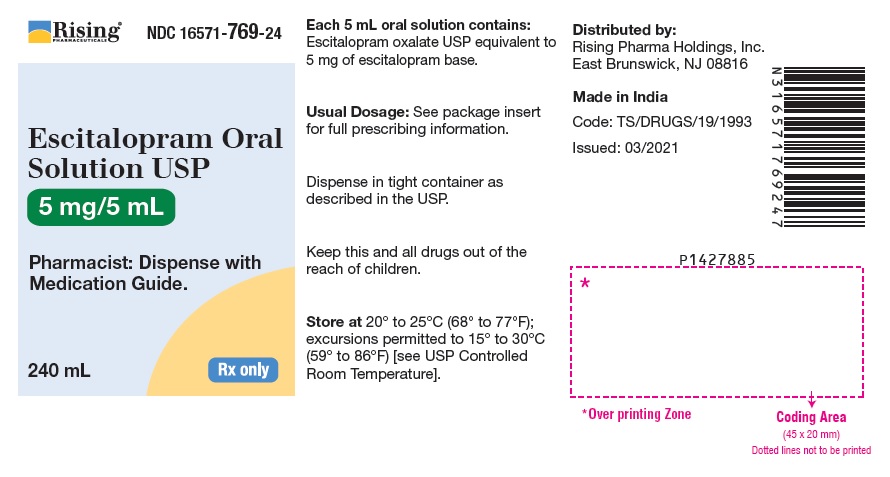
escitalopram 5 MG Oral Tablet — Selective serotonin reuptake inhibitors. INDICATIONS AND USAGE Escitalopram oxalate USP is a selective serotonin reuptake inhibitor (SSRI) indicated for: Acute and Maintenance Treatment of…
Boxed warning
WARNINGS: SUICIDALITY AND ANTIDEPRESSANT DRUGS Antidepressants increased the risk compared to placebo of suicidal thinking and behavior (suicidality) in children, adolescents, and young adults in short-term studies of major depressive disorder (MDD) and other psychiatric disorders. Anyone considering the use of Escitalopram or any other antidepressant in a child, adolescent, or young adult must balance this risk with the clinical need. Short-term studies did not show an increase in the risk of suicidality with antidepressants compared to placebo in adults beyond age 24; there was a reduction in risk with antidepressants compared to placebo in adults aged 65 and older. Depression and certain other psychiatric disorders are themselves associated with increases in the risk of suicide. Patients of all ages who are started on antidepressant therapy should be monitored appropriately and observed closely for clinical worsening, suicidality, or unusual changes in behavior. Families and caregivers should be advised of the need for close observation and communication with the prescriber. Escitalopram is not approved for use in pediatric patients less than 12 years of age. [See Warnings and Precautions: Clinical Worsening and Suicide Risk ( 5.1 ), Patient Counseling Information: Information for Patients ( 17.1 ), and Use in Specific Populations: Pediatric Use ( 8.4 )]. WARNING: Suicidality and Antidepressant Drugs See full prescribing information for complete boxed warning. Increased risk of suicidal thinking and behavior in children, adolescents and young adults taking antidepressants for major depressive disorder (MDD) and other psychiatric disorders. Escitalopram is not approved for use in pediatric patients less than 12 years of age ( 5.1 ). If you take Escitalopram tablets, you should not take any other medicines that contain escitalopram oxalate or citalopram hydrobromide including:
Escitalopram has several clinically important drug interactions that may increase the risk of serotonin syndrome or bleeding.
majorMonoamine Oxidase Inhibitors (MAOIs) — increases the risk of serotonin syndrome
majorpimozide — increases plasma concentrations of pimozide and may increase the risk of QT prolongation and/or ventricular arrhythmias
majorother serotonergic drugs — increases the risk of serotonin syndrome
majorNSAIDs, Aspirin, Warfarin — may potentiate the risk of bleeding
unknownsumatriptan — patients may experience weakness, hyperreflexia, and incoordination
moderatecarbamazepine — may increase the clearance of escitalopram
moderatedrugs metabolized by CYP2D6 — may increase plasma levels of drugs metabolized by CYP2D6
Indications
INDICATIONS AND USAGE Escitalopram oxalate USP is a selective serotonin reuptake inhibitor (SSRI) indicated for: Acute and Maintenance Treatment of Major Depressive Disorder (MDD) in adults and adolescents aged 12 to 17 years ( 1.1 ) Acute Treatment of Generalized Anxiety Disorder (GAD) in adults ( 1.2 ) 1.1 Major Depressive Disorder Escitalopram tablet USP is indicated for the acute and maintenance treatment of major depressive disorder in adults and in adolescents 12 to 17 years of age [ see Clinical Studies ( 14.1 ) ]. A major depressive episode (DSM-IV) implies a prominent and relatively persistent (nearly every day for at least 2 weeks) depressed or dysphoric mood that usually interferes with daily functioning, and includes at least five of the following nine symptoms: depressed mood, loss of interest in usual activities, significant change in weight and/or appetite, insomnia or hypersomnia, psychomotor agitation or retardation, increased fatigue, feelings of guilt or worthlessness, slowed thinking or impaired concentration, a suicide attempt or suicidal ideation. 1.2 Generalized Anxiety Disorder Escitalopram tablet USP is indicated for the acute treatment of Generalized Anxiety Disorder (GAD) in adults [ see Clinical Studies ( 14.2 ) ]. Generalized Anxiety Disorder (DSM-IV) is characterized by excessive anxiety and worry (apprehensive expectation) that is persistent for at least 6 months and which the person finds difficult to control. It must be associated with at least 3 of the following symptoms: restlessness or feeling keyed up or on edge, being easily fatigued, difficulty concentrating or mind going blank, irritability, muscle tension, and sleep disturbance.
Dosage
DOSAGE AND ADMINISTRATION Escitalopram tablets should be administered once daily, in the morning or evening, with or without food. Escitalopram tablets should generally be administered once daily, morning or evening with or without food ( 2.1 , 2.2 ). Indication Recommended Dose MDD in Adolescents ( 2.1 ) Initial: 10 mg once daily Recommended: 10 mg once daily Maximum: 20 mg once daily MDD in Adults ( 2.1 ) Initial: 10 mg once daily Recommended: 10 mg once daily Maximum: 20 mg once daily GAD in Adults ( 2.2 ) Initial: 10 mg once daily Recommended: 10 mg once daily No additional benefits seen at 20 mg/day dose ( 2.1 ). 10 mg/day is the recommended dose for most elderly patients and patients with hepatic impairment ( 2.3 ). No dosage adjustment for patients with mild or moderate renal impairment. Use caution in patients with severe renal impairment ( 2.3 ). Discontinuing escitalopram tablets: A gradual dose reduction is recommended ( 2.4 ). 2.1 Major Depressive Disorder Initial Treatment Adolescents The recommended dose of escitalopram tablet is 10 mg once daily. A flexible-dose trial of escitalopram tablets (10 to 20 mg/day) demonstrated the effectiveness of escitalopram oxalate [ see Clinical Studies ( 14.1 ) ]. If the dose is increased to 20 mg, this should occur after a minimum of three weeks. Adults The recommended dose of escitalopram tablet is 10 mg once daily. A fixed-dose trial of escitalopram tablets demonstrated the effectiveness of both 10 mg and 20 mg of escitalopram tablets, but failed to demonstrate a greater benefit of 20 mg over 10 mg [ see Clinical Studies ( 14.1 ) ]. If the dose is increased to 20 mg, this should occur after a minimum of one week. Maintenance Treatment It is generally agreed that acute episodes of major depressive disorder require several months or longer of sustained pharmacological therapy beyond response to the acute episode. Systematic evaluation of continuing escitalopram tablets 10 or 20 mg/day in adults patients with major depressive disorder who responded while taking escitalopram tablets during an 8-week, acute-treatment phase demonstrated a benefit of such maintenance treatment [see Clinical Studies ( 14.1 )]. Nevertheless, the physician who elects to use escitalopram tablets for extended periods should periodically re-evaluate the long-term usefulness of the drug for the individual patient. Patients should be periodically reassessed to determine the need for maintenance treatment. 2.2 Generalized Anxiety Disorder Initial Treatment Adults The recommended starting dose of escitalopram tablet is 10 mg once daily. If the dose is increased to 20 mg, this should occur after a minimum of one week. Maintenance Treatment Generalized anxiety disorder is recognized as a chronic condition. The efficacy of escitalopram tablets in the treatment of GAD beyond 8 weeks has not been systematically studied. The physician who elects to use escitalopram tablets for extended periods should periodically re-evaluate the long-term usefulness of the drug for the individual patient. 2.3 Screen for Bipolar Disorder Prior to Starting Escitalopram Tablets Prior to initiating treatment with escitalopram tablets or another antidepressant, screen patients for a personal family history of bipolar disorder, mania, or hypomania [see Warnings and Precautions ( 5.5 )]. 2.4 Special Populations 10 mg/day is the recommended dose for most elderly patients and patients with hepatic impairment. No dosage adjustment is necessary for patients with mild or moderate renal impairment. Escitalopram tablets should be used with caution in patients with severe renal impairment. 2.5 Discontinuation of Treatment with Escitalopram Tablets Symptoms associated with discontinuation of escitalopram tablets and other SSRIs and SNRIs have been reported [ see Warnings and Precautions ( 5.3 ) ]. Patients should be monitored for these symptoms when discontinuing treatment. A gradual reduction in the dose rather than abrupt cessation is recommended whenever possible. If intolerable symptoms occur following a decrease in the dose or upon discontinuation of treatment, then resuming the previously prescribed dose may be considered. Subsequently, the physician may continue decreasing the dose but at a more gradual rate. 2.6 Switching a Patient to or from a Monoamine Oxidase Inhibitor (MAOI) Intended to Treat Psychiatric Disorders At least 14 days should elapse between discontinuation of an MAOI intended to treat psychiatric disorders and initiation of therapy with escitalopram tablets. Conversely, at least 14 days should be allowed after stopping escitalopram tablets before starting an MAOI intended to treat psychiatric disorders [ see Contraindications ( 4.1 ) ]. 2.7 Use of Escitalopram Tablets with Other MAOIs such as Linezolid or Methylene Blue Do not start escitalopram tablets in a patient who is being treated with linezolid or intravenous methylene blue because there is an increased risk of serotonin syndrome. In a patient who requires more urgent treatment of a psychiatric condition, other interventions, including hospitalization, should be considered [ see Contraindications ( 4.1 ) ]. In some cases, a patient already receiving escitalopram tablets therapy may require urgent treatment with linezolid or intravenous methylene blue. If acceptable alternatives to linezolid or intravenous methylene blue treatment are not available and the potential benefits of linezolid or intravenous methylene blue treatment are judged to outweigh the risks of serotonin syndrome in a particular patient, escitalopram tablets should be stopped promptly, and linezolid or intravenous methylene blue can be administered. The patient should be monitored for symptoms of serotonin syndrome for 2 weeks or until 24 hours after the last dose of linezolid or intravenous methylene blue, whichever comes first. Therapy with escitalopram tablets may be resumed 24 hours after the last dose of linezolid or intravenous methylene blue [ see Warnings and Precautions ( 5.2 ) ]. The risk of administering methylene blue by non-intravenous routes (such as oral tablets or by local injection) or in intravenous doses much lower than 1 mg/kg with escitalopram tablet is unclear. The clinician should, nevertheless, be aware of the possibility of emergent symptoms of serotonin syndrome with such use [ see Warnings and Precautions ( 5.2 ) ].
Warnings
WARNINGS AND PRECAUTIONS • Serotonin Syndrome: Increased risk when co-administered with other serotonergic agents but also when taken alone. If it occurs, discontinue Escitalopram and serotonergic agents and initiate supportive treatment ( 4 , 5.2 ) • Discontinuation syndrome: When discontinuing Escitalopram, reduce dosage gradually whenever possible, and monitor for discontinuation symptoms ( 5.3 ) • Seizures: Use with caution in patients with a history of seizure ( 5.4 ) • Activation of Mania/Hypomania: Screen patients for bipolar disorder ( 5.5 ) • Hyponatremia: Can occur in association with syndrome of inappropriate antidiuretic hormone secretion ( 5.6 ) • Increased Risk of Bleeding: Concomitant use of nonsteroidal anti-inflammatory drugs, aspirin, other antiplatelet drugs, warfarin and other drugs that affect coagulation may increase risk ( 5.7 ) • Interference with Cognitive and Motor Performance: Use caution when operating machinery ( 5.8 ) • Angle Closure Glaucoma: Angle closure glaucoma has occurred in patients with untreated anatomically narrow angles treated with antidepressants ( 5.9 ) • Use in Patients with Concomitant Illness: Use caution in patients with diseases or conditions that produce altered metabolism or hemodynamic responses ( 5.10 ) • Sexual Dysfunction: Escitalopram may cause symptoms of sexual dysfunction ( 5.11 ) 5.1 Suicidal Thoughts and Behaviors in Adolescents and Young Adults In pooled analyses of placebo-controlled trials of antidepressant drugs (SSRIs and other antidepressant classes) that included approximately 77,000 adult patients and 4,500 pediatric patients, the incidence of suicidal thoughts and behaviors in the antidepressant-treated patients age 24 years and younger was greater than in placebo-treated patients. There was considerable variation in risk of suicidal thoughts and behaviors among drugs, but there was an increased risk identified in young patients for most drugs studied. There were differences in absolute risk of suicidal thoughts and behaviors across the different indications, with the highest incidence in patients with MDD. The drug-placebo differences in the number of cases of suicidal thoughts and behaviors per 1,000 patients treated are provided in Table 1. Table 1: Risk Differences of the Number of Patients of Suicidal Thoughts and Behaviors in the Pooled Placebo-Controlled Trials of Antidepressants in Pediatric and Adult Patients Age Range Drug-Placebo Difference in Number of Patients of Suicidal Thoughts and Behaviors per 1,000 Patients Treated Increases Compared to Placebo <18 years old 14 additional patients 18 to 24 years old 5 additional patients Decreases Compared to Placebo 25 to 64 years old 1 fewer patient ≥65 years old 6 fewer patients It is unknown whether the risk of suicidal thoughts and behaviors in children, adolescents, and young adults extends to longer-term use, i.e., beyond four months. However, there is substantial evidence from placebo-controlled maintenance trials in adults with MDD that antidepressants delay the recurrence of depression and that depression itself is a risk factor for suicidal thoughts and behaviors. Monitor all antidepressant-treated patients for any indication for clinical worsening and emergence of suicidal thoughts and behaviors, especially during the initial few months of drug therapy, and at times of dosage changes. Counsel family members or caregivers of patients to monitor for changes in behavior and to alert the healthcare provider. Consider changing the therapeutic regimen, including possibly discontinuing escitalopram, in patients whose depression is persistently worse, or who are experiencing emergent suicidal thoughts or behaviors. 5.2 Serotonin Syndrome SSRIs, including escitalopram tablets, can precipitate serotonin syndrome, a potentially life-threatening condition. The risk is increased with concomitant use of other serotonergic drugs (including triptans, tricyclic antidepressants, fentanyl, meperidine, methadone, lithium, tramadol, tryptophan, buspirone, amphetamines, and St. John’s Wort) and with drugs that impair metabolism of serotonin, i.e., MAOIs [see Contraindications ( 4 ) and Drug Interactions ( 7 )] . Serotonin syndrome symptoms may include mental status changes (e.g., agitation, hallucinations, delirium, and coma), autonomic instability (e.g., tachycardia, labile blood pressure, dizziness, diaphoresis, flushing, hyperthermia), neuromuscular symptoms (e.g., tremor, rigidity, myoclonus, hyperreflexia, incoordination) seizures, and/or gastrointestinal symptoms (e.g., nausea, vomiting, diarrhea). The concomitant use of escitalopram with MAOIs is contraindicated. In addition, do not initiate Escitalopram in a patient who is being treated with MAOIs such as linezolid or intravenous methylene blue. No reports involved the administration of methylene blue by other routes (such as oral tablets or local tissue injection). If it is necessary to initiate treatment with an MAOI such as linezolid or intravenous methylene blue in a patient taking Escitalopram, discontinue Escitalopram before initiating treatment with the MAOI [see Contraindications (4) and Dosage and Administration ( 2.7 )] . Monitor all patients taking escitalopram tablets for the emergence of serotonin syndrome. Discontinue treatment with escitalopram tablets and any concomitant serotonergic agents immediately if the above symptoms occur, and initiate supportive symptomatic treatment. If concomitant use of escitalopram with other serotonergic drugs is clinically warranted, inform patients of the increased risk for serotonin syndrome and monitor for symptoms. 5.3 Discontinuation Syndrome During marketing of escitalopram tablets and other SSRIs, there have been spontaneous reports of adverse reactions occurring upon discontinuation of these drugs, particularly when abrupt, including the following: dysphoric mood, irritability, agitation, dizziness, sensory disturbances (e.g., paresthesias such as electric shock sensations), anxiety, confusion, headache, lethargy, emotional lability, insomnia, and hypomania. While these events are generally self-limiting, there have been reports of serious discontinuation symptoms. Monitor for these symptoms when discontinuing treatment with escitalopram. A gradual reduction in the dose rather than abrupt cessation is recommended whenever possible. If intolerable symptoms occur following a decrease in the dose or upon discontinuation of treatment, then resuming the previously prescribed dose may be considered. Subsequently, the physician may continue decreasing the dose but at a more gradual rate [see Dosage and Administration ( 2.6 )] . 5.4 Seizures Although anticonvulsant effects of racemic citalopram have been observed in animal studies, escitalopram has not been systematically evaluated in patients with a seizure disorder. These patients were excluded from clinical studies during the product's premarketing testing. In clinical trials of escitalopram, cases of convulsion have been reported in association with escitalopram treatment. Like other drugs effective in the treatment of major depressive disorder, escitalopram tablets should be introduced with care in patients with a history of seizure disorder. 5.5 Activation of Mania or Hypomania In patients with bipolar disorder, treating a depressive episode with escitalopram or another antidepressant may precipitate a mixed/manic episode. In placebo-controlled trials of escitalopram in major depressive disorder, activation of mania/hypomania was reported in one (0.1%) of 715 patients treated with escitalopram and in none of the 592 patients treated with placebo. One additional case of hypomania has been reported in association with escitalopram treatment. Activation of mania/hypomania has also been reported in a small proportion of patients with major affective disorders treated with racemic citalopram and other marketed drugs effective in the treatment of major depressive disorder. Prior to
Contraindications
CONTRAINDICATIONS • Serotonin Syndrome and MAOIs: Do not use MAOIs intended to treat psychiatric disorders with Escitalopram tablets or within 14 days of stopping treatment with Escitalopram tablets. Do not use Escitalopram tablets within 14 days of stopping an MAOI intended to treat psychiatric disorders. In addition, do not start Escitalopram tablets in a patient who is being treated with linezolid or intravenous methylene blue ( 4.1 ). • Pimozide: Do not use concomitantly ( 4.2 ). • Known hypersensitivity to escitalopram or citalopram or any of the inactive ingredients ( 4.3 ). 4.1 Monoamine Oxidase Inhibitors (MAOIs) The use of MAOIs intended to treat psychiatric disorders with Escitalopram tablets or within 14 days of stopping treatment with Escitalopram tablets is contraindicated because of an increased risk of serotonin syndrome. The use of Escitalopram tablets within 14 days of stopping an MAOI intended to treat psychiatric disorders is also contraindicated [ see Dosage and Administration ( 2.5 ), and Warnings and Precautions ( 5.2 ) ]. Starting Escitalopram tablets in a patient who is being treated with MAOIs such as linezolid or intravenous methylene blue is also contraindicated because of an increased risk of serotonin syndrome [ see Dosage and Administration ( 2.6 ), and Warnings and Precautions ( 5.2 )]. 4.2 Pimozide Concomitant use in patients taking pimozide is contraindicated [ see Drug Interactions ( 7.10 ) ]. 4.3 Hypersensitivity to escitalopram or citalopram Escitalopram tablets are contraindicated in patients with a hypersensitivity to escitalopram or citalopram or any of the inactive ingredients in Escitalopram tablets.
Mechanism of action
CLINICAL PHARMACOLOGY 12.1 Mechanism of Action The mechanism of antidepressant action of escitalopram, the S-enantiomer of racemic citalopram, is presumed to be linked to potentiation of serotonergic activity in the central nervous system (CNS) resulting from its inhibition of CNS neuronal reuptake of serotonin (5-HT). 12.2 Pharmacodynamics In vitro and in vivo studies in animals suggest that escitalopram is a highly selective serotonin reuptake inhibitor (SSRI) with minimal effects on norepinephrine and dopamine neuronal reuptake. Escitalopram is at least 100-fold more potent than the R-enantiomer with respect to inhibition of 5-HT reuptake and inhibition of 5-HT neuronal firing rate. Tolerance to a model of antidepressant effect in rats was not induced by long-term (up to 5 weeks) treatment with escitalopram. Escitalopram has no or very low affinity for serotonergic (5-HT 1-7 ) or other receptors including alpha- and beta-adrenergic, dopamine (D 1-5 ), histamine (H 1-3 ), muscarinic (M 1-5 ), and benzodiazepine receptors. Escitalopram also does not bind to, or has low affinity for, various ion channels including Na + , K + , Cl - , and Ca ++ channels. Antagonism of muscarinic, histaminergic, and adrenergic receptors has been hypothesized to be associated with various anticholinergic, sedative, and cardiovascular side effects of other psychotropic drugs. 12.3 Pharmacokinetics The single- and multiple-dose pharmacokinetics of escitalopram are linear and dose-proportional in a dose range of 10 to 30 mg/day. With once-daily dosing, steady-state plasma concentrations are achieved within approximately one week. At steady-state, the extent of accumulation of escitalopram in plasma in young healthy subjects was 2.2 to 2.5 times the plasma concentrations observed after a single dose. Absorption The absolute bioavailability of citalopram is about 80% relative to an intravenous dose. The tablet and the oral solution dosage forms of escitalopram oxalate are bioequivalent. Following a single oral dose (20 mg) of escitalopram, peak blood levels occur at about 5 hours. Absorption of escitalopram is not affected by food. Distribution The binding of escitalopram to human plasma proteins is approximately 56%. The volume of distribution of citalopram is about 12 L/kg. Data specific on escitalopram are unavailable. Elimination Biotransformation of escitalopram is mainly hepatic, with a mean terminal half-life of about 27 to 32 hours. The oral clearance of escitalopram is 600 mL/min, with approximately 7% of that due to renal clearance. Metabolism Escitalopram is metabolized to S-DCT and S-didemethylcitalopram (S-DDCT). In humans, unchanged escitalopram is the predominant compound in plasma. At steady-state, the concentration of the escitalopram metabolite S-DCT in plasma is approximately one-third that of escitalopram. The level of S-DDCT was not detectable in most subjects. In vitro studies show that escitalopram is at least 7 and 27 times more potent than S-DCT and S-DDCT, respectively, in the inhibition of serotonin reuptake, suggesting that the metabolites of escitalopram do not contribute significantly to the antidepressant actions of escitalopram. S-DCT and S-DDCT also have no or very low affinity for serotonergic (5-HT 1-7 ) or other receptors including alpha- and beta-adrenergic, dopamine (D 1-5 ), histamine (H 1-3 ), muscarinic (M 1-5 ), and benzodiazepine receptors. S-DCT and S-DDCT also do not bind to various ion channels including Na + , K + , Cl - , and Ca ++ channels. In vitro studies using human liver microsomes indicated that CYP3A4 and CYP2C19 are the primary isozymes involved in the N-demethylation of escitalopram. Excretion Following oral administrations of escitalopram, the fraction of drug recovered in the urine as escitalopram and S-demethylcitalopram (S-DCT) is about 8% and 10%, respectively. Specific Populations Pediatric Patients Pediatric patients 12 to 17 years of age: In a single dose study of 10 mg escitalopram, AUC of escitalopram decreased by 19%, and C max increased by 26% in healthy pediatric subjects 12 to 17 years of age compared to adults. Following multiple dosing of 40 mg/day citalopram, escitalopram elimination half-life, steady-state C max and AUC were similar in pediatric patients 12 to 17 years of age with MDD compared to adults [see Use in Specific Populations (8.4) ] . Geriatric Patients Escitalopram pharmacokinetics in subjects ≥ 65 years of age were compared to adults in a single-dose and a multiple-dose study. Escitalopram AUC and half-life were increased by approximately 50% in elderly subjects, and C max was unchanged [see Dosage and Administration (2.5) , Use in Specific Populations (8.5) ] . Male and Female Patients Based on data from single- and multiple-dose studies measuring escitalopram in elderly, young adults and adolescents, no dosage adjustment on the basis of gender is needed. Patients with Hepatic Impairment Citalopram oral clearance was reduced by 37% and half-life was doubled in patients with reduced hepatic function compared to normal subjects [see Dosage and Administration (2.5) , Use in Specific Populations (8.6) ] . Patients with Renal Impairment In patients with mild to moderate renal function impairment, oral clearance of citalopram was reduced by 17% compared to normal subjects. No information is available about the pharmacokinetics of escitalopram in patients with severely reduced renal function (creatinine clearance < 20 mL/min) [see Use in Specific Populations (8.7) ] . Drug Interaction Studies In vitro enzyme inhibition data did not reveal an inhibitory effect of escitalopram on CYP3A4, -1A2, -2C9, -2C19, and -2E1. Based on in vitro data, escitalopram would be expected to have little inhibitory effect on in vivo metabolism mediated by these cytochromes. While in vivo data to address this question are limited, results from drug interaction studies suggest that escitalopram, at a dose of 20 mg, has no 3A4 inhibitory effect and a modest 2D6 inhibitory effect [see Drug Interactions (7) ] . CYP3A4 and CYP2C19 Inhibitors In vitro studies indicated that CYP3A4 and -2C19 are the primary enzymes involved in the metabolism of escitalopram. However, co-administration of escitalopram (20 mg) and ritonavir (600 mg), a potent inhibitor of CYP3A4, did not significantly affect the pharmacokinetics of escitalopram. Because escitalopram is metabolized by multiple enzyme systems, inhibition of a single enzyme may not appreciably decrease escitalopram clearance. Cimetidine In subjects who had received 21 days of 40 mg/day racemic citalopram, combined administration of 400 mg twice a day cimetidine for 8 days resulted in an increase in citalopram AUC and C max of 43% and 39%, respectively. The clinical significance of these findings is unknown. Digoxin In subjects who had received 21 days of 40 mg/day racemic citalopram, combined administration of citalopram and digoxin (single dose of 1 mg) did not significantly affect the pharmacokinetics of either citalopram or digoxin. Lithium Co-administration of racemic citalopram (40 mg/day for 10 days) and lithium (30 mmol/day for 5 days) had no significant effect on the pharmacokinetics of citalopram or lithium. Plasma lithium levels should be monitored with appropriate adjustment to the lithium dose in accordance with standard clinical practice. Because lithium may enhance the serotonergic effects of escitalopram, caution should be exercised when escitalopram and lithium are co-administered. Theophylline Combined administration of racemic citalopram (40 mg/day for 21 days) and the CYP1A2 substrate theophylline (single dose of 300 mg) did not affect the pharmacokinetics of theophylline. The effect of theophylline on the pharmacokinetics of citalopram was not evaluated. Ketoconazole Combined administration of racemic citalopram (40 mg) and ketoconazole (200 mg), a potent CYP3A4 inhibitor, decreased the C max and AUC of ketoconazole by 21% and 10%, respectively, and did not
A drug lookup is just the start. Eleplan keeps the whole care plan in one place.
Medications, diagnoses, documents, appointments, and the whole care team — organized and always in sync, with Ellie, your AI care assistant, on top of it. Free to start.