givinostat 8.86 MG/ML Oral Suspension
Managing this medication for someone you care for? Eleplan keeps diagnoses, medications and appointments in one plan.
Start free with EleplanClinical drug
givinostat 8.86 MG/ML Oral Suspension
8.86 MG/ML · Oral Suspension · oral
A form of givinostat →
givinostat 8.86 MG/ML Oral Suspension — Other drugs for disorders of the musculo-skeletal system. INDICATIONS AND USAGE DUVYZAT is indicated for the treatment of Duchenne muscular dystrophy (DMD) in patients 6 years of age and older. DUVYZAT is a…
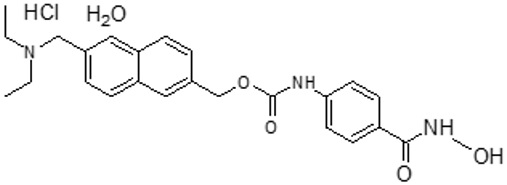
Active ingredient
Classification
Other drugs for disorders of the musculo-skeletal systemHistone Deacetylase Inhibitor
Drug interactions
The label indicates several drug interactions with givinostat, particularly concerning CYP3A4 and OCT2 substrates, as well as drugs that prolong the QTc interval.
- majorCYP3A4 sensitive substrates — may lead to serious toxicities due to small changes in substrate plasma concentration
- majorOCT2 sensitive substrates — may lead to serious toxicities due to small changes in substrate plasma concentration
- majordrugs that prolong the QTc interval — may result in a greater increase in the QTc interval and adverse reactions associated with QTc interval prolongation
Indications
INDICATIONS AND USAGE DUVYZAT is indicated for the treatment of Duchenne muscular dystrophy (DMD) in patients 6 years of age and older. DUVYZAT is a histone deacetylase inhibitor indicated for the treatment of Duchenne muscular dystrophy (DMD) in patients 6 years of age and older. ( 1 )
Dosage
DOSAGE AND ADMINISTRATION Obtain and evaluate baseline platelet counts and triglycerides prior to initiation of DUVYZAT. Do not initiate DUVYZAT in patients with a platelet count less than 150 x 10^9/L. ( 2.1 , 5.1 , 5.2 ) The dosage of DUVYZAT is based on patient’s body weight. ( 2.2 ) Administer orally twice daily with food. ( 2.2 ) Dosage modifications may be needed for decreased platelet counts, diarrhea, increased triglycerides, or QTc prolongation. ( 2.3 , 5.1 , 5.2 , 5.3 , 5.4 ) 2.1 Recommended Evaluation and Testing Before Initiation of DUVYZAT Obtain and evaluate baseline platelet counts and triglycerides prior to initiation of DUVYZAT [see Warnings and Precautions (5.1 , 5.2) ] . Do not initiate DUVYZAT in patients with a platelet count less than 150 x 10 9 /L. Monitor platelet counts and triglycerides as recommended during treatment to determine if dosage modifications are needed [see Dosage and Administration (2.3) ]. In addition, in patients with underlying cardiac disease or taking concomitant medications that cause QT prolongation, obtain ECGs when initiating treatment with DUVYZAT, during concomitant use, and as clinically indicated [see Dosage and Administration (2.3) , Warnings and Precautions (5.4) , and Drug Interactions (7.2) ] . 2.2 Recommended Dosage The recommended dosage of DUVYZAT is based on body weight and administered orally twice daily with food (see Table 1 ) [see Dosage and Administration (2.4) ] . Table 1: Recommended Dosage in Patients 6 Years of Age and Older for the Treatment of DMD Weight Based on actual body weight Dosage Oral Suspension Volume 10 kg to less than 20 kg 22.2 mg twice daily 2.5 mL twice daily 20 kg to less than 40 kg 31 mg twice daily 3.5 mL twice daily 40 kg to less than 60 kg 44.3 mg twice daily 5 mL twice daily 60 kg or more 53.2 mg twice daily 6 mL twice daily 2.3 Dosage Modifications for Adverse Reactions Decrease in Platelets, Diarrhea, Increase in Triglycerides DUVYZAT may cause adverse reactions [see Warnings and Precautions (5.1 , 5.2 , 5.3) ], which may necessitate a dosage modification (see Table 2 ) if the following occur: Platelet count <150 x 10 9 /L verified in two assessments one week apart or Moderate or severe diarrhea or Fasting triglycerides >300 mg/dL verified by two assessments one week apart Based on the severity of these adverse reactions, treatment interruption prior to dosage modification should be considered. Table 2: Dosage Modifications for Adverse Reactions in Patients 6 Years of Age and Older for the Treatment of DMD First Dosage Modification If the adverse reaction(s) persist after the first dosage modification, proceed to the second dosage modification. Second Dosage Modification If the adverse reaction(s) persist after the second dosage modification, DUVYZAT should be discontinued. Weight Based on actual body weight Dosage Oral Suspension Volume Dosage Oral Suspension Volume 10 kg to less than 20 kg 17.7 mg twice daily 2 mL twice daily 13.3 mg twice daily 1.5 mL twice daily 20 kg to less than 40 kg 22.2 mg twice daily 2.5 mL twice daily 17.7 mg twice daily 2 mL twice daily 40 kg to less than 60 kg 31 mg twice daily 3.5 mL twice daily 26.6 mg twice daily 3 mL twice daily 60 kg or more 39.9 mg twice daily 4.5 mL twice daily 35.4 mg twice daily 4 mL twice daily QTc Interval Prolongation Withhold DUVYZAT if the QTc interval is > 500 ms or the change from baseline is > 60 ms [see Warnings and Precautions (5.4) and Drug Interactions (7.2) ]. 2.4 Preparation and Administration Instructions See the Instructions for Use for further details. Before use, shake the DUVYZAT suspension for at least 30 seconds by inverting the bottle by 180°. Visually verify the homogeneity of the suspension. Using a graduated oral syringe, measure the appropriate volume of suspension corresponding to the prescribed dose of DUVYZAT. Administer orally with the provided graduated oral syringe. 2.5 Missed Dose If a dose is missed, patients should not take double or extra doses.
Warnings
WARNINGS AND PRECAUTIONS Hematological Changes: DUVYZAT can cause dose-related thrombocytopenia and other signs of myelosuppression, including anemia and neutropenia. Monitor platelets; dosage adjustment or discontinuation may be needed. ( 2.3 , 5.1 ) Increased Triglycerides: An increase in triglycerides can occur; dosage modification may be needed. Discontinuation may be needed. ( 2.3 , 5.2 ) Gastrointestinal Disturbances: Adjust dosage if moderate or severe diarrhea occurs. Antiemetics or antidiarrheal medications may be considered during treatment with DUVYZAT. Discontinue DUVYZAT if the symptoms persist. ( 2.3 , 5.3 ) QTc Prolongation: Avoid use of DUVYZAT in patients who are at an increased risk for ventricular arrhythmias. ( 2.1 , 5.4 , 7.2 ) 5.1 Hematological Changes DUVYZAT can cause dose-related thrombocytopenia and other signs of myelosuppression, including decreased hemoglobin and neutropenia. In Study 1 [see Clinical Studies (14) ] , thrombocytopenia occurred in 33% of patients treated with DUVYZAT compared to no patients on placebo. The maximum decrease in platelets occurred within the first 2 months of therapy and remained low throughout the course of therapy. In a few patients, thrombocytopenia was associated with bleeding events including epistaxis, hematoma or contusions. Low platelet counts resulted in DUVYZAT dose reduction in 28% of patients. Patients with baseline platelet counts below the lower limit of normal were excluded from the study. Decreased hemoglobin and decreased neutrophils were also observed in patients treated with DUVYZAT compared to placebo. Monitor blood counts every 2 weeks for the first 2 months of treatment, at month 3, and then every 3 months thereafter. Modify the dosage of DUVYZAT for confirmed thrombocytopenia [see Dosage and Administration (2.3) ] . Treatment should be permanently discontinued if the abnormalities worsen despite dose modification. If a patient develops signs or symptoms of thrombocytopenia, obtain a platelet count as soon as possible, and hold dosing until platelet count is confirmed. 5.2 Increased Triglycerides DUVYZAT can cause elevations in triglycerides. In Study 1 [see Clinical Studies (14) ] , hypertriglyceridemia occurred in 23% of patients treated with DUVYZAT (one of whom had familial hypertriglyceridemia) compared to 7% of patients on placebo. High triglycerides (i.e., levels greater than 300 mg/dL) resulted in discontinuation and led to dosage modification in 2% and 8%, respectively, of patients treated with DUVYZAT. Monitor triglycerides at 1 month, 3 months, 6 months, and then every 6 months thereafter. Modify the dosage if fasting triglycerides are verified > 300 mg/dL [see Dosage and Administration (2.3) ] . Treatment with DUVYZAT should be discontinued if triglycerides remain elevated despite adequate dietary intervention and dosage adjustment. 5.3 Gastrointestinal Disturbances Gastrointestinal disturbances, including diarrhea, nausea/vomiting, and abdominal pain were common adverse reactions in DUVYZAT clinical trials in DMD. In Study 1, diarrhea was reported in 37% of patients treated with DUVYZAT (with 1 severe case reported) compared to 20% of patients on placebo. Diarrhea usually occurred within the first few weeks of initiation of treatment with DUVYZAT. Vomiting and nausea, sometimes severe and usually occurring within the first 2 months of treatment, occurred in 32% of patients treated with DUVYZAT compared to 18% of patients on placebo. Abdominal pain occurred in 34% of patients treated with DUVYZAT compared to 25% of patients on placebo. One case of abdominal pain was serious. Antiemetics or antidiarrheal medications may be considered during treatment with DUVYZAT. Fluid and electrolytes should be replaced as needed to prevent dehydration [see Warnings and Precautions (5.4) ] . Modify the dosage of DUVYZAT in patients with moderate or severe diarrhea, and treatment should be discontinued if significant symptoms persist [see Dosage and Administration (2.3) ] . 5.4 QTc Prolongation DUVYZAT can cause prolongation of QTc interval [see Clinical Pharmacology (12.2) ] . Avoid use of DUVYZAT in patients who are at an increased risk for ventricular arrhythmias (including torsades de pointes), such as those with congenital long QT syndrome, coronary artery disease, electrolyte disturbance [see Warnings and Precautions (5.3) ] , concomitant use of other medicinal products known to cause QT prolongation [see Drug Interactions (7.2) ] . Obtain ECGs prior to initiating treatment with DUVYZAT in patients with underlying cardiac disease or in patients who are taking concomitant medications that cause QT prolongation [see Dosage and Administration (2.1) ] .
Contraindications
CONTRAINDICATIONS None. None. ( 4 )
Mechanism of action
Mechanism of Action DUVYZAT is a histone deacetylase inhibitor. The precise mechanism by which DUVYZAT exerts its effect in patients with DMD is unknown.
Indicated ICD-10 codes
Source: RxNorm + openFDA + RxClass + FAERS · 2026
Look up another medication