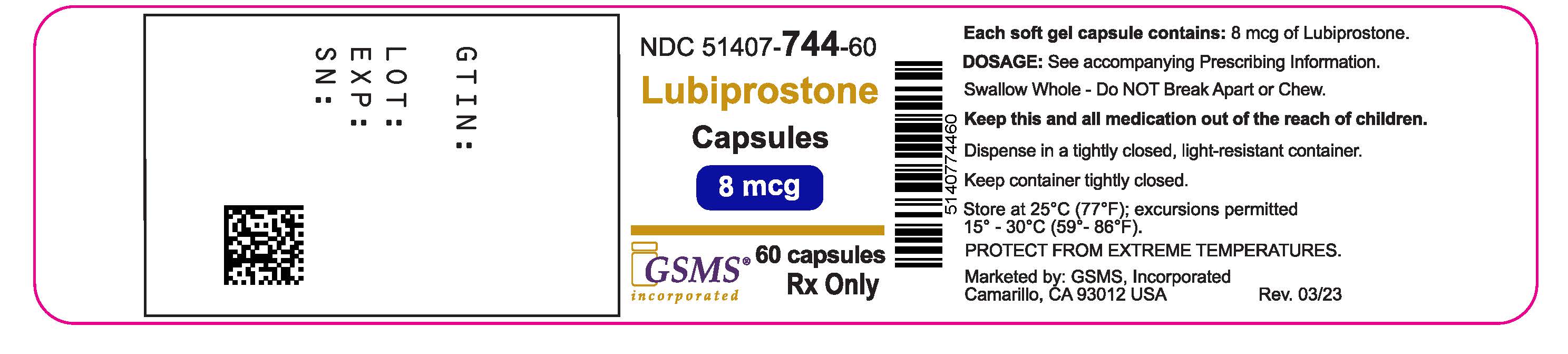
lubiprostone 0.024 MG Oral Capsule
Managing this medication for someone you care for? Eleplan keeps diagnoses, medications and appointments in one plan.
Start free with EleplanClinical drug
lubiprostone 0.024 MG Oral Capsule
0.024 MG · Oral Capsule · oral
A form of lubiprostone →
lubiprostone 0.024 MG Oral Capsule — Other drugs for constipation. 1. INDICATIONS AND USAGE Lubiprostone capsules is a chloride channel activator indicated for the treatment of: chronic idiopathic constipation (CIC)…
Active ingredient
Classification
Other drugs for constipationChloride Channel Activator
Drug interactions
Lubiprostone may have reduced efficacy when used with diphenylheptane opioids such as methadone.
- moderatemethadone — possible decrease in efficacy of lubiprostone
Indications
1. INDICATIONS AND USAGE Lubiprostone capsules is a chloride channel activator indicated for the treatment of: chronic idiopathic constipation (CIC) in adults. (1.1) opioid-induced constipation (OIC) in adult patients with chronic, non-cancer pain, including patients with chronic pain related to prior cancer or its treatment who do not require frequent (e.g., weekly) opioid dosage escalation. (1.2) o Limitations of Use: Effectiveness of lubiprostone capsules in the treatment of OIC in patients taking diphenylheptane opioids (e.g., methadone) has not been established. (1.2, 7.1) irritable bowel syndrome with constipation (IBS-C) in women ≥18 years old. (1.3) 1.1 Chronic Idiopathic Constipation in Adults Lubiprostone capsules are indicated for the treatment of chronic idiopathic constipation (CIC) in adults. 1.2 Opioid-Induced Constipation in Adult Patients with Chronic Non-Cancer Pain Lubiprostone capsules are indicated for the treatment of opioid-induced constipation (OIC) in adult patients with chronic non-cancer pain, including patients with chronic pain related to prior cancer or its treatment who do not require frequent (e.g., weekly) opioid dosage escalation. Limitations of Use: Effectiveness of lubiprostone capsules in the treatment of opioid-induced constipation in patients taking diphenylheptane opioids (e.g., methadone) has not been established. [see Clinical Studies (14.2)] 1.3 Irritable Bowel Syndrome with Constipation Lubiprostone capsules are indicated for the treatment of irritable bowel syndrome with constipation (IBS-C) in women at least 18 years old.
Dosage
DOSAGE AND ADMINISTRATION Recommended Dosage ( 2.1 ) • CIC and OIC: 24 mcg twice daily. • IBS-C: 8 mcg twice daily. • See full prescribing information for dosage adjustment by indication and degree of hepatic impairment. Administration Instructions ( 2.2 ) • Swallow capsules whole and do not break apart or chew, • Take capsules with food and water, • Assess periodically the need for continuous therapy. 2.1 Recommended Dosage The recommended oral dosage of lubiprostone by indication and adjustments for patients with moderate (Child Pugh Class B) and severe (Child Pugh Class C) hepatic impairment are shown in Table 1. Table 1. Recommended Dosage Regimen CIC and OIC IBS-C Recommended Adult Dosage Regimen 24 mcg twice daily 8 mcg twice daily Dosage Adjustment for Hepatic Impairment [see Use in Specific Populations (8.6) ] Moderate Impairment (Child-Pugh Class B) : 16 mcg twice daily If the dose is tolerated and an adequate response has not been obtained after an appropriate interval, doses can then be escalated to full dosing with appropriate monitoring of patient response. Moderate Impairment (Child-Pugh Class B) : No adjustment necessary Severe Impairment (Child-Pugh Class C) : 8 mcg twice daily Severe Impairment (Child-Pugh Class C) : 8 mcg once daily 2.2 Administration Instructions • Take lubiprostone orally with food and water. • Swallow capsules whole and do not break apart or chew. • Physicians and patients should periodically assess the need for continued therapy.
Warnings
5. WARNINGS AND PRECAUTIONS Nausea : Patients may experience nausea; concomitant administration of food may reduce this symptom. (2.2, 5.1) Diarrhea : Avoid use in patients with severe diarrhea. Instruct patients to discontinue lubiprostone capsules and contact their healthcare provider if severe diarrhea occurs during treatment. (5.2) Syncope and Hypotension : May occur after taking the first dose or with subsequent doses. Generally resolves prior to the next dose, but may recur with repeat dosing. Instruct patients to discontinue lubiprostone capsules and contact their healthcare provider if symptoms occur. (5.3) Dyspnea : May occur within an hour of first dose. Generally resolves within 3 hours, but may recur with repeat dosing. Instruct patients to contact their healthcare provider if symptoms occur. (5.4) Bowel Obstruction : Evaluate patients with symptoms suggestive of mechanical gastrointestinal obstruction prior to initiating treatment with lubiprostone capsules. (4, 5.5) 5.1 Nausea Patients taking lubiprostone capsules may experience nausea. Concomitant administration of food with lubiprostone capsules may reduce symptoms of nausea [see Adverse Reactions (6.1)]. 5.2 Diarrhea Avoid use of lubiprostone capsules in patients with severe diarrhea. Patients should be aware of the possible occurrence of diarrhea during treatment. Instruct patients to discontinue lubiprostone capsules and contact their healthcare provider if severe diarrhea occurs [see Adverse Reactions (6.1)]. 5.3 Syncope and Hypotension Syncope and hypotension have been reported with lubiprostone in the postmarketing setting and a few of these adverse reactions resulted in hospitalization. Most cases occurred in patients taking 24 mcg twice daily and some occurred within an hour after taking the first dose or subsequent doses of lubiprostone capsules. Some patients had concomitant diarrhea or vomiting prior to developing the adverse reaction. Syncope and hypotension generally resolved following lubiprostone discontinuation or prior to next dose, but recurrence has been reported with subsequent doses. Several cases reported concomitant use of medications known to lower blood pressure, which may increase the risk for the development of syncope or hypotension. Patients should be aware of the risk of syncope and hypotension during treatment and that other adverse reactions may increase this risk, such as diarrhea or vomiting. 5.4 Dyspnea In clinical trials, dyspnea was reported by 3%, 1%, and <1% of the treated CIC, OIC, and IBS-C populations receiving lubiprostone capsules, respectively, compared to 0%, 1%, and <1% of placebo-treated patients. There have been postmarketing reports of dyspnea when using lubiprostone capsules 24 mcg twice daily. Some patients have discontinued treatment because of dyspnea. These events have usually been described as a sensation of chest tightness and difficulty taking in a breath, and generally have an acute onset within 30 to 60 minutes after taking the first dose. They generally resolve within a few hours after taking the dose, but recurrence has been frequently reported with subsequent doses. Instruct patients to contact their healthcare provider if dyspnea occurs. 5.5 Bowel Obstruction In patients with symptoms suggestive of mechanical gastrointestinal obstruction, perform a thorough evaluation to confirm the absence of an obstruction prior to initiating therapy with lubiprostone capsules [see Contraindications (4)].
Contraindications
4. CONTRAINDICATIONS Lubiprostone capsules are contraindicated in patients with known or suspected mechanical gastrointestinal obstruction [see Warnings and Precautions (5.5)]. Patients with known or suspected mechanical gastrointestinal obstruction. (4, 5.5)
Mechanism of action
Mechanism of Action Lubiprostone is a locally acting chloride channel activator that enhances a chloride-rich intestinal fluid secretion without altering sodium and potassium concentrations in the serum. Lubiprostone acts by specifically activating ClC-2, which is a normal constituent of the apical membrane of the human intestine, in a protein kinase A–independent fashion. By increasing intestinal fluid secretion, lubiprostone increases motility in the intestine, thereby facilitating the passage of stool and alleviating symptoms associated with chronic idiopathic constipation. Patch clamp cell studies in human cell lines have indicated that the majority of the beneficial biological activity of lubiprostone and its metabolites is observed only on the apical (luminal) portion of the gastrointestinal epithelium. Lubiprostone, via activation of apical ClC-2 channels in intestinal epithelial cells, bypasses the antisecretory action of opiates that results from suppression of secretomotor neuron excitability. Activation of ClC-2 by lubiprostone has also been shown to stimulate recovery of mucosal barrier function and reduce intestinal permeability via the restoration of tight junction protein complexes in ex vivostudies of ischemic porcine intestine. 12.2 Pharmacodynamics Although the pharmacologic effects of lubiprostone in humans have not been fully evaluated, animal studies have shown that oral administration of lubiprostone increases chloride ion transport into the intestinal lumen, enhances fluid secretion into the bowels, and improves fecal transit. 12.3 Pharmacokinetics Following oral administration, concentrations of lubiprostone in plasma are below the level of quantitation (10 pg/mL). Therefore, standard pharmacokinetic parameters such as area under the curve (AUC), maximum concentration (C max), and half-life (t ½) cannot be reliably calculated. However, the pharmacokinetic parameters of M3 (only measurable active metabolite of lubiprostone) have been characterized. Absorption Peak plasma concentrations of M3, after a single oral dose of 24 mcg of lubiprostone, occurred at approximately 1.1 hours. The C maxwas 41.5 pg/mL and the mean AUC 0–twas 57.1 pg∙hr/mL. The AUC 0–tof M3 increases dose proportionally after single 24-mcg and 144-mcg doses of lubiprostone (6-times the maximum recommended 24 mcg dose). Food Effect A study was conducted with a single 72-mcg dose of 3H-labeled lubiprostone (3-times the maximum recommended 24 mcg dose) to evaluate the potential of a food effect on lubiprostone absorption, metabolism, and excretion. Pharmacokinetic parameters of total radioactivity demonstrated that C maxdecreased by 55% while AUC 0–∞was unchanged when lubiprostone was administered with a high-fat meal. The clinical relevance of the effect of food on the pharmacokinetics of lubiprostone is not clear. However, lubiprostone was administered with food and water in a majority of clinical trials. Distribution In vitroprotein binding studies indicate lubiprostone is approximately 94% bound to human plasma proteins. Elimination Metabolism Lubiprostone is rapidly and extensively metabolized by 15-position reduction, α-chain β-oxidation, and ω-chain ω-oxidation. In vitrostudies using human liver microsomes indicate that cytochrome P450 isoenzymes are not involved in the metabolism of lubiprostone. Further in vitrostudies indicate that M3, a metabolite of lubiprostone, is formed by the reduction of the 15-carbonyl moiety to a hydroxy moiety by microsomal carbonyl reductase. M3 makes up less than 10% of the dose of radiolabeled lubiprostone. Animal studies have shown that metabolism of lubiprostone rapidly occurs within the stomach and jejunum, most likely in the absence of any systemic absorption. Excretion Lubiprostone could not be detected in plasma; however, M3 has a t ½ranging from 0.9 to 1.4 hours. After a single oral dose of 72 mcg of 3H-labeled lubiprostone, 60% of total administered radioactivity was recovered in the urine within 24 hours and 30% of total administered radioactivity was recovered in the feces by 168 hours. Lubiprostone and M3 are only detected in trace amounts in human feces. Specific Populations Male and Female Patients The pharmacokinetics of M3 were similar between male and female subjects. Patients with Renal Impairment Sixteen subjects, 34 to 47 years old (8 severe renally impaired subjects [creatinine clearance (CrCl) less than 20 mL/min] who required hemodialysis and 8 control subjects with normal renal function [CrCl above 80 mL/min]), received a single oral 24-mcg dose of lubiprostone. Following administration, lubiprostone plasma concentrations were below the limit of quantitation (10 pg/mL). Plasma concentrations of M3 were within the range of exposure from previous clinical experience with lubiprostone. Patients with Hepatic Impairment Twenty-five subjects, 38 to 78 years old (9 with severe hepatic impairment [Child-Pugh Class C], 8 with moderate impairment [Child-Pugh Class B], and 8 with normal liver function), received either 12 mcg or 24 mcg of lubiprostone under fasting conditions. Following administration, lubiprostone plasma concentrations were below the limit of quantitation (10 pg/mL) except for two subjects. In moderately and severely impaired subjects, the C maxand AUC 0–tof the active lubiprostone metabolite M3 were increased, as shown in Table 5. Table 5. Pharmacokinetic Parameters of the Metabolite M3 for Subjects with Normal or Impaired Liver Function following Dosing with lubiprostone Liver Function Status Mean (SD) AUC 0–t (pg∙hr/mL) % Change vs. Normal Mean (SD) C max (pg/mL) % Change vs. Normal Normal (n=8) 39.6 (18.7) n.a. 37.5 (15.9) n.a. Child-Pugh Class B (n=8) 119 (104) +119 70.9 (43.5) +66 Child-Pugh Class C (n=8) 234 (61.6) +521 114 (59.4) +183 These results demonstrate that there is a correlation between increased exposure of M3 and severity of hepatic impairment. [see Use in Specific Populations (8.6)] Drug Interaction Studies Based upon the results of in vitrohuman microsome studies, there is low likelihood of pharmacokinetic drug–drug interactions with lubiprostone. Additionally, in vitrostudies in human liver microsomes demonstrate that lubiprostone does not inhibit cytochrome P450 isoforms 3A4, 2D6, 1A2, 2A6, 2B6, 2C9, 2C19, or 2E1, and in vitrostudies of primary cultures of human hepatocytes show no induction of cytochrome P450 isoforms 1A2, 2B6, 2C9, and 3A4 by lubiprostone. Based on the available information, no protein binding–mediated drug interactions of clinical significance are anticipated.
Source: RxNorm + openFDA + RxClass + FAERS · 2026
Look up another medication