ozanimod 0.23 MG Oral Capsule
Managing this medication for someone you care for? Eleplan keeps diagnoses, medications and appointments in one plan.
Start free with EleplanClinical drug
ozanimod 0.23 MG Oral Capsule
0.23 MG · Oral Capsule · oral
A form of ozanimod →
ozanimod 0.23 MG Oral Capsule — Sphingosine-1-phosphate (S1P) receptor modulators. INDICATIONS AND USAGE ZEPOSIA is indicated for the treatment of: relapsing forms of multiple sclerosis (MS), to include clinically isolated…
Active ingredient
Classification
Sphingosine-1-phosphate (S1P) receptor modulatorsSphingosine 1-phosphate Receptor Modulator
Drug interactions
The label for ozanimod (ZEPOSIA) outlines several clinically important drug interactions and management strategies.
- majoralemtuzumab — Initiating treatment with ZEPOSIA after alemtuzumab is not recommended due to immune suppressive effects.
- majorQT prolonging drugs — Potential additive effects on heart rate may occur, increasing the risk of arrhythmias.
- majorbeta blockers and calcium channel blockers — Potential additive effects on heart rate may occur.
- majorlive attenuated vaccines — Vaccinations may be less effective and carry the risk of infection.
- majorstrong CYP2C8 inhibitors — Increased exposure of ozanimod metabolites may lead to adverse reactions.
- majorstrong CYP2C8 inducers — Decreased efficacy of ZEPOSIA may occur.
- majorMAO inhibitors — Co-administration is contraindicated due to potential altered exposures.
Indications
INDICATIONS AND USAGE ZEPOSIA is indicated for the treatment of: relapsing forms of multiple sclerosis (MS), to include clinically isolated syndrome, relapsing-remitting disease, and active secondary progressive disease, in adults. moderately to severely active ulcerative colitis (UC) in adults. ZEPOSIA is a sphingosine 1-phosphate receptor modulator indicated for the treatment of: Relapsing forms of multiple sclerosis (MS), to include clinically isolated syndrome, relapsing-remitting disease, and active secondary progressive disease, in adults. ( 1 ) Moderately to severely active ulcerative colitis (UC) in adults. ( 1 )
Dosage
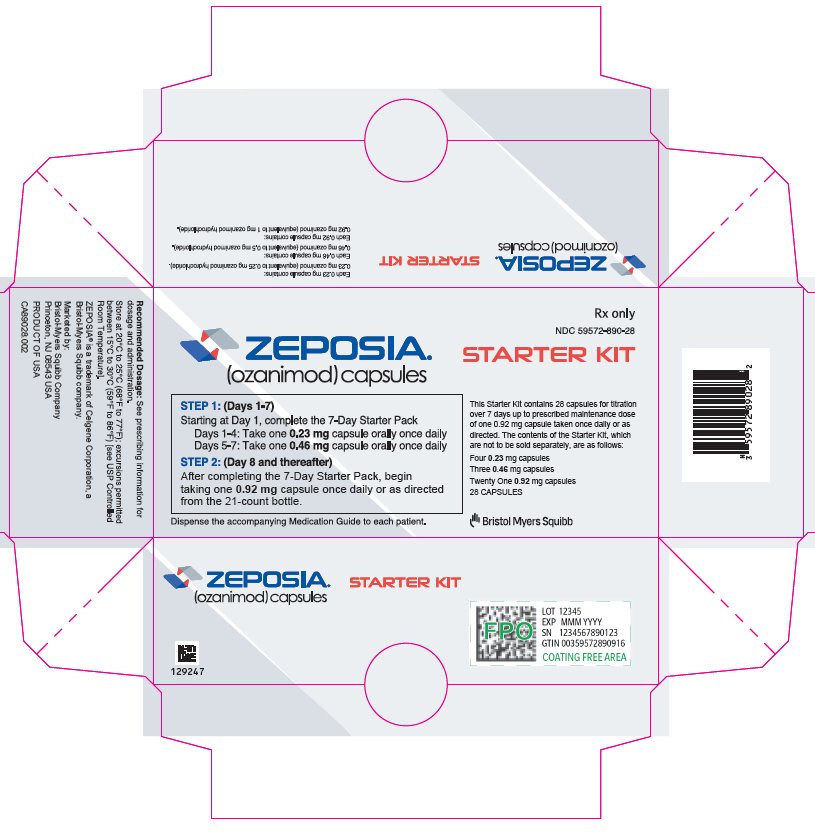
DOSAGE AND ADMINISTRATION Assessments are required prior to initiating ZEPOSIA. ( 2.1 ) Titration is required for treatment initiation. ( 2.2 ) The recommended maintenance dosage is 0.92 mg orally once daily. ( 2.2 ) The recommended maintenance dosage in patients with mild or moderate chronic hepatic impairment (Child-Pugh class A or B) is 0.92 mg once every other day. ( 2.3 ) If a dose is missed within the first 2 weeks of treatment, reinitiate with the titration regimen. If a dose is missed after the first 2 weeks of treatment, continue treatment as planned. ( 2.4 ) 2.1 Assessments Prior to First Dose of ZEPOSIA Before initiation of treatment with ZEPOSIA, assess the following: Cardiac Evaluation Obtain an electrocardiogram (ECG) to determine whether preexisting conduction abnormalities are present. In patients with certain preexisting conditions, advice from a cardiologist should be sought [see Warnings and Precautions (5.3) ]. Complete Blood Count Obtain a recent (i.e., within the last 6 months or after discontinuation of prior MS or UC therapy) complete blood count (CBC), including lymphocyte count [see Warnings and Precautions (5.1) ]. Liver Function Tests Obtain recent (i.e., within the last 6 months) transaminase and bilirubin levels [see Warnings and Precautions (5.4) ]. Ophthalmic Assessment Obtain a baseline evaluation of the fundus, including the macula, near the start of treatment with ZEPOSIA [see Warnings and Precautions (5.8) ]. Skin Examination Obtain a baseline skin examination prior to or shortly after initiation of ZEPOSIA. If a suspicious skin lesion is observed, it should be promptly evaluated [see Warnings and Precautions (5.9) ]. Current or Prior Medications If patients are taking anti-neoplastic, non-corticosteroid immunosuppressive, or immune-modulating therapies, or if there is a history of prior use of these drugs, consider possible unintended additive immunosuppressive effects before initiating treatment with ZEPOSIA [see Warnings and Precautions (5.1) and Drug Interactions (7) ] . Determine if patients are taking drugs that could slow heart rate or atrioventricular conduction [see Warnings and Precautions (5.3) and Drug Interactions (7) ]. Vaccinations Patients without a healthcare professional-confirmed history of chickenpox or without documentation of a full course of vaccination against varicella zoster virus (VZV) should be tested for antibodies to VZV before initiating ZEPOSIA; VZV vaccination of antibody-negative patients is recommended prior to commencing treatment with ZEPOSIA [see Warnings and Precautions (5.1) and Drug Interactions (7) ]. If live attenuated vaccine immunizations are required, administer at least 1 month prior to initiation of ZEPOSIA. 2.2 Recommended Dosage for Multiple Sclerosis and Ulcerative Colitis Initiate ZEPOSIA with a 7-day titration, as shown in Table 1 [see Warnings and Precautions (5.3) ]. After initial titration, the recommended dosage of ZEPOSIA is 0.92 mg taken orally once daily starting on Day 8. Swallow ZEPOSIA capsules whole, with or without food [see Clinical Pharmacology (12.3) ]. Table 1: Dose Titration Regimen Days 1-4 0.23 mg once daily Days 5-7 0.46 mg once daily Day 8 and thereafter 0.92 mg once daily* *Patients with mild to moderate hepatic impairment (Child-Pugh class A or B) should take 0.92 mg once every other day [see Recommended Dosage in Patients with Hepatic Impairment (2.3) . ] 2.3 Recommended Dosage in Patients with Hepatic Impairment In patients with mild or moderate hepatic impairment (Child-Pugh class A or B), initiate ZEPOSIA with a 7-day titration, as shown in Table 1. After initial titration, the recommended dosage of ZEPOSIA in these patients is 0.92 mg taken orally once every other day, starting on Day 8 [see Use in Specific Populations (8.6) and Clinical Pharmacology (12.3) ] . 2.4 Reinitiation of ZEPOSIA after Treatment Interruption If a dose of ZEPOSIA is missed during the first 2 weeks of treatment, reinitiate treatment using the titration regimen [see Dosage and Administration (2.2) ] . If a dose of ZEPOSIA is missed after the first 2 weeks of treatment, continue with the treatment as planned .
Warnings
WARNINGS AND PRECAUTIONS Infections : ZEPOSIA may increase the risk of infections. Obtain a complete blood count (CBC) before initiation of treatment. Monitor for infection during treatment and for 3 months after discontinuation. Do not start ZEPOSIA in patients with active infections. ( 5.1 ) Progressive Multifocal Leukoencephalopathy (PML) : Withhold ZEPOSIA at the first sign or symptom suggestive of PML. ( 5.2 ) Bradyarrhythmia and Atrioventricular Conduction Delays : ZEPOSIA may result in transient decrease in heart rate; titration is required for treatment initiation. Check an electrocardiogram (ECG) to assess for preexisting cardiac conduction abnormalities before starting ZEPOSIA. Consider cardiology consultation for conduction abnormalities or concomitant use with other drugs that decrease heart rate. ( 2.1 , 2.2 , 5.3 , 7 ) Liver Injury : Obtain liver enzyme results before initiation and periodically during treatment. Discontinue if there is evidence of liver injury without other cause. ( 5.4 ) Fetal Risk : Women of childbearing potential should use effective contraception during treatment and for 3 months after stopping ZEPOSIA. ( 5.5 , 8.3 ) Increased Blood Pressure (BP) : Monitor BP during treatment. ( 5.6 ) Respiratory Effects : May cause a decline in pulmonary function. Assess pulmonary function (e.g., spirometry) if clinically indicated. ( 5.7 ) Macular Edema : Increases the risk of macular edema. Obtain a baseline evaluation of the fundus, including the macula, near the start of treatment with ZEPOSIA. Conduct an evaluation of the fundus, including the macula, periodically while on therapy and any time there is a change in vision. Consider discontinuing ZEPOSIA if macular edema develops. Diabetes mellitus and uveitis increase the risk. ( 5.8 ) Cutaneous Malignancies : Skin examination prior to or shortly after the start of treatment and periodically thereafter is recommended. Suspicious skin lesions should be evaluated. ( 5.9 ) 5.1 Infections Risk of Infections ZEPOSIA causes a mean reduction in peripheral blood lymphocyte count to approximately 45% of baseline values because of reversible sequestration of lymphocytes in lymphoid tissues [see Clinical Pharmacology (12.2) ]. ZEPOSIA may therefore increase the susceptibility to infections, some serious in nature . Life-threatening and rare fatal infections have occurred in patients receiving ZEPOSIA. Obtain a recent (i.e., within 6 months or after discontinuation of prior MS or UC therapy) complete blood count (CBC) including lymphocyte count before initiation of ZEPOSIA . Delay initiation of ZEPOSIA in patients with an active infection until the infection is resolved. In MS Study 1 and Study 2, the overall rate of infections and rate of serious infections in patients treated with ZEPOSIA were similar to that in patients who received interferon (IFN) beta-1a (35% vs. 34% and 1% vs. 0.8%, respectively). In UC Study 1 and Study 3, the overall rate of infections and rate of serious infections in patients treated with ZEPOSIA were similar to that in patients who received placebo (9.9% vs. 10.7% and 0.8% vs. 0.4%, respectively). In UC Study 2, the overall rate of infections in patients treated with ZEPOSIA was higher than in patients treated with placebo (23% vs. 12%) and the rate of serious infections was similar (0.9% vs. 1.8%). ZEPOSIA increased the risk of viral upper respiratory tract infections, urinary tract infections, and herpes infections [see Adverse Reactions (6.1) ]. The proportion of patients treated with ZEPOSIA who experienced lymphocyte counts less than 0.2 × 10 9 /L was 3.3% in MS Study 1 and Study 2. The proportion of patients treated with ZEPOSIA with lymphocyte counts less than 0.2 × 10 9 /L was 2% in UC Study 1 and Study 3 and 2.3% in UC Study 2. These values generally returned to greater than 0.2 × 10 9 /L while patients remained on treatment with ZEPOSIA. After discontinuing ZEPOSIA 0.92 mg, the median time for peripheral blood lymphocytes to return to the normal range was approximately 30 days, with approximately 80% to 90% of patients in the normal range within 3 months [see Clinical Pharmacology (12.2) ]. Consider interruption of treatment with ZEPOSIA if a patient develops a serious infection. Because the elimination of ZEPOSIA after discontinuation may take up to 3 months, continue monitoring for infections throughout this period. Herpes Viral Infection Cases of localized herpes virus infection (e.g., herpes zoster and herpes simplex) were seen in clinical trials of ZEPOSIA. In MS Study 1 and Study 2, herpes zoster was reported as an adverse reaction in 0.6% of patients treated with ZEPOSIA 0.92 mg and in 0.2% of patients who received IFN beta-1a. In UC Study 1 and Study 3, herpes zoster was reported in 0.4% of patients who received ZEPOSIA and none in patients who received placebo. In UC Study 2, herpes zoster was reported in 2.2% of patients who received ZEPOSIA and 0.4% of patients who received placebo. None were serious or disseminated. Herpes simplex encephalitis and varicella zoster meningitis have been reported with sphingosine 1-phosphate (S1P) receptor modulators. Patients without a healthcare professional-confirmed history of varicella (chickenpox), or without documentation of a full course of vaccination against varicella zoster virus (VZV), should be tested for antibodies to VZV before initiating ZEPOSIA (see Vaccinations below). Cryptococcal Infection Cases of fatal cryptococcal meningitis (CM) and disseminated cryptococcal infections have been reported with S1P receptor modulators. Physicians should be vigilant for clinical symptoms or signs of CM. Patients with symptoms or signs consistent with a cryptococcal infection should undergo prompt diagnostic evaluation and treatment. ZEPOSIA treatment should be suspended until a cryptococcal infection has been excluded. If CM is diagnosed, appropriate treatment should be initiated. Prior and Concomitant Treatment with Anti-Neoplastic, Non-Corticosteroid Immunosuppressive, or Immune-modulating Therapies In the MS and UC clinical studies, patients who received ZEPOSIA were not to receive concomitant treatment with anti-neoplastic, non-corticosteroid immunosuppressive, or immune-modulating therapies used for the treatment of MS and UC. Concomitant use of ZEPOSIA with any of these therapies would be expected to increase the risk of immunosuppression. In UC studies, concomitant use of corticosteroids was allowed and did not appear to influence the safety or efficacy of ZEPOSIA [see Clinical Studies (14.2) ]. Anti-neoplastic, immune-modulating, or immunosuppressive therapies (including corticosteroids) should be co-administered with caution because of the risk of additive immune system effects during such therapy. When switching to ZEPOSIA from immunosuppressive medications, consider the duration of their effects and their mode of action to avoid unintended additive immunosuppressive effects. Vaccinations Patients without a healthcare professional-confirmed history of chickenpox or without documentation of a full course of vaccination against VZV should be tested for antibodies to VZV before initiating ZEPOSIA. A full course of vaccination for antibody-negative patients with varicella vaccine is recommended prior to commencing treatment with ZEPOSIA, following which initiation of treatment with ZEPOSIA should be postponed for 4 weeks to allow the full effect of vaccination to occur. No clinical data are available on the efficacy and safety of vaccinations in patients taking ZEPOSIA. Vaccinations may be less effective if administered during ZEPOSIA treatment. If live attenuated vaccine immunizations are required, administer at least 1 month prior to initiation of ZEPOSIA. Avoid the use of live attenuated vaccines during and for 3 months after treatment with ZEPOSIA. 5.2 Progressive Multifocal Leukoencephalopathy Progressive multifocal leukoencephalopathy (PML) is an opportunistic viral infection of the brain c
Contraindications
CONTRAINDICATIONS ZEPOSIA is contraindicated in patients who: In the last 6 months, have experienced a myocardial infarction, unstable angina, stroke, transient ischemic attack (TIA), decompensated heart failure requiring hospitalization, or Class III or IV heart failure [see Warnings and Precautions (5.3) ] Have the presence of Mobitz type II second-degree or third degree atrioventricular (AV) block, sick sinus syndrome, or sino-atrial block, unless the patient has a functioning pacemaker [see Warnings and Precautions (5.3) ] Have severe untreated sleep apnea [see Warnings and Precautions (5.3) ] Are taking a monoamine oxidase (MAO) inhibitor [see Drug Interactions (7) ] In the last 6 months, experienced myocardial infarction, unstable angina, stroke, transient ischemic attack, decompensated heart failure requiring hospitalization, or Class III or IV heart failure. ( 4 ) Presence of Mobitz type II second-degree or third degree atrioventricular (AV) block, sick sinus syndrome, or sino-atrial block, unless the patient has a functioning pacemaker. ( 4 ) Severe untreated sleep apnea. ( 4 ) Concomitant use of a monoamine oxidase inhibitor. ( 4 , 7 )
Mechanism of action
Mechanism of Action Ozanimod is a sphingosine 1-phosphate (S1P) receptor modulator that binds with high affinity to S1P receptors 1 and 5. Ozanimod blocks the capacity of lymphocytes to egress from lymph nodes, reducing the number of lymphocytes in peripheral blood. Ozanimod has minimal or no activity on S1P 2 , S1P 3 , and S1P 4 . The mechanism by which ozanimod exerts therapeutic effects in multiple sclerosis and ulcerative colitis is unknown but may involve the reduction of lymphocyte migration into the central nervous system and intestine.
Source: RxNorm + openFDA + RxClass + FAERS · 2026
Look up another medication