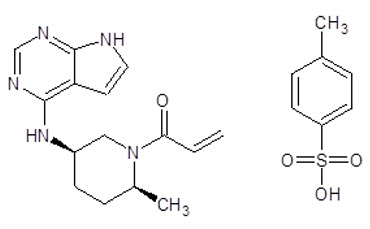
ritlecitinib 50 MG Oral Capsule — Janus-associated kinase (JAK) inhibitors. INDICATIONS AND USAGE LITFULO is a kinase inhibitor indicated for the treatment of severe alopecia areata in adults and adolescents 12 years and…
Boxed warning
WARNING: SERIOUS INFECTIONS, MORTALITY, MALIGNANCY, MAJOR ADVERSE CARDIOVASCULAR EVENTS (MACE), and THROMBOSIS WARNING: SERIOUS INFECTIONS, MORTALITY, MALIGNANCY, MAJOR ADVERSE CARDIOVASCULAR EVENTS (MACE), and THROMBOSIS See full prescribing information for complete boxed warning. • Increased risk of serious bacterial, fungal, viral, and opportunistic infections that may lead to hospitalization or death, including tuberculosis (TB). Interrupt treatment if serious infection occurs until the infection is controlled. LITFULO should not be given to patients with active tuberculosis. Test for latent TB before and during therapy; start treating latent TB prior to use. Monitor all patients for active TB during treatment, even patients with initial negative, latent TB test. ( 5.1 ). Monitor all patients for signs and symptoms of infection during and after treatment with LITFULO. ( 5.1 ) • Higher rate of all-cause mortality, including sudden cardiovascular death with another Janus kinase inhibitor (JAK) vs. TNF blockers in rheumatoid arthritis (RA) patients. LITFULO is not approved for use in RA patients. ( 5.2 ) • Malignancies were reported in patients treated with LITFULO ( 5.3 ). Higher rate of lymphomas and lung cancers with another JAK inhibitor vs. TNF blockers in RA patients. • Higher rate of MACE (defined as cardiovascular death, myocardial infarction, and stroke) with another JAK inhibitor vs. TNF blockers in RA patients. ( 5.4 ). • Thrombosis has occurred in patients treated with LITFULO. Increased incidence of pulmonary embolism, venous and arterial thrombosis with another JAK inhibitor vs. TNF blockers. ( 5.5 ) • Increased risk of serious bacterial, fungal, viral and opportunistic infections leading to hospitalization or death, including tuberculosis (TB). Interrupt treatment if serious infection occurs until the infection is controlled. LITFULO should not be given to patients with active tuberculosis. Test for latent TB before and during therapy; treat latent TB prior to use. Monitor all patients for active TB during treatment, even patients with initial negative, latent TB test. ( 5.1 ) • Higher rate of all-cause mortality, including sudden cardiovascular death with another Janus kinase inhibitor (JAK) vs. TNF blockers in rheumatoid arthritis (RA) patients. LITFULO is not approved for use in RA patients. ( 5.2 ) • Malignancies have occurred in patients treated with LITFULO [see Warnings and Precautions (5.3) ] . Higher rate of lymphomas and lung cancers with another JAK inhibitor vs. TNF blockers in RA patients. ( 5.3 ) • Higher rate of MACE (defined as cardiovascular death, myocardial infarction, and stroke) with another JAK inhibitor vs. TNF blockers in RA patients. ( 5.4 ) • Thrombosis has occurred in patients treated with LITFULO. Increased incidence of pulmonary embolism, venous and arterial thrombosis with another JAK inhibitor vs. TNF blockers. ( 5.5 )
Ritlecitinib has several clinically significant drug interactions with CYP3A and CYP1A2 substrates and inducers.
moderateCYP3A substrates — Increased risk of adverse reactions due to increased AUC and C max.
moderateCYP1A2 substrates — Increased risk of adverse reactions due to increased AUC and C max.
majorstrong CYP3A inducers — Decreased AUC and C max of ritlecitinib, potentially resulting in loss of clinical response.
Indications
INDICATIONS AND USAGE LITFULO is a kinase inhibitor indicated for the treatment of severe alopecia areata in adults and adolescents 12 years and older. Limitations of Use : Not recommended for use in combination with other JAK inhibitors, biologic immunomodulators, cyclosporine or other potent immunosuppressants. LITFULO is a kinase inhibitor indicated for the treatment of severe alopecia areata in adults and adolescents 12 years and older. ( 1 ) Limitations of Use : Not recommended for use in combination with other JAK inhibitors, biologic immunomodulators, cyclosporine or other potent immunosuppressants ( 1 ).
Dosage
DOSAGE AND ADMINISTRATION • For recommended testing, evaluations and immunizations prior to LITFULO initiation, see Full Prescribing Information. ( 2.1 ) • Recommended dosage is 50 mg orally once daily. ( 2.2 ) • For dosage interruption for certain adverse reactions, see Full Prescribing Information. ( 2.4 ) 2.1 Recommended Evaluations and Immunizations Prior to Treatment Initiation Perform the following evaluations prior to LITFULO initiation: • Tuberculosis (TB) infection evaluation: LITFULO initiation is not recommended in patients with active TB. For patients with latent TB or those with a negative latent TB test who are at high risk for TB, start preventive therapy for latent TB prior to initiation of LITFULO [see Warnings and Precautions (5.1) ] . • Viral hepatitis screening in accordance with clinical guidelines: LITFULO initiation is not recommended in patients with hepatitis B or hepatitis C [see Warnings and Precautions (5.1) ] . • Treatment with LITFULO should not be initiated in patients with an absolute lymphocyte count (ALC) <500/mm 3 or a platelet count <100,000/mm 3 [see Warnings and Precautions (5.7) ] . • Update immunizations according to current immunization guidelines [see Warnings and Precautions (5.8) ] . 2.2 Recommended Dosage The recommended dosage of LITFULO is 50 mg orally once daily with or without food [see Clinical Pharmacology (12.3) ] . Swallow capsules whole. Do not crush, split, or chew LITFULO capsules. If a dose is missed, administer the dose as soon as possible unless it is less than 8 hours before the next dose, in which case, skip the missed dose. Thereafter, resume dosing at the regular scheduled time. 2.3 Patients with Severe Hepatic Impairment LITFULO is not recommended in patients with severe (Child Pugh C) hepatic impairment [see Use in Specific Populations (8.6) and Clinical Pharmacology (12.3) ] . 2.4 Treatment Interruption or Discontinuation If treatment interruption is indicated, a temporary treatment interruption for less than 6 weeks is not expected to result in significant loss of regrown scalp hair. Hematologic Abnormalities Recommendations for LITFULO treatment interruption or discontinuation for hematologic abnormalities are summarized in Table 1. Table 1. Laboratory Monitoring Guidance Laboratory Measure Recommendation ALC = absolute lymphocyte count. Platelet Count Treatment should be discontinued if platelet count is <50,000/mm 3 Lymphocytes Treatment should be interrupted if ALC is <500/mm 3 and may be restarted once ALC return above this value. ALC and platelet counts are recommended before treatment initiation and at 4 weeks after treatment initiation, and thereafter according to routine patient management [see Warnings and Precautions (5.7) ] .
Warnings
WARNINGS AND PRECAUTIONS • Hypersensitivity: Discontinue LITFULO if a clinically significant hypersensitivity reaction occurs. ( 5.6 ) • Laboratory Abnormalities: Perform ALC and platelet counts prior to LITFULO initiation. Treatment interruption or discontinuation are recommended based on ALC and platelet count abnormalities. ( 5.7 ) • Vaccinations: Avoid use of live vaccines during or shortly prior to LITFULO treatment. ( 5.8 ) 5.1 Serious Infections Serious infections have been reported in patients receiving LITFULO. The most frequent serious infections have been appendicitis, COVID-19 infection (including pneumonia), and sepsis [see Adverse Reactions (6.1) ] . Among opportunistic infections, multi-dermatomal herpes zoster was reported with LITFULO. Avoid use of LITFULO in patients with an active, serious infection. Consider the risks and benefits of treatment prior to initiating LITFULO in patients: • with chronic or recurrent infection • who have been exposed to TB • with a history of serious infection or an opportunistic infection • who have resided or traveled in areas of endemic TB or mycoses, or • with underlying conditions that may predispose them to infection Closely monitor patients for the development of signs and symptoms of infection during and after treatment with LITFULO. Interrupt LITFULO if a patient develops a serious or opportunistic infection. A patient who develops a new infection during treatment with LITFULO should undergo prompt and complete diagnostic testing appropriate for an immunocompromised patient, appropriate antimicrobial therapy should be initiated, and the patient should be closely monitored. LITFULO may be resumed once the infection is controlled. Tuberculosis Screen patients for tuberculosis (TB) before starting therapy. LITFULO should not be given to patients with active TB. Anti-TB therapy should be started prior to initiating therapy with LITFULO in patients with a new diagnosis of latent TB or previously untreated latent TB. In patients with a negative latent TB test, consider anti-TB therapy before initiating treatment with LITFULO in those at high risk and consider screening patients at high risk for TB during treatment with LITFULO. Viral Reactivation Viral reactivation, including cases of herpes virus reactivation (e.g., herpes zoster), was reported in clinical trials [see Adverse Reactions (6.1) ] . If a patient develops herpes zoster, consider interrupting treatment until the episode resolves. Screening for viral hepatitis should be performed in accordance with clinical guidelines before starting therapy with LITFULO. Patients with evidence of HIV infection or hepatitis B or C infection were excluded from clinical trials. 5.2 Mortality In a large, randomized, postmarketing safety study of another JAK inhibitor in RA patients 50 years of age and older with at least one cardiovascular risk factor, a higher rate of all-cause mortality, including sudden cardiovascular death, was observed in patients treated with the JAK inhibitor compared with TNF blockers. Consider the benefits and risks for the individual patient prior to initiating or continuing therapy with LITFULO. 5.3 Malignancy and Lymphoproliferative Disorders Malignancies, including non-melanoma skin cancer (NMSC), were observed in clinical trials of LITFULO [see Adverse Reactions (6.1) ] . In a large, randomized, postmarketing safety study of another JAK inhibitor in RA patients, a higher rate of malignancies (excluding non-melanoma skin cancer (NMSC)) was observed in patients treated with the JAK inhibitor compared to those treated with TNF blockers. A higher rate of lymphomas was observed in patients treated with the JAK inhibitor compared to those treated with TNF blockers. A higher rate of lung cancers was observed in current or past smokers treated with the JAK inhibitor compared to those treated with TNF blockers. In this study, current or past smokers had an additional increased risk of overall malignancies. The risks and benefits of ritlecitinib treatment should be considered prior to initiating or continuing therapy in patients with a known malignancy other than a successfully treated NMSC or cervical cancer. Periodic skin examination is recommended for patients who are at increased risk for skin cancer. 5.4 Major Adverse Cardiovascular Events (MACE) In a large, randomized, postmarketing safety study of another JAK inhibitor in RA patients 50 years of age and older with at least one cardiovascular risk factor, a higher rate of major adverse cardiovascular events (MACE) defined as cardiovascular death, non-fatal myocardial infarction (MI), and non-fatal stroke was observed with the JAK inhibitor compared to those treated with TNF blockers. Patients who are current or past smokers are at additional increased risk. Consider the benefits and risks for the individual patient prior to initiating or continuing therapy with LITFULO, particularly in patients who are current or past smokers and patients with other cardiovascular risk factors. Patients should be informed about the symptoms of serious cardiovascular events and the steps to take if they occur. Discontinue LITFULO in patients that have experienced a myocardial infarction or stroke. 5.5 Thromboembolic Events An event of pulmonary embolism (PE) was reported in a patient receiving LITFULO [see Adverse Reactions (6.1) ] . In a ritlecitinib higher dosing group, 1 patient reported an event of retinal artery occlusion. In a large, randomized, postmarketing safety study of another JAK inhibitor in RA patients 50 years of age and older with at least one cardiovascular risk factor, higher rates of overall thrombosis, DVT, and PE were observed compared to those treated with TNF blockers. Avoid LITFULO in patients who may be at increased risk of thrombosis. If symptoms of thrombosis or embolism occur, patients should interrupt LITFULO and be evaluated promptly and treated appropriately. 5.6 Hypersensitivity Serious reactions including anaphylactic reactions, urticaria and rash have been observed in patients receiving LITFULO in clinical trials. If a clinically significant hypersensitivity reaction occurs, discontinue LITFULO and institute appropriate therapy [see Adverse Reactions (6.1) ] . 5.7 Laboratory Abnormalities Treatment with LITFULO was associated with decreases in lymphocytes and platelets [see Adverse Reactions (6.1) ] . Prior to LITFULO initiation, perform ALC and platelet counts [see Dosage and Administration (2.1) ] . After initiating treatment with LITFULO, treatment interruption or discontinuation are recommended based on ALC and platelet count abnormalities [see Dosage and Administration (2.4) ] . Liver Enzyme Elevations – Treatment with LITFULO was associated with increased incidence of liver enzyme elevation compared to placebo. Increases of ALT ≥5 times the upper limit of normal (ULN) and increases of AST ≥5 times the ULN were observed in patients in LITFULO clinical trials. Evaluate at baseline and thereafter according to routine patient management. Prompt investigation of the cause of liver enzyme elevation is recommended to identify potential cases of drug-induced liver injury. If increases in ALT or AST are observed and drug-induced liver injury is suspected, interrupt LITFULO until this diagnosis is excluded. Creatine Phosphokinase (CPK) Elevations – Treatment with LITFULO was associated with increased incidence of CPK elevation compared to placebo. 5.8 Vaccinations No data are available on the response to vaccination in patients receiving LITFULO. Use of live attenuated vaccines should be avoided during or shortly prior to initiating treatment. Prior to initiating LITFULO, it is recommended that patients be brought up to date with all immunizations, including prophylactic herpes zoster vaccinations, in agreement with current immunization guidelines.
Contraindications
CONTRAINDICATIONS LITFULO is contraindicated in patients with known hypersensitivity to ritlecitinib or any of its excipients [see Warnings and Precautions (5.6) ] . LITFULO is contraindicated in patients with known hypersensitivity to ritlecitinib or any of its excipients. ( 4 )
Mechanism of action
Mechanism of Action LITFULO is a kinase inhibitor. Ritlecitinib irreversibly inhibits Janus kinase 3 (JAK3) and the tyrosine kinase expressed in hepatocellular carcinoma (TEC) kinase family by blocking the adenosine triphosphate (ATP) binding site. In cellular settings, ritlecitinib inhibits cytokine induced STAT phosphorylation mediated by JAK3-dependent receptors. Additionally, ritlecitinib inhibits signaling of immune receptors dependent on TEC kinase family members. The relevance of inhibition of specific JAK or TEC family enzymes to therapeutic effectiveness is not currently known.
A drug lookup is just the start. Eleplan keeps the whole care plan in one place.
Medications, diagnoses, documents, appointments, and the whole care team — organized and always in sync, with Ellie, your AI care assistant, on top of it. Free to start.