vonoprazan 10 MG Oral Tablet
Managing this medication for someone you care for? Eleplan keeps diagnoses, medications and appointments in one plan.
Start free with EleplanClinical drug
vonoprazan 10 MG Oral Tablet
10 MG · Oral Tablet · oral
A form of vonoprazan →
vonoprazan 10 MG Oral Tablet — Proton pump inhibitors. INDICATIONS AND USAGE VOQUEZNA is indicated: for healing of all grades of erosive esophagitis and relief of heartburn associated with erosive…
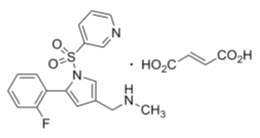
Active ingredient
Classification
Proton pump inhibitors
Drug interactions
The label indicates several potential drug interactions with vonoprazan, particularly involving CYP3A substrates and inducers, as well as other medications that may affect its efficacy or increase the risk of adverse reactions.
- majorCYP3A inducers — may reduce the effectiveness of VOQUEZNA TRIPLE PAK and VOQUEZNA DUAL PAK
- moderateprobenecid — may increase the risk of VOQUEZNA TRIPLE PAK adverse reactions
- moderateallopurinol — increase in the incidence of rashes
- majoromeprazole — may increase clarithromycin concentrations
- moderateitraconazole — may increase the risk of VOQUEZNA TRIPLE PAK adverse reactions
- moderateantivirals (CYP3A substrates, inducers, or inhibitors) — may increase the risk of adverse reactions or loss of effectiveness
- majorrilpivirine-containing products — concomitant use is contraindicated
- majoratazanavir — avoid concomitant use
Indications
INDICATIONS AND USAGE VOQUEZNA is indicated: for healing of all grades of erosive esophagitis and relief of heartburn associated with erosive esophagitis in adults. to maintain healing of all grades of erosive esophagitis and relief of heartburn associated with erosive esophagitis in adults. for the relief of heartburn associated with non-erosive gastroesophageal reflux disease in adults. in combination with amoxicillin and clarithromycin for the treatment of Helicobacter pylori ( H. pylori ) infection in adults. in combination with amoxicillin for the treatment of H. pylori infection in adults. VOQUEZNA is a potassium-competitive acid blocker indicated: for healing of all grades of erosive esophagitis and relief of heartburn associated with erosive esophagitis in adults. ( 1 ) to maintain healing of all grades of erosive esophagitis and relief of heartburn associated with erosive esophagitis in adults. ( 1 ) for the relief of heartburn associated with non-erosive gastroesophageal reflux disease in adults. ( 1 ) in combination with amoxicillin and clarithromycin for the treatment of Helicobacter pylori (H. pylori) infection in adults. ( 1 ) in combination with amoxicillin for the treatment of H. pylori infection in adults. ( 1 )
Dosage
DOSAGE AND ADMINISTRATION Recommended Dosage : Healing of Erosive Esophagitis: 20 mg once daily for 8 weeks. ( 2.1 ) Maintenance of Healed Erosive Esophagitis: 10 mg once daily for up to 6 months. ( 2.1 ) Relief of Heartburn Associated with Non-Erosive Gastroesophageal Reflux Disease: 10 mg once daily for 4 weeks. ( 2.1 ) Treatment of H. pylori Infection: see full prescribing information. ( 2.1 ) See also full prescribing information for the recommended dosage by indication for patients with renal or hepatic impairment. ( 2.2 , 2.3 ) Administration Instructions : Take with or without food. ( 2.4 ) Swallow whole; do not chew or crush. ( 2.4 ) 2.1 Recommended Dosage Healing of Erosive Esophagitis The recommended adult oral dosage is VOQUEZNA 20 mg once daily for 8 weeks for the treatment of healing of erosive esophagitis and relief of associated heartburn. Maintenance of Healed Erosive Esophagitis The recommended adult oral dosage is VOQUEZNA 10 mg once daily for up to 6 months for the maintenance of healed erosive esophagitis and relief of associated heartburn. Relief of Heartburn Associated with Non-Erosive Gastroesophageal Reflux Disease The recommended adult oral dosage is VOQUEZNA 10 mg once daily for 4 weeks. Treatment of H. pylori Infection Triple Therapy: The recommended adult oral dosage is VOQUEZNA 20 mg plus amoxicillin 1,000 mg plus clarithromycin 500 mg, each given twice daily (in the morning and evening, 12 hours apart) for 14 days. Dual Therapy: The recommended adult oral dose is VOQUEZNA 20 mg given twice daily (in the morning and evening) plus amoxicillin 1,000 mg three times daily (in the morning, mid-day, and evening) for 14 days. Also refer to the amoxicillin and clarithromycin full prescribing information. 2.2 Recommended Dosage in Patients with Renal Impairment Healing of Erosive Esophagitis The recommended dosage of VOQUEZNA in adult patients with renal impairment is described in Table 1 below [see Use in Specific Populations (8.6) and Clinical Pharmacology (12.3) ] . Table 1: Recommended VOQUEZNA Dosage in Patients with Renal Impairment: Healing of Erosive Esophagitis Estimated glomerular filtration rate (GFR) Recommended Dosage 30 mL/minute or greater 20 mg once daily Less than 30 mL/minute 10 mg once daily Maintenance of Healed Erosive Esophagitis or Relief of Heartburn Associated with Non-Erosive Gastroesophageal Reflux Disease The recommended dosage of VOQUEZNA in adult patients with renal impairment is the same as for adult patients with normal renal function [see Dosage and Administration (2.1) ] . Treatment of H. pylori Infection The recommended dosage of VOQUEZNA in adult patients with renal impairment is described in Table 2 below [see Use in Specific Populations (8.6) and Clinical Pharmacology (12.3) ]. Table 2: Recommended VOQUEZNA Dosage in Patients with Renal Impairment: Treatment of H. pylori Infection Also refer to the Dosage and Administration section of the amoxicillin and clarithromycin prescribing information for dosage recommendations in patients with renal impairment. Estimated GFR Recommended Dosage 30 mL/minute or greater 20 mg twice daily Less than 30 mL/minute Use is not recommended 2.3 Recommended Dosage in Patients with Hepatic Impairment Healing of Erosive Esophagitis The recommended dosage of VOQUEZNA in adult patients with hepatic impairment is described in Table 3 below [see Use in Specific Populations (8.7) and Clinical Pharmacology (12.3) ] . Table 3: Recommended VOQUEZNA Dosage in Patients with Hepatic Impairment: Healing of Erosive Esophagitis Classification Recommended Dosage Child-Pugh Class A 20 mg once daily Child-Pugh Class B 10 mg once daily Child-Pugh Class C 10 mg once daily Maintenance of Healed Erosive Esophagitis or Relief of Heartburn Associated with Non-Erosive Gastroesophageal Reflux Disease The recommended dosage of VOQUEZNA in adult patients with hepatic impairment is the same as for patients with normal hepatic function [see Dosage and Administration (2.1) ]. Treatment of H. pylori Infection The recommended dosage of VOQUEZNA in adult patients with hepatic impairment is described in Table 4 below [see Use in Specific Populations (8.7) and Clinical Pharmacology (12.3) ]. Table 4: Recommended VOQUEZNA Dosage in Patients with Hepatic Impairment: Treatment of H. pylori Infection Classification Recommended Dosage Child-Pugh Class A 20 mg twice daily Child-Pugh Class B Use is not recommended Child-Pugh Class C Use is not recommended 2.4 Administration Instructions Take VOQUEZNA with or without food [see Clinical Pharmacology (12.3) ] . Swallow VOQUEZNA tablets whole; do not chew or crush the tablet. Missed doses: For the healing or maintenance of healed erosive esophagitis, or the relief of heartburn associated with non-erosive gastroesophageal reflux disease: If a dose is missed, administer VOQUEZNA as soon as possible within 12 hours after the missed dose. If more than 12 hours have passed, skip the missed dose and administer the next dose at the regularly scheduled time. For the treatment of H. pylori infection: If a dose is missed, administer VOQUEZNA as soon as possible within 4 hours after the missed dose. If more than 4 hours have passed, skip the missed dose and administer the next dose at the regularly scheduled time. Continue the normal dosing schedule until the treatment is completed.
Warnings
WARNINGS AND PRECAUTIONS Gastric Malignancy : Symptomatic response to treatment does not preclude the presence of gastric malignancy; consider additional follow-up and diagnostic testing. ( 5.1 ) Acute Tubulointerstitial Nephritis : Discontinue treatment and evaluate patients. ( 5.2 ) Clostridioides difficile -Associated Diarrhea (CDAD) : May be associated with an increased risk; use the shortest duration of treatment appropriate to the condition. ( 5.3 ) Bone Fracture, including Osteoporosis-related Fracture : Use the shortest duration of treatment appropriate to the condition. ( 5.4 ) Severe Cutaneous Adverse Reactions : Discontinue at the first signs or symptoms of severe cutaneous adverse reactions or other signs of hypersensitivity and consider further evaluation. ( 5.5 ) Vitamin B12 (Cobalamin) Deficiency : Long-term use may lead to malabsorption or deficiency; consider further workup if clinical symptoms are present. ( 5.6 ) Hypomagnesemia and Mineral Metabolism : Hypomagnesemia may lead to hypocalcemia and/or hypokalemia. Consider monitoring magnesium and calcium levels in at-risk patients, or if there is concomitant use of digoxin or other drugs that cause hypomagnesemia. ( 5.7 ) Interactions with Investigations for Neuroendocrine Tumors : Increased chromogranin A (CgA) levels may interfere with diagnostic investigations; temporarily stop VOQUEZNA at least 4 weeks before assessing CgA levels. ( 5.8 , 7 ) Fundic Gland Polyps : Risk increases with long-term use; use the shortest duration of treatment appropriate to the condition. ( 5.9 ) 5.1 Presence of Gastric Malignancy In adults, symptomatic response to therapy with VOQUEZNA does not preclude the presence of gastric malignancy. Consider additional follow-up and diagnostic testing in patients who have a suboptimal response or an early symptomatic relapse after completing treatment with VOQUEZNA. In older patients, also consider endoscopy. 5.2 Acute Tubulointerstitial Nephritis Acute tubulointerstitial nephritis (TIN) has been reported with VOQUEZNA [see Adverse Reactions (6.1) ] . If suspected, discontinue VOQUEZNA and evaluate patients with suspected acute TIN. 5.3 Clostridioides difficile -Associated Diarrhea Published observational studies suggest that proton pump inhibitors (PPIs) may be associated with an increased risk of Clostridioides difficile -associated diarrhea (CDAD), especially in hospitalized patients. VOQUEZNA, another drug that blocks the proton pump to inhibit gastric acid production, may also increase the risk of CDAD. Consider CDAD in patients with diarrhea that does not improve [see Adverse Reactions (6.2) ] . Use the shortest duration of VOQUEZNA appropriate to the condition being treated. CDAD has been reported with use of nearly all antibacterial agents. For more information specific to antibacterial agents (clarithromycin and amoxicillin) indicated for use in combination with VOQUEZNA, refer to the Warnings and Precautions section of the corresponding prescribing information. 5.4 Bone Fracture Several published observational studies suggest that PPI therapy may be associated with an increased risk for osteoporosis-related fractures of the hip, wrist, or spine. The risk of fracture was increased in patients who received high-dose, defined as multiple daily doses, and long-term therapy (a year or longer). Bone fracture, including osteoporosis-related fracture, has also been reported with vonoprazan. Use the shortest duration of VOQUEZNA appropriate to the condition being treated [see Dosage and Administration (2.1) ]. Patients at risk for osteoporosis-related fractures should be managed according to the established treatment guidelines . 5.5 Severe Cutaneous Adverse Reactions Severe cutaneous adverse reactions, including Stevens-Johnson syndrome (SJS) and toxic epidermal necrolysis (TEN) have been reported with VOQUEZNA [see Adverse Reactions (6.2) ] . Discontinue VOQUEZNA at the first signs or symptoms of severe cutaneous adverse reactions or other signs of hypersensitivity and consider further evaluation. 5.6 Vitamin B12 (Cobalamin) Deficiency Long-term use of acid-suppressing drugs can lead to malabsorption of Vitamin B12 caused by hypo- or achlorhydria. Vitamin B12 deficiency has been reported postmarketing with vonoprazan [see Adverse Reactions (6.2) ]. If clinical symptoms consistent with Vitamin B12 deficiency are observed in patients treated with VOQUEZNA consider further workup. 5.7 Hypomagnesemia and Mineral Metabolism Hypomagnesemia has been reported postmarketing with vonoprazan [see Adverse Reactions (6.2) ] . Hypomagnesemia may lead to hypocalcemia and/or hypokalemia and may exacerbate underlying hypocalcemia in at-risk patients. Consider monitoring magnesium levels prior to initiation of VOQUEZNA and periodically in patients expected to be on prolonged treatment, in patients taking drugs that may have increased toxicity in the presence of hypomagnesemia (e.g., digoxin), or drugs that may cause hypomagnesemia (e.g., diuretics). Treatment of hypomagnesemia may require magnesium replacement and discontinuation of VOQUEZNA. Consider monitoring magnesium and calcium levels prior to initiation of VOQUEZNA and periodically while on treatment in patients with a preexisting risk of hypocalcemia (e.g., hypoparathyroidism). Supplement with magnesium and/or calcium, as necessary. If hypocalcemia is refractory to treatment, consider discontinuing VOQUEZNA. 5.8 Interactions with Diagnostic Investigations for Neuroendocrine Tumors Serum chromogranin A (CgA) levels increase secondary to drug-induced decreases in gastric acidity. The increased CgA level may cause false positive results in diagnostic investigations for neuroendocrine tumors. Temporarily discontinue VOQUEZNA treatment at least 4 weeks before assessing CgA levels and consider repeating the test if initial CgA levels are high. If serial tests are performed (e.g., for monitoring), the same commercial laboratory should be used for testing, as reference ranges between tests may vary [see Drug Interactions (7) and Clinical Pharmacology (12.2) ] . 5.9 Fundic Gland Polyps Use of VOQUEZNA is associated with a risk of fundic gland polyps that increases with long-term use, especially beyond one year. Fundic gland polyps have been reported with vonoprazan in clinical trials and postmarketing use with PPIs. Most patients who developed fundic gland polyps were asymptomatic and fundic gland polyps were identified incidentally on endoscopy. Use the shortest duration of VOQUEZNA appropriate to the condition being treated [see Dosage and Administration (2.1) ] .
Contraindications
CONTRAINDICATIONS VOQUEZNA is contraindicated in patients with a known hypersensitivity to vonoprazan or any component of VOQUEZNA. Reactions have included anaphylactic shock [see Adverse Reactions (6.2) and Description (11) ] . VOQUEZNA is contraindicated with rilpivirine-containing products [see Drug Interactions (7) ] . For information about contraindications of antibacterial agents (clarithromycin and amoxicillin) indicated in combination with VOQUEZNA, refer to the Contraindications section of the corresponding prescribing information. Known hypersensitivity to vonoprazan or any component of VOQUEZNA. ( 4 ) Rilpivirine-containing products. ( 4 , 7 )
Mechanism of action
Mechanism of Action Vonoprazan suppresses basal and stimulated gastric acid secretion at the secretory surface of the gastric parietal cell through inhibition of the H + , K + -ATPase enzyme system in a potassium-competitive manner. Because this enzyme is regarded as the acid (proton) pump within the parietal cell, vonoprazan has been characterized as a type of gastric proton-pump inhibitor, in that it blocks the final step of acid production. Vonoprazan does not require activation by acid. Vonoprazan may selectively concentrate in the parietal cells in both the resting and stimulated states. Vonoprazan binds to the active pumps in a noncovalent and reversible manner.
Source: RxNorm + openFDA + RxClass + FAERS · 2026
Look up another medication