Riboflavin 5-phosphate Ophthalmic
Managing this medication for someone you care for? Eleplan keeps diagnoses, medications and appointments in one plan.
Start free with EleplanMedication reference
Riboflavin 5-phosphate Ophthalmic
OPHTHALMIC
Riboflavin 5-phosphate Ophthalmic. INDICATIONS AND USAGE EPIOXA HD and EPIOXA are indicated in epithelium-on corneal collagen cross-linking for the treatment of keratoconus in adults…
Brand names
EPIOXA CROSS-LINKING
Indications
INDICATIONS AND USAGE EPIOXA HD and EPIOXA are indicated in epithelium-on corneal collagen cross-linking for the treatment of keratoconus in adults and pediatric patients aged 13 years and older, in conjunction with the O 2 n System and the Boost Goggles. EPIOXA HD and EPIOXA are photoenhancers indicated for use in epithelium-on corneal collagen cross-linking for the treatment of keratoconus in adults and pediatric patients aged 13 years and older, in conjunction with the O 2 n System and the Boost Goggles ( 1 ).
Dosage
DOSAGE AND ADMINISTRATION Apply topical anesthetic and insert a lid speculum ( 2 ). Using a cellulose spear sponge soaked with EPIOXA HD, remove the mucin layer from the corneal surface without debriding the corneal epithelium (epithelium-on) by swiping the sponge 4 to 10 times horizontally and vertically ( 2 ). Apply two drops of EPIOXA HD topically on the eye every 60 seconds for 4 minutes (STEP 1), followed by two drops of EPIOXA topically on the eye every 30 seconds for 6 minutes (STEP 2) ( 2 ). Gently rinse the corneal surface with approximately 5 mL of balanced salt solution (BSS) ( 2 ). Perform ultrasound pachymetry. If corneal thickness is less than 325 microns, irradiation should not be performed ( 2 ). Apply the Boost Goggles and turn on the oxygen flow. Refer to the Boost Goggles User Guide ( 2 ). Center the optical head of the O 2 n System over the cornea and irradiate the eye as per the instructions in the O 2 n System Operator's Manual . The O 2 n System automatically delivers irradiation to the eye for 11 minutes 6 seconds at 30 mW/cm 2 with an on/off cycle of 1 second UV-A on/ 1 second UV-A off at a wavelength of 365 nm ( 2 ). Instill BSS on the cornea every 2 minutes, or more frequently as needed, to maintain corneal hydration during UV-A irradiation ( 2 ). When the UV-A irradiation has stopped, shut off the oxygen flow and remove the Boost Goggles and lid speculum ( 2 ). Apply a bandage contact lens ( 2 ). 2.1 Important Administration Instructions EPIOXA HD and EPIOXA are for topical ophthalmic use. NOT for injection or intraocular use. EPIOXA HD and EPIOXA are supplied in single-dose syringes. Discard opened syringes after use. EPIOXA HD and EPIOXA are for use with the O 2 n System and Boost Goggles only. Refer to the O 2 n System Operator's Manual and Boost Goggles User Guide for device instructions. 2.2 Recommended Dosage and Administration Instructions Apply topical anesthetic and insert a lid speculum. Using a cellulose spear sponge soaked with EPIOXA HD, remove the mucin layer from the corneal surface without debriding the corneal epithelium (epithelium-on) by swiping the sponge 4 to 10 times horizontally and vertically. Apply two drops of EPIOXA HD topically on the eye every 60 seconds for 4 minutes (STEP 1), followed by two drops of EPIOXA topically on the eye every 30 seconds for 6 minutes (STEP 2). Gently rinse the corneal surface with approximately 5 mL of balanced salt solution (BSS). Perform ultrasound pachymetry. If corneal thickness is less than 325 microns, irradiation should not be performed. Apply the Boost Goggles and turn on the oxygen flow as per the instructions in the Boost Goggles User Guide . Center the optical head of the O 2 n System over the cornea and irradiate the eye as per the instructions in the O 2 n System Operator's Manual . The O 2 n System automatically delivers irradiation to the eye for 11 minutes 6 seconds at 30 mW/cm 2 with an on/off cycle of 1 second UV-A on/1 second UV-A off at a wavelength of 365 nm. Instill BSS on the cornea every 2 minutes, or more frequently as needed, to maintain corneal hydration during UV-A irradiation. When the UV-A irradiation has stopped, shut off the oxygen flow, and remove the Boost Goggles and lid speculum. Apply a bandage contact lens.
Warnings
WARNINGS AND PRECAUTIONS Herpetic keratitis : Use with caution in patients with a history of herpetic keratitis due to the potential for reactivation ( 5 ). 5.1 Herpetic Keratitis Corneal collagen cross-linking should be used with caution in patients with a history of herpetic keratitis due to the potential for reactivation of herpes keratitis.
Contraindications
CONTRAINDICATIONS Hypersensitivity ( 4.1 ) Aphakic and pseudophakic patients without a UV-blocking intraocular lens ( 4.2 ) 4.1 Hypersensitivity EPIOXA HD and EPIOXA are contraindicated in patients with known hypersensitivity to benzalkonium chloride or any ingredients in EPIOXA HD and EPIOXA. 4.2 Aphakic and Pseudophakic Patients Epithelium-on corneal collagen cross-linking is contraindicated in aphakic patients and pseudophakic patients without a UV-blocking intraocular lens.
Adverse reactions
ADVERSE REACTIONS The following clinically significant adverse reactions are described elsewhere in the labeling: Herpetic keratitis [see Warnings and Precautions (5.1) ] The most common adverse reaction was conjunctival hyperaemia (31%). Other adverse reactions, occurring in 5% to 25% of eyes included: corneal opacity (haze), photophobia, punctate keratitis, eye pain, eye irritation, increased lacrimation, corneal epithelium defect, eyelid oedema, corneal striae, visual acuity reduced, dry eye, and anterior chamber flare ( 6.1 ). To report SUSPECTED ADVERSE REACTIONS, contact GLAUKOS CORPORATION at 1-888-404-1644 or FDA at 1-800-FDA-1088 or www.fda.gov/medwatch . 6.1 Clinical Trials Experience Because clinical trials are conducted under widely varying conditions, adverse reaction rates observed in the clinical trials of a drug cannot be directly compared to rates in the clinical trials of another drug and may not reflect the rates observed in practice. The safety of EPIOXA HD and EPIOXA in the epithelium-on corneal collagen cross-linking procedure with UV-A irradiation and supplemental oxygen was evaluated in two randomized, parallel-group, sham procedure/vehicle-controlled trials. Study eyes were randomized in a 2:1 treatment allocation to receive corneal collagen cross-linking (CXL) or sham procedure/vehicle control at the baseline visit. In both trials, CXL-treated eyes were followed for 12 months. Safety data were obtained from a total of 389 CXL-treated eyes. The most commonly reported adverse reaction in CXL-treated eyes was conjunctival hyperaemia (31%). Other adverse reactions occurring in 5% to 25% of CXL-treated eyes included: corneal opacity (haze), photophobia, punctate keratitis, eye pain, eye irritation, lacrimation increased, corneal epithelium defect, eyelid oedema, corneal striae, visual acuity reduced, dry eye, and anterior chamber flare.
Mechanism of action
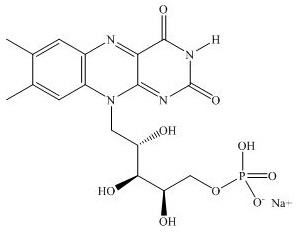
Mechanism of Action Riboflavin 5'-phosphate sodium (Vitamin B2) is the precursor of two coenzymes, flavin adenine dinucleotide and flavin mononucleotide, which catalyze oxidation/reduction reactions involved in a number of metabolic pathways. Under the conditions used for corneal collagen cross-linking, riboflavin 5'-phosphate functions as a photoenhancer and generates singlet oxygen which is responsible for the cross-linking.
NDC examples
25357-024
Indicated ICD-10 codes
Treats these conditions
Source: openFDA + RxNorm · 2026
Look up another medication