Seladelpar
Managing this medication for someone you care for? Eleplan keeps diagnoses, medications and appointments in one plan.
Start free with EleplanMedication reference
Seladelpar
ORAL
Seladelpar. INDICATIONS AND USAGE LIVDELZI is indicated for the treatment of primary biliary cholangitis (PBC) in combination with ursodeoxycholic acid (UDCA)…
Brand names
Livdelzi
Active ingredients
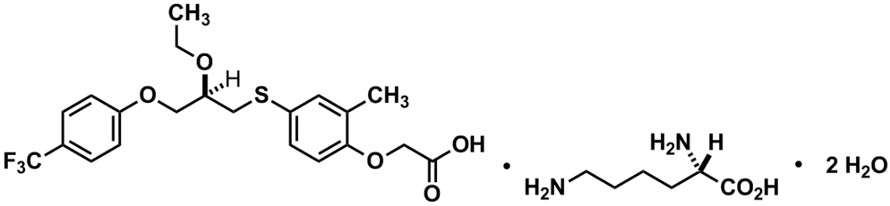
SELADELPAR LYSINE
Indications
INDICATIONS AND USAGE LIVDELZI is indicated for the treatment of primary biliary cholangitis (PBC) in combination with ursodeoxycholic acid (UDCA) in adults who have had an inadequate response to UDCA, or as monotherapy in patients unable to tolerate UDCA. This indication is approved under accelerated approval based on a reduction of alkaline phosphatase (ALP) [see Clinical Studies (14) ] . Improvement in survival or prevention of liver decompensation events have not been demonstrated. Continued approval for this indication may be contingent upon verification and description of clinical benefit in confirmatory trial(s). LIVDELZI is a peroxisome proliferator-activated receptor (PPAR)-delta agonist indicated for the treatment of primary biliary cholangitis (PBC) in combination with ursodeoxycholic acid (UDCA) in adults who have an inadequate response to UDCA, or as monotherapy in patients unable to tolerate UDCA. This indication is approved under accelerated approval based on a reduction of alkaline phosphatase (ALP). Improvement in survival or prevention of liver decompensation events have not been demonstrated. Continued approval for this indication may be contingent upon verification and description of clinical benefit in confirmatory trial(s). ( 1 ) Limitations of Use Use of LIVDELZI is not recommended in patients who have or develop decompensated cirrhosis (e.g., ascites, variceal bleeding, hepatic encephalopathy). ( 8.7 ) Limitations of Use Use of LIVDELZI is not recommended in patients who have or develop decompensated cirrhosis (e.g., ascites, variceal bleeding, hepatic encephalopathy) [see Use in Specific Populations (8.7) ] .
Dosage
DOSAGE AND ADMINISTRATION The recommended dosage of LIVDELZI is 10 mg orally once daily. Administer LIVDELZI with or without food. ( 2.1 ) 2.1 Recommended Dosage and Administration The recommended dosage of LIVDELZI is 10 mg orally once daily. Administer LIVDELZI with or without food [see Clinical Pharmacology (12.3) ] . 2.2 Administration Modification for Bile Acid Sequestrants Administer LIVDELZI at least 4 hours before or 4 hours after taking bile acid sequestrants, or at as great an interval as possible [see Drug Interactions (7.1) ] .
Warnings
WARNINGS AND PRECAUTIONS Fractures : Consider the risk of fracture in patients treated with LIVDELZI. Monitor bone health according to current standards of care. ( 5.1 ) Liver Test Abnormalities : Obtain baseline clinical and laboratory liver assessments prior to starting LIVDELZI and monitor during treatment. Interrupt or discontinue LIVDELZI if the liver tests worsen. ( 5.2 ) Biliary Obstruction : Avoid use in patients with complete biliary obstruction. If biliary obstruction is suspected, interrupt LIVDELZI and treat as clinically indicated. ( 5.3 ) 5.1 Fractures Fractures occurred in 4% of LIVDELZI-treated patients compared to no placebo-treated patients [see Adverse Reactions (6.1) ] . Consider the risk of fracture in the care of patients treated with LIVDELZI and monitor bone health according to current standards of care. 5.2 Liver Test Abnormalities LIVDELZI has been associated with dose-related increases in serum transaminase (aspartate aminotransferase [AST] and alanine aminotransferase [ALT]) levels greater than 3-times upper limit of normal (ULN) in PBC patients receiving 50 mg once daily (5-times higher than the recommended dosage) and 200 mg (20-times higher than the recommended dosage) once daily. Transaminase levels returned to pretreatment levels upon LIVDELZI discontinuation. LIVDELZI 10 mg once daily did not show a similar pattern for increases in transaminase levels [see Overdosage (10) ] . Obtain baseline clinical and laboratory assessments at treatment initiation with LIVDELZI and monitor thereafter according to routine patient management. Interrupt LIVDELZI treatment if the liver tests (ALT, AST, total bilirubin [TB], and/or alkaline phosphatase [ALP]) worsen, or the patient develops signs and symptoms consistent with clinical hepatitis (e.g., jaundice, right upper quadrant pain, eosinophilia). Consider permanent discontinuation if liver tests worsen after restarting LIVDELZI. 5.3 Biliary Obstruction Avoid use of LIVDELZI in patients with complete biliary obstruction. If biliary obstruction is suspected, interrupt LIVDELZI and treat as clinically indicated.
Contraindications
CONTRAINDICATIONS None. None.
Drug interactions
DRUG INTERACTIONS Probenecid : Avoid concomitant use. ( 7.1 ) Strong CYP2C9 Inhibitors : Monitor for adverse effects. ( 7.1 ) Dual Moderate CYP2C9 and Moderate to Strong CYP3A4 Inhibitors : Monitor for adverse effects. ( 7.1 ) CYP2C9 Poor Metabolizers using Moderate to Strong CYP3A4 Inhibitors : Monitor for adverse effects. ( 7.1 ) Dual or Multiple Clinical Inhibitors of Drug Transporters OATP1B1, OATP1B3, and BCRP : Monitor for adverse effects. ( 7.1 ) Rifampin : Monitor biochemical response (e.g., ALP and bilirubin) when patients initiate rifampin. ( 7.1 ) Bile Acid Sequestrants : Administer at least 4 hours before or 4 hours after taking a bile acid sequestrant, or at as great an interval as possible. ( 7.1 ) 7.1 Effect of Other Drugs on LIVDELZI Table 2 includes clinically significant drug interactions affecting LIVDELZI. Table 2: Clinically Significant Interactions Affecting LIVDELZI Concomitant Drug or Class Potential Effect on Seladelpar Exposure ↑ = Increase, ↓ = Decrease. Clinical Intervention Probenecid ↑ seladelpar Avoid concomitant administration of LIVDELZI with probenecid. Strong CYP2C9 Inhibitors ↑ seladelpar Monitor patients for adverse effects during concomitant use of LIVDELZI with strong CYP2C9 inhibitors. Dual Moderate CYP2C9 and Moderate or Strong CYP3A4 Inhibitors (e.g., fluconazole) ↑ seladelpar Monitor patients for adverse effects during concomitant use of LIVDELZI with drugs that are dual moderate CYP2C9 and moderate or strong CYP3A4 inhibitors. CYP2C9 Poor Metabolizers Using Moderate or Strong CYP3A4 Inhibitors ↑ seladelpar Monitor patients who are CYP2C9 poor metabolizers for adverse effects during concomitant use of LIVDELZI with moderate or strong CYP3A4 inhibitor. Dual or Multiple Clinical Inhibitors of Drug Transporters OATP1B1, OATP1B3, and BCRP (e.g, cyclosporine) ↑ seladelpar Monitor patients for adverse effects during concomitant use of LIVDELZI with dual or multiple clinical inhibitors of drug transporters OATP1B1, OATP1B3, and BCRP. Rifampin ↓ seladelpar Concomitant use of LIVDELZI with rifampin, an inducer of metabolizing enzymes, may result in delayed or suboptimal LIVDELZI biochemical response. Monitor the biochemical response (e.g., ALP and bilirubin) when patients initiate rifampin during LIVDELZI treatment. Bile Acid Sequestrants ↓ seladelpar Bile acid sequestrants may interfere with the action of LIVDELZI by reducing its absorption and systemic exposure, which may reduce LIVDELZI efficacy. Administer LIVDELZI at least 4 hours before or 4 hours after taking a bile acid sequestrant, or at as great an interval as possible [see Dosage and Administration (2.2) ] .
Adverse reactions
ADVERSE REACTIONS The following clinically significant adverse reactions are described elsewhere in labeling: Fractures [see Warnings and Precautions (5.1) ] Liver Test Abnormalities [see Warnings and Precautions (5.2) ] Most common adverse reactions (reported in ≥5% and higher compared to placebo) are headache, abdominal pain, nausea, abdominal distension, and dizziness. ( 6.1 ) To report SUSPECTED ADVERSE REACTIONS, contact Gilead Sciences, Inc. at 1-800-GILEAD-5 or FDA at 1-800-FDA-1088 or www.fda.gov/medwatch . 6.1 Clinical Trial Experience Because clinical trials are conducted under widely varying conditions, adverse reaction rates observed in the clinical trials of a drug cannot be directly compared to rates in the clinical trials of another drug and may not reflect the rates observed in practice. In Trial 1, 193 patients were randomized to receive either LIVDELZI 10 mg (N=128) or placebo (N=65) once daily for 12 months [see Clinical Studies (14) ] . LIVDELZI or placebo was administered in combination with UDCA in 94% of patients and as monotherapy in 6% of patients who were unable to tolerate UDCA. Common Adverse Reactions Table 1 presents common adverse reactions that occurred in Trial 1. Table 1: Common Adverse Reactions Occurring Through Week 52 in Adult Patients with PBC (Trial 1) Included 12 patients (6%) who were intolerant to UDCA and initiated treatment as monotherapy: 8 patients (6%) in the LIVDELZI 10 mg arm and 4 patients (6%) in the placebo arm. Adverse Reaction Occurring in greater than or equal to 5% of patients in the LIVDELZI treatment arm and at an incidence greater than or equal to 1% higher than in the placebo arm. LIVDELZI 10 mg Once Daily (N=128) % (n) PLACEBO (N=65) % (n) Headache 8% (10) 3% (2) Abdominal pain The gastrointestinal adverse reactions were mild to moderate without the need for discontinuation of LIVDELZI. 7% (9) 2% (1) Nausea 6% (8) 5% (3) Abdominal distension 6% (8) 3% (2) Dizziness 5% (6) 2% (1) Fractures In Trial 1, fractures occurred in 4% (n=5) of LIVDELZI-treated patients compared to no placebo-treated patients. Baseline bone mineral density was not obtained. The median time to fracture after receiving LIVDELZI was 295 days (range: 89–349). Less Common Adverse Reactions Additional adverse reactions that occurred more frequently in the LIVDELZI-treated patients compared to placebo, but in less than 5% of patients, included dyspepsia, rash, alopecia, anemia, and cough. Laboratory Abnormalities Estimated Glomerular Filtration Rate In Trial 1, LIVDELZI-treated patients developed decreased estimated glomerular filtration rate (eGFR) (serum creatinine elevations) more frequently compared to placebo-treated patients. Ten percent (n=12) of LIVDELZI-treated patients had a decline in eGFR of at least 25%, compared to 2% (n=1) of placebo-treated patients. None of the patients experienced an eGFR decline of 50% or more. The decline in eGFR stabilized or returned towards baseline with ongoing LIVDELZI treatment. None of the patients required discontinuation of LIVDELZI and there were no clinical findings associated with the observed changes in eGFR.
Mechanism of action
Mechanism of Action Seladelpar is a peroxisome proliferator-activated receptor (PPAR)-delta (δ) agonist. However, the mechanism by which seladelpar exerts its therapeutic effects in patients with PBC is not well understood. Pharmacological activity that is potentially relevant to therapeutic effects includes inhibition of bile acid synthesis through activation of PPARδ, which is a nuclear receptor expressed in most tissues, including the liver. Published studies show that PPARδ activation by seladelpar reduces bile acid synthesis through Fibroblast Growth Factor 21 (FGF21)-dependent downregulation of CYP7A1, the key enzyme for the synthesis of bile acids from cholesterol.
Available forms (2)
NDC examples
61958-3301
Indicated ICD-10 codes
Treats these conditions
Source: openFDA + RxNorm · 2026
Look up another medication