Sodium Chloride, Soldium Lactate, Potassium Chloride and Calcium Chloride
Managing this medication for someone you care for? Eleplan keeps diagnoses, medications and appointments in one plan.
Start free with EleplanMedication reference
Sodium Chloride, Soldium Lactate, Potassium Chloride and Calcium Chloride
IRRIGATION
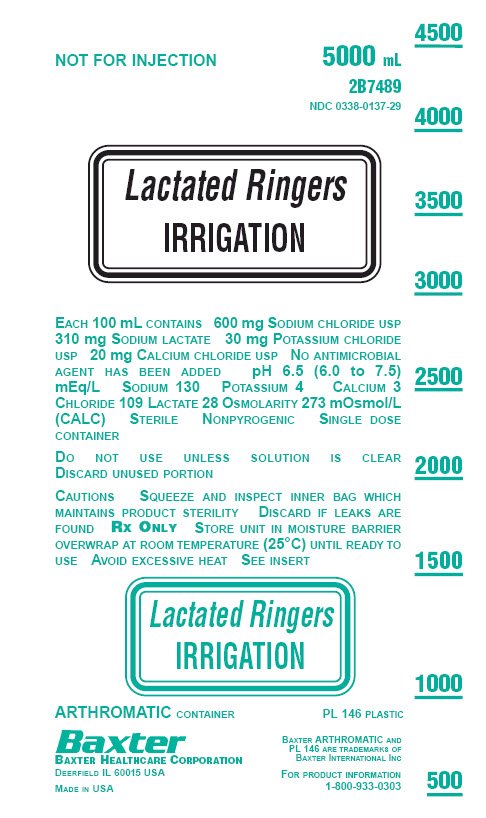
Sodium Chloride, Soldium Lactate, Potassium Chloride and Calcium Chloride. INDICATIONS AND USAGE Lactated Ringer’s Irrigation is indicated for use as an arthroscopic irrigating fluid with endoscopic instruments during…
Brand names
Lactated Ringers
Active ingredients
CALCIUM CHLORIDEPOTASSIUM CHLORIDESODIUM CHLORIDESODIUM LACTATE
Indications
INDICATIONS AND USAGE Lactated Ringer’s Irrigation is indicated for use as an arthroscopic irrigating fluid with endoscopic instruments during arthroscopic procedures requiring distension and irrigation of the knee, shoulder, elbow, or other bone joints.
Dosage
DOSAGE AND ADMINISTRATION The volume and/or rate of solution needed will vary with the nature and duration of the arthroscopic procedure. This solution, as it is packaged, is not intended for IV administration or injection. The container must not be vented (See Precautions ). Parenteral drug products should be inspected visually for particulate matter and discoloration prior to administration whenever solution and container permit. Do not administer unless the solution is clear and the seal is intact. If particulate matter or discoloration is found, contact Baxter Customer Service Aseptic technique should be used when applying this product. The contents of an opened container should be used promptly to minimize the possibility of bacterial growth or pyrogen formation. Discard the unused portion of irrigating solution since no antimicrobial agent has been added. When using Lactated Ringer’s Irrigation for pour irrigation, prevent contact of the fluid with the external surface of the container. Lactated Ringer’s Irrigation is for single-patient use only. Microwave heating of irrigation fluids is not recommended. If desired, Lactated Ringer’s Irrigation may be warmed in a water bath or oven to not more than 45° C while maintaining sterility. Lactated Ringer’s Irrigation that has been warmed must not be returned to storage. Cetriaxone must not be mixed with calcium-containing solutions, including Lactated Ringer’s Irrigation. Additives may be incompatible with Lactated Ringer’s Irrigation. Additives known or determined to be incompatible should not be used. As with all parenteral solutions, compatibility of the additives with the solution must be assessed before addition, by checking for, for example, a possible color change and/or the appearance of precipitates, insoluble complexes, or crystals. Before adding a substance or medication, verify that it is soluble and/or stable in water and that the pH range of Lactated Ringer’s Irrigation is appropriate. The instructions for use of the medication to be added and other relevant literature must be consulted. When making additions to Lactated Ringer’s Irrigation, aseptic technique must be used. Mix the solution thoroughly when additives have been introduced. Do not store solutions containing additives.
Warnings
WARNINGS Absorption of large volume of irrigation fluids through a perforation or open wound may result in circulatory overload, cardiac failure, or electrolyte disturbances and acid-base imbalance. Patients and fluid balance should be monitored accordingly. If absorption of clinically relevant amounts of fluid is suspected, the fluid administration should be interrupted, and the patient evaluated for possible adverse consequences. Particularly close monitoring is required in patients with: • Severely impaired renal function • Impaired cardiac function, or • Clinical states in which there is edema with sodium retention as a fluid overload syndrome may develop in these patients following absorption of even small quantities of irrigation fluid. Appropriate therapy should be initiated, as indicated. Lactated Ringer’s Irrigation must not be used when types of electrocautery are used that are not safe and effective when performed in the presence of electrolyte solutions. Excessive volume or pressure during irrigation may cause excessive fluid absorption, undue distention of cavities, and/or disruption of tissue.
Contraindications
CONTRAINDICATIONS Lactated Ringer’s Irrigation is contraindicated in patients with a known hypersensitivity to Sodium Lactate.
Drug interactions
Drug Interactions If clinically relevant amounts of solution have been absorbed, potential interactions with other agents must be considered, such as: Patients treated with drugs that may increase the risk of sodium and fluid retention, such as corticosteroids and carbenoxolone, may have an increased risk of sodium and fluid retention. Due to the alkalinizing action of lactate (formation of bicarbonate), Lactated Ringer’s Irrigation may interfere with the elimination of drugs for which renal elimination is pH dependent: • Renal clearance of acidic drugs such as salicylates, barbiturates, and lithium may be increased. • Renal clearance of alkaline drugs, such as sympathomimetics (e.g., ephedrine, pseudoephedrine), dextroamphetamine (dexamphetamine) sulfate, and fenfluramine (phenfluramine) hydrochloride may be decreased. The risk of hyperkalemia is increased in patients treated with agents or products that can cause hyperkalemia or increase the risk of hyperkalemia, such as potassium-sparing diuretics (amiloride, spironolactone, triameterene), with ACE inhibitors, angiotensin II receptor antagonists, or the immunosuppressants tacrolimus and cyclosporine. Administration of potassium in patients treated with such medications can produce severe and potentially fatal hyperkalemia, particularly in patients with severe renal insufficiency. Absorption of calcium-containing solutions may increase the effects of digitalis and lead to serious or fatal cardiac arrhythmia. In patients treated with thiazide diuretics or vitamin D, the risk of hypercalcemia is increased.
Adverse reactions
ADVERSE REACTIONS Post-Marketing Adverse Reactions No adverse reactions were identified in Baxter’s Adverse Event Reporting System database with Lactated Ringer’s Irrigation. Class Reactions Adverse reactions reported with Lactated Ringer’s Irrigation (manufacturer unspecified) are: Fluid absorption manifested by Pulmonary edema, Edema, and Electrolyte disturbances. Though not indicated for intravenous administration, absorption of irrigation fluid into tissue or vasculature through a perforation or open wound is possible. As a result, adverse reactions reported with Lactated Ringer’s solutions with and without Dextrose for intravenous administration may be applicable and include: • Hypersensitivity reactions, including Anaphylactic/Anaphylactoid reactions, with the following manifestations: Angioedema, Chest pain, Chest discomfort, Decreased heart rate, Tachycardia, Blood pressure decreased, Respiratory distress, Bronchospasm, Dyspnea, Cough, Urticaria, Rash, Pruritus, Erythema, Flushing, Throat irritation, Paresthesias, Hypoesthesia oral, Dysgeusia, Nausea, Anxiety, Headache, Hyperkalemia • Pyrexia Overdose In the event of clinically relevant absorption of irrigation fluid, the patients must be evaluated and corrective measures instituted as appropriate.
Mechanism of action
CLINICAL PHARMACOLOGY Lactated Ringer’s Irrigation is useful as an irrigating fluid for body joints because it approximates the electrolyte composition of synovial fluid, and provides a transparent fluid medium with optical properties suitable for good visualization of the interior joint surface during endoscopic examination. During arthroscopic surgical procedures, the solution acts as a lavage for removing blood, tissue fragments, and bone fragments.
NDC examples
0338-0137
Indicated ICD-10 codes
Treats these conditions
Source: openFDA + RxNorm · 2026
Look up another medication