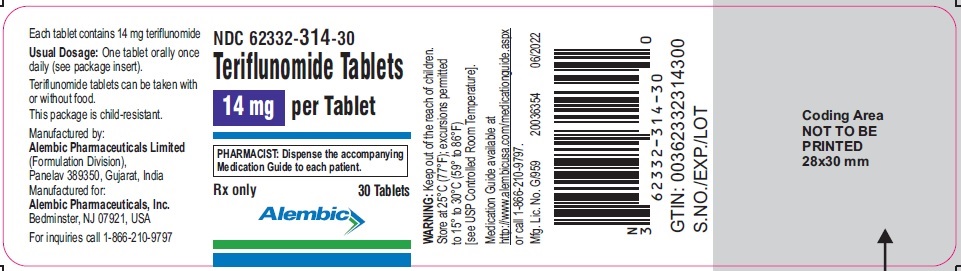
Teriflunomide — Pyrimidine Synthesis Inhibitor [EPC]. INDICATIONS AND USAGE Teriflunomide tablets are indicated for the treatment of relapsing forms of multiple sclerosis (MS), to include clinically…
Boxed warning
WARNING: HEPATOTOXICITY and RISK OF TERATOGENICITY • Hepatotoxicity Severe liver injury including fatal liver failure has been reported in patients treated with leflunomide, which is indicated for rheumatoid arthritis. A similar risk would be expected for teriflunomide because recommended doses of teriflunomide and leflunomide result in a similar range of plasma concentrations of teriflunomide. Concomitant use of teriflunomide tablets with other potentially hepatotoxic drugs may increase the risk of severe liver injury. Obtain transaminase and bilirubin levels within 6 months before initiation of teriflunomide tablets therapy. Monitor ALT levels at least monthly for six months after starting teriflunomide tablets [see Warnings and Precautions (5.1)]. If drug induced liver injury is suspected, discontinue teriflunomide tablets and start an accelerated elimination procedure with cholestyramine or charcoal [see Warnings and Precautions (5.3)]. Teriflunomide tablets are contraindicated in patients with severe hepatic impairment [see Contraindications (4)]. Patients with pre-existing liver disease may be at increased risk of developing elevated serum transaminases when taking teriflunomide tablets. • Risk of Teratogenicity Teriflunomide tablets are contraindicated for use in pregnant women and in women of reproductive potential who are not using effective contraception because of the potential for fetal harm. Teratogenicity and embryolethality occurred in animals at plasma teriflunomide exposures lower than that in humans. Exclude pregnancy before the start of treatment with teriflunomide tablets in females of reproductive potential. Advise females of reproductive potential to use effective contraception during teriflunomide tablets treatment and during an accelerated drug elimination procedure after teriflunomide tablets treatment. Stop teriflunomide tablets and use an accelerated drug elimination procedure if the patient becomes pregnant [see Contraindications (4), Warnings and Precautions (5.2, 5.3), Use in Specific Populations (8.1), and Clinical Pharmacology (12.3)]. WARNING: HEPATOTOXICITY and RISK OF TERATOGENICITY See full prescribing information for complete boxed warning • Hepatotoxicity Severe liver injury including fatal liver failure has been reported in patients treated with leflunomide, which is indicated for rheumatoid arthritis. A similar risk would be expected for teriflunomide because recommended doses of teriflunomide and leflunomide result in a similar range of plasma concentrations of teriflunomide. Obtain transaminase and bilirubin levels within 6 months before initiation of teriflunomide tablets and monitor ALT levels at least monthly for six months (5.1). If drug induced liver injury is suspected, discontinue teriflunomide tablets and start accelerated elimination procedure (5.3). • Risk of Teratogenicity Teratogenicity and embryolethality occurred in animals administered teriflunomide (5.2, 8.1). Exclude pregnancy prior to initiating teriflunomide tablets therapy (4, 5.2, 8.1). Advise use of effective contraception in females of reproductive potential during treatment and during an accelerated drug elimination procedure (4, 5.2, 5.3, 8.1). Stop teriflunomide tablets and use an accelerated drug elimination procedure if the patient becomes pregnant (5.2, 5.3, 8.1).
INDICATIONS AND USAGE Teriflunomide tablets are indicated for the treatment of relapsing forms of multiple sclerosis (MS), to include clinically isolated syndrome, relapsing-remitting disease, and active secondary progressive disease, in adults. Teriflunomide tablets are a pyrimidine synthesis inhibitor indicated for the treatment of relapsing forms of multiple sclerosis (MS), to include clinically isolated syndrome, relapsing-remitting disease, and active secondary progressive disease, in adults. ( 1 )
Dosage
DOSAGE AND ADMINISTRATION The recommended dose of teriflunomide tablets is 7 mg or 14 mg orally once daily. Teriflunomide tablets can be taken with or without food. Monitoring to Assess Safety: • Obtain transaminase and bilirubin levels within 6 months before initiation of teriflunomide tablets therapy. Monitor ALT levels at least monthly for six months after starting teriflunomide tablets [see Warnings and Precautions (5.1) ] . • Obtain a complete blood cell count (CBC) within 6 months before the initiation of treatment with teriflunomide tablets. Further monitoring should be based on signs and symptoms of infection [see Warnings and Precautions (5.4) ] . • Prior to initiating teriflunomide tablets, screen patients for latent tuberculosis infection with a tuberculin skin test or blood test for mycobacterium tuberculosis infection [see Warnings and Precautions (5.4) ] . • Exclude pregnancy prior to initiation of treatment with teriflunomide tablets in females of reproductive potential [see Warnings and Precautions (5.2) ] . • Check blood pressure before start of teriflunomide tablets treatment and periodically thereafter [see Warnings and Precautions (5.9) ] . 7 mg or 14 mg orally once daily, with or without food. ( 2 )
Warnings
WARNINGS AND PRECAUTIONS • Elimination of teriflunomide tablets can be accelerated by administration of cholestyramine or activated charcoal for 11 days. ( 5.3 ) • Teriflunomide tablets may decrease WBC. A recent CBC should be available before starting teriflunomide tablets. Monitor for signs and symptoms of infection. Consider suspending treatment with teriflunomide tablets in case of serious infection. Do not start teriflunomide tablets in patients with active infections. ( 5.4 ) • Stop teriflunomide tablets if patient has anaphylaxis, angioedema, Stevens-Johnson syndrome, toxic epidermal necrolysis, drug reaction with eosinophilia and systemic symptoms; initiate rapid elimination. ( 5.3 , 5.5 , 5.6 , 5.7 ) • If patient develops symptoms consistent with peripheral neuropathy, evaluate patient and consider discontinuing teriflunomide tablets. ( 5.8 ) • Teriflunomide tablets may increase blood pressure. Measure blood pressure at treatment initiation and monitor blood pressure during treatment. ( 5.9 ) 5.1 Hepatotoxicity Clinically significant and potentially life-threatening liver injury, including acute liver failure requiring transplant, has been reported in patients treated with teriflunomide tablets in the postmarketing setting. Patients with pre-existing liver disease and patients taking other hepatotoxic drugs may be at increased risk for developing liver injury when taking teriflunomide tablets. Clinically significant liver injury can occur at any time during treatment with teriflunomide tablets. Patients with pre-existing acute or chronic liver disease, or those with serum alanine aminotransferase (ALT) greater than two times the upper limit of normal (ULN) before initiating treatment, should not normally be treated with teriflunomide tablets. Teriflunomide tablets are contraindicated in patients with severe hepatic impairment [see Contraindications (4) ] . In placebo-controlled trials in adult patients, ALT greater than three times the ULN occurred in 61/1045 (5.8%) and 62/1002 (6.2%) of patients receiving teriflunomide tablets 7 mg and 14 mg, respectively, and 38/997 (3.8%) of patients receiving placebo, during the treatment period. These elevations occurred mostly within the first year of treatment. Half of the cases returned to normal without drug discontinuation. In clinical trials, if ALT elevation was greater than three times the ULN on two consecutive tests, teriflunomide tablets were discontinued and patients underwent an accelerated elimination procedure [see Warnings and Precautions (5.3) ] . Of the patients who underwent discontinuation and accelerated elimination in controlled trials, half returned to normal or near normal values within 2 months. One patient in the controlled trials in adult patients developed ALT 32 times the ULN and jaundice 5 months after initiation of teriflunomide tablets 14 mg treatment. The patient was hospitalized for 5 weeks and recovered after plasmapheresis and cholestyramine accelerated elimination procedure. Teriflunomide tablets-induced liver injury in this patient could not be ruled out. Obtain serum transaminase and bilirubin levels within 6 months before initiation of teriflunomide tablets therapy. Monitor ALT levels at least monthly for six months after starting teriflunomide tablets. Consider additional monitoring when teriflunomide tablets are given with other potentially hepatotoxic drugs. Consider discontinuing teriflunomide tablets if serum transaminase increase (greater than three times the ULN) is confirmed. Monitor serum transaminase and bilirubin on teriflunomide tablets therapy, particularly in patients who develop symptoms suggestive of hepatic dysfunction, such as unexplained nausea, vomiting, abdominal pain, fatigue, anorexia, or jaundice and/or dark urine. If liver injury is suspected to be teriflunomide tablets-induced, discontinue teriflunomide tablets and start an accelerated elimination procedure [see Warnings and Precautions (5.3) ] and monitor liver tests weekly until normalized. If teriflunomide tablets-induced liver injury is unlikely because some other probable cause has been found, resumption of teriflunomide tablets therapy may be considered. 5.2 Embryofetal Toxicity Teriflunomide tablets may cause fetal harm when administered to a pregnant woman. Teratogenicity and embryofetal lethality occurred in animal reproduction studies in multiple animal species at plasma teriflunomide exposures similar to or lower than that in humans at the maximum recommended human dose (MRHD) of 14 mg/day [see Use in Specific Populations (8.1) ] . Teriflunomide tablets are contraindicated for use in pregnant women and in females of reproductive potential not using effective contraception [see Contraindications (4) ] . Exclude pregnancy before starting treatment with teriflunomide tablets in females of reproductive potential [see Dosage and Administration (2) ] . Advise females of reproductive potential to use effective contraception during teriflunomide tablets treatment and during an accelerated drug elimination procedure after teriflunomide tablets treatment [see Use in Specific Populations (8.3) ] . If a woman becomes pregnant while taking teriflunomide tablets, stop treatment with teriflunomide tablets, apprise the patient of the potential risk to a fetus, and perform an accelerated drug elimination procedure to achieve a plasma teriflunomide concentration of less than 0.02 mg/L [see Warnings and Precautions (5.3) ] . Upon discontinuing teriflunomide tablets, it is recommended that all females of reproductive potential undergo an accelerated drug elimination procedure. Women receiving teriflunomide tablets treatment who wish to become pregnant must discontinue teriflunomide tablets and undergo an accelerated drug elimination procedure, which includes verification that plasma concentrations of teriflunomide are less than 0.02 mg/L (0.02 mcg/mL). Men wishing to father a child should also discontinue use of teriflunomide tablets and either undergo an accelerated elimination procedure or wait until verification that the plasma teriflunomide concentration is less than 0.02 mg/L (0.02 mcg/mL) [see Use in Specific Populations (8.3) ]. Based on animal data, human plasma concentrations of teriflunomide of less than 0.02 mg/L (0.02 mcg/mL) are expected to have minimal embryofetal risk [see Contraindications (4) , Warnings and Precautions (5.3) , and Use in Specific Populations (8.1) ] . 5.3 Procedure for Accelerated Elimination of Teriflunomide Teriflunomide is eliminated slowly from the plasma [see Clinical Pharmacology (12.3) ] . Without an accelerated elimination procedure, it takes on average 8 months to reach plasma concentrations less than 0.02 mg/L, although because of individual variations in drug clearance it may take as long as 2 years. An accelerated elimination procedure could be used at any time after discontinuation of teriflunomide tablets. Elimination can be accelerated by either of the following procedures: • Administration of cholestyramine 8 g every 8 hours for 11 days. If cholestyramine 8 g three times a day is not well tolerated, cholestyramine 4 g three times a day can be used. • Administration of 50 g oral activated charcoal powder every 12 hours for 11 days. If either elimination procedure is poorly tolerated, treatment days do not need to be consecutive unless there is a need to lower teriflunomide plasma concentration rapidly. At the end of 11 days, both regimens successfully accelerated teriflunomide elimination, leading to more than 98% decrease in teriflunomide plasma concentrations. Use of the accelerated elimination procedure may potentially result in return of disease activity if the patient had been responding to teriflunomide tablets treatment. 5.4 Bone Marrow Effects/Immunosuppression Potential/Infections Bone Marrow Effects A mean decrease compared to baseline in white blood cell (WBC) count of approximately 15% (mainly neutrophils and lymphocytes) and in platel
Contraindications
CONTRAINDICATIONS Teriflunomide tablets are contraindicated in/with: • Patients with severe hepatic impairment [see Warnings and Precautions (5.1) ] . • Pregnant women and females of reproductive potential not using effective contraception. Teriflunomide tablets may cause fetal harm [see Warnings and Precautions (5.2 , 5.3) and Use in Specific Populations (8.1) ] . • Patients with a history of a hypersensitivity reaction to teriflunomide, leflunomide, or to any of the inactive ingredients in teriflunomide tablets. Reactions have included anaphylaxis, angioedema, and serious skin reactions [see Warnings and Precautions (5.5) ]. • Coadministration with leflunomide [see Clinical Pharmacology (12.3) ]. • Severe hepatic impairment ( 4 , 5.1 ) • Pregnancy ( 4 , 5.2 , 8.1 ) • Hypersensitivity ( 4 , 5.5 ) • Current leflunomide treatment ( 4 )
Drug interactions
DRUG INTERACTIONS Effect of Teriflunomide Tablets on CYP2C8 Substrates Teriflunomide is an inhibitor of CYP2C8 in vivo . In patients taking teriflunomide tablets, exposure of drugs metabolized by CYP2C8 (e.g., paclitaxel, pioglitazone, repaglinide, rosiglitazone) may be increased. Monitor these patients and adjust the dose of the concomitant drug(s) metabolized by CYP2C8 as required [see Clinical Pharmacology (12.3) ] . Effect of Teriflunomide Tablets on Warfarin Coadministration of teriflunomide tablets with warfarin requires close monitoring of the international normalized ratio (INR) because teriflunomide tablets may decrease peak INR by approximately 25%. Effect of Teriflunomide Tablets on Oral Contraceptives Teriflunomide tablets may increase the systemic exposures of ethinylestradiol and levonorgestrel. Consideration should be given to the type or dose of contraceptives used in combination with teriflunomide tablets [see Clinical Pharmacology (12.3) ] . Effect of Teriflunomide Tablets on CYP1A2 Substrates Teriflunomide may be a weak inducer of CYP1A2 in vivo . In patients taking teriflunomide tablets, exposure of drugs metabolized by CYP1A2 (e.g., alosetron, duloxetine, theophylline, tizanidine) may be reduced. Monitor these patients and adjust the dose of the concomitant drug(s) metabolized by CYP1A2 as required [see Clinical Pharmacology (12.3) ] . Effect of Teriflunomide Tablets on Organic Anion Transporter 3 (OAT3) Substrates Teriflunomide inhibits the activity of OAT3 in vivo . In patients taking teriflunomide tablets, exposure of drugs which are OAT3 substrates (e.g., cefaclor, cimetidine, ciprofloxacin, penicillin G, ketoprofen, furosemide, methotrexate, zidovudine) may be increased. Monitor these patients and adjust the dose of the concomitant drug(s) which are OAT3 substrates as required [see Clinical Pharmacology (12.3) ] . Effect of Teriflunomide Tablets on BCRP and Organic Anion Transporting Polypeptide B1 and B3 (OATP1B1/1B3) Substrates Teriflunomide inhibits the activity of BCRP and OATP1B1/1B3 in vivo . For a patient taking teriflunomide tablets, the dose of rosuvastatin should not exceed 10 mg once daily. For other substrates of BCRP (e.g., mitoxantrone) and drugs in the OATP family (e.g., methotrexate, rifampin), especially HMG-Co reductase inhibitors (e.g., atorvastatin, nateglinide, pravastatin, repaglinide, and simvastatin), consider reducing the dose of these drugs and monitor patients closely for signs and symptoms of increased exposures to the drugs while patients are taking teriflunomide tablets [see Clinical Pharmacology (12.3) ] . • Drugs metabolized by CYP2C8 and OAT3 transporters: Monitor patients because teriflunomide may increase exposure of these drugs. ( 7 ) • Teriflunomide may increase exposure of ethinylestradiol and levonorgestrel. Choose an appropriate oral contraceptive. ( 7 ) • Drugs metabolized by CYP1A2: Monitor patients because teriflunomide may decrease exposure of these drugs. ( 7 ) • Warfarin: Monitor INR as teriflunomide may decrease INR. ( 7 ) • Drugs metabolized by BCRP and OATP1B1/B3 transporters: Monitor patients because teriflunomide may increase exposure of these drugs. ( 7 ) • Rosuvastatin: The dose of rosuvastatin should not exceed 10 mg once daily in patients taking teriflunomide tablets. ( 7 )
Adverse reactions
ADVERSE REACTIONS The following clinically significant adverse reactions are described elsewhere in the prescribing information: • Hepatotoxicity [see Contraindications (4) and Warnings and Precautions (5.1)] • Bone Marrow Effects/Immunosuppression Potential/Infections [see Warnings and Precautions (5.4)] • Hypersensitivity Reactions [see Contraindications (4) and Warnings and Precautions (5.5)] • Serious Skin Reactions [see Warnings and Precautions (5.6)] • Drug Reaction with Eosinophilia and Systemic Symptoms [see Warnings and Precautions (5.7)] • Cutaneous or Mucocutaneous Ulcers and Impaired Wound Healing [see Warnings and Precautions (5.8)] • Peripheral Neuropathy [see Warnings and Precautions (5.9)] • Increased Blood Pressure [see Warnings and Precautions (5.10)] • Respiratory Effects [see Warnings and Precautions (5.11)] • Pancreatitis in Pediatric Patients [see Warnings and Precautions (5.12)] Most common adverse reactions (≥10% and ≥2% greater than placebo): headache, diarrhea, nausea, alopecia, increase in ALT. ( 6 ) To report SUSPECTED ADVERSE REACTIONS, contact Alembic Pharmaceuticals Limited at 1-866-210-9797 or FDA at 1-800-FDA-1088 or www.fda.gov/medwatch. 6.1 Clinical Trials Experience Because clinical trials are conducted under widely varying conditions, adverse reaction rates observed in the clinical trials of a drug cannot be directly compared to rates in the clinical trials of another drug and may not reflect the rates observed in clinical practice. A total of 2,047 patients receiving teriflunomide tablets (7 mg or 14 mg once daily) constituted the safety population in the pooled analysis of placebo-controlled studies in patients with relapsing forms of multiple sclerosis; of these, 71% were female. The average age was 37 years. Table 1 lists adverse reactions in placebo-controlled trials with rates that were at least 2% for teriflunomide tablets patients and also at least 2% above the rate in placebo patients. The most common were headache, an increase in ALT, diarrhea, alopecia, and nausea. The adverse reaction most commonly associated with discontinuation was an increase in ALT (3.3%, 2.6%, and 2.3% of all patients in the teriflunomide tablets 7 mg, teriflunomide tablets 14 mg, and placebo treatment arms, respectively). Table 1: Adverse Reactions in Pooled Placebo-Controlled Studies in Patients with Relapsing Forms of Multiple Sclerosis Adverse Reaction Teriflunomide Tablets 7 mg (N=1,045) Teriflunomide Tablets 14 mg (N=1,002) Placebo (N=997) Headache 18% 16% 15% Increase in Alanine aminotransferase 13% 15% 9% Diarrhea 13% 14% 8% Alopecia 10% 13% 5% Nausea 8% 11% 7% Paresthesia 8% 9% 7% Arthralgia 8% 6% 5% Neutropenia 4% 6% 2% Hypertension 3% 4% 2% Cardiovascular Deaths Four cardiovascular deaths, including three sudden deaths, and one myocardial infarction in a patient with a history of hyperlipidemia and hypertension were reported among approximately 2,600 patients exposed to teriflunomide tablets in the premarketing database. These cardiovascular deaths occurred during uncontrolled extension studies, one to nine years after initiation of treatment. A relationship between teriflunomide tablets and cardiovascular death has not been established. Acute Renal Failure In placebo-controlled studies, creatinine values increased more than 100% over baseline in 8/1,045 (0.8%) patients in the 7 mg teriflunomide tablets group and 6/1,002 (0.6%) patients in the 14 mg teriflunomide tablets group versus 4/997 (0.4%) patients in the placebo group. These elevations were transient. Some elevations were accompanied by hyperkalemia. Teriflunomide tablets may cause acute uric acid nephropathy with transient acute renal failure because teriflunomide tablets increases renal uric acid clearance. Hypophosphatemia In clinical trials, 18% of teriflunomide tablets-treated patients had hypophosphatemia with serum phosphorus levels of at least 0.6 mmol/L, compared to 7% of placebo-treated patients; 4% of teriflunomide tablets-treated patients had hypophosphatemia with serum phosphorus levels at least 0.3 mmol/L but less than 0.6 mmol/L, compared to 0.8% of placebo-treated patients. No patient in any treatment group had a serum phosphorus below 0.3 mmol/L. 6.2 Postmarketing Experience The following adverse reactions have been identified during postapproval use of teriflunomide tablets. Because these reactions are reported voluntarily from a population of uncertain size, it is not always possible to reliably estimate their frequency or establish a causal relationship to drug exposure. Blood and Lymphatic System Disorders : Thrombocytopenia [see Warnings and Precautions (5.4)] Gastrointestinal Disorders : Pancreatitis, colitis Hepatobiliary Disorders : Drug-induced liver injury (DILI) [see Warnings and Precautions (5.1)] Immune System Disorders : Hypersensitivity reactions, some of which were severe, such as anaphylaxis and angioedema [see Warnings and Precautions (5.5)] Respiratory, Thoracic, and Mediastinal Disorders : Interstitial lung disease [see Warnings and Precautions (5.11)] Skin and Subcutaneous Tissue Disorders: Severe skin reactions, including toxic epidermal necrolysis and Stevens-Johnson syndrome [see Warnings and Precautions (5.6) ] ; drug reaction with eosinophilia and systemic symptoms (DRESS) [see Warnings and Precautions (5.7)] ; psoriasis or worsening of psoriasis (including pustular psoriasis and nail psoriasis); nail disorders; cutaneous or mucocutaneous ulcers; impaired wound healing [see Warnings and Precautions (5.8)]
Mechanism of action
Mechanism of Action Teriflunomide, an immunomodulatory agent with anti-inflammatory properties, inhibits dihydroorotate dehydrogenase, a mitochondrial enzyme involved in de novo pyrimidine synthesis. The exact mechanism by which teriflunomide exerts its therapeutic effect in multiple sclerosis is unknown but may involve a reduction in the number of activated lymphocytes in CNS.
A drug lookup is just the start. Eleplan keeps the whole care plan in one place.
Medications, diagnoses, documents, appointments, and the whole care team — organized and always in sync, with Ellie, your AI care assistant, on top of it. Free to start.