Vedolizumab
Managing this medication for someone you care for? Eleplan keeps diagnoses, medications and appointments in one plan.
Start free with EleplanMedication reference
Vedolizumab
Integrin Receptor Antagonist [EPC] — SUBCUTANEOUS · INTRAVENOUS
Vedolizumab — Integrin Receptor Antagonist [EPC]. INDICATIONS AND USAGE ENTYVIO is indicated in adults for the treatment of: moderately to severely active ulcerative colitis (UC). moderately to…
Brand names
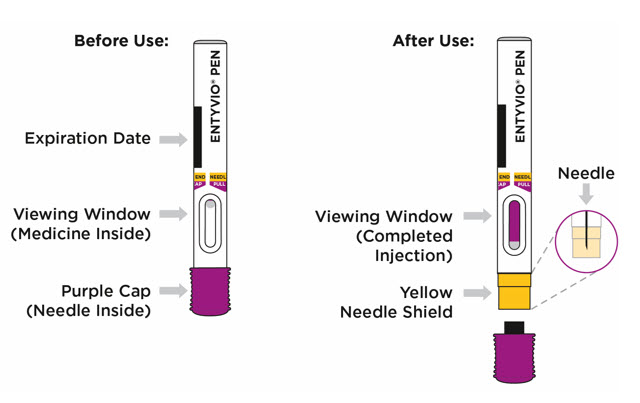
ENTYVIOENTYVIO PenEntyvio
Active ingredients
VEDOLIZUMAB
Indications
INDICATIONS AND USAGE ENTYVIO is indicated in adults for the treatment of: moderately to severely active ulcerative colitis (UC). moderately to severely active Crohn's disease (CD). ENTYVIO is an integrin receptor antagonist indicated in adults for the treatment of: moderately to severely active ulcerative colitis (UC). ( 1 ) moderately to severely active Crohn's disease (CD). ( 1 )
Dosage
DOSAGE AND ADMINISTRATION Important Administration Information Before Initiating ENTYVIO Consider evaluating patients for tuberculosis (TB) infection. ( 2.1 , 5.2 ) Update immunizations according to current immunization guidelines. ( 2.1 , 5.5 ) Intravenous Administration : ENTYVIO should be administered intravenously by a healthcare provider. ( 2.1 ) Subcutaneous Injection : ENTYVIO prefilled syringe and ENTYVIO PEN are intended for subcutaneous use. A patient may self-inject or caregiver may inject after proper training on correct subcutaneous injection technique. ( 2.1 ) Recommended Dosage ( 2.2 ) Week 0 : 300 mg infused intravenously over approximately 30 minutes. Week 2 : 300 mg infused intravenously over approximately 30 minutes. Week 6 : Patients may remain on ENTYVIO intravenous therapy or switch to subcutaneous injection after receiving two ENTYVIO intravenous doses administered at Week 0 and Week 2. Intravenous Infusion : 300 mg infused over approximately 30 minutes and then every eight weeks thereafter. Subcutaneous Injection : 108 mg subcutaneously once every two weeks. Discontinue ENTYVIO in patients who do not show evidence of therapeutic benefit by Week 14. Patients currently receiving and responding to ENTYVIO intravenous therapy after Week 6 may also be switched to subcutaneous injection. Administer the first subcutaneous dose in place of the next scheduled intravenous infusion and every two weeks thereafter. Preparation and Administration Instructions: See full prescribing information for complete information on reconstitution, dilution, administration, and storage. ( 2.3 , 2.4 ) 2.1 Important Administration Information Before Initiating ENTYVIO Consider evaluating patients for tuberculosis (TB) infection prior to initiating treatment with ENTYVIO [see Warnings and Precautions (5.2) ]. Update immunizations according to current immunization guidelines [see Warnings and Precautions (5.5) ]. Intravenous Administration ENTYVIO should be administered by a healthcare provider prepared to manage hypersensitivity reactions including anaphylaxis, if they occur [see Warnings and Precautions (5.1) ] . Appropriate monitoring and medical support measures should be available for immediate use. Observe patients during infusion and until the infusion is complete. Reconstitute and dilute ENTYVIO lyophilized powder prior to administration as a 30-minute intravenous infusion [see Dosage and Administration (2.3) ]. Subcutaneous Injection ENTYVIO prefilled syringe and ENTYVIO PEN are intended for subcutaneous use under the guidance and supervision of a healthcare professional. Patients may self-inject or caregivers may inject subcutaneous ENTYVIO using either the ENTYVIO prefilled syringe or ENTYVIO PEN after training in subcutaneous injection technique. Provide proper training to patients and/or caregivers on the subcutaneous injection technique of ENTYVIO. 2.2 Recommended Dosage in Adults with Ulcerative Colitis and Crohn’s Disease Week 0: Administer ENTYVIO 300 mg by intravenous infusion over approximately 30 minutes [ see Dosage and Administration (2.3) ]. Week 2: Administer ENTYVIO 300 mg by intravenous infusion over approximately 30 minutes. Week 6: Patients may remain on ENTYVIO intravenous therapy or switch to subcutaneous injection after receiving two ENTYVIO intravenous doses administered at Week 0 and Week 2. Intravenous Infusion : Administer ENTYVIO 300 mg by intravenous infusion over approximately 30 minutes and then every eight weeks thereafter. Subcutaneous Injection : Administer ENTYVIO 108 mg subcutaneously once every 2 weeks. Discontinue therapy in patients who show no evidence of therapeutic benefit by Week 14. Patients currently receiving and responding to ENTYVIO intravenous therapy after Week 6 may also be switched to subcutaneous injection. Administer the first subcutaneous dose in place of the next scheduled intravenous infusion and every two weeks thereafter. 2.3 Preparation and Administration Instructions for Intravenous Infusion Reconstitution Instructions Remove the flip-off cap from the single-dose vial and wipe with alcohol swab. Reconstitute ENTYVIO vial containing lyophilized powder with 4.8 mL of Sterile Water for injection, 0.9% Sodium Chloride Injection, or Lactated Ringer's Injection, at room temperature (20°C to 25°C [68ºF to 77ºF]), using a syringe with a 21- to 25-gauge needle. Insert the syringe needle into the vial through the center of the stopper and direct the stream of Sterile Water for Injection, 0.9% Sodium Chloride Injection, or Lactated Ringer's Injection, to the glass wall of the vial to avoid excessive foaming. Gently swirl the vial for at least 15 seconds to dissolve the lyophilized powder. Do not vigorously shake or invert. Allow the solution to sit for up to 20 minutes at room temperature to allow for reconstitution and for any foam to settle; the vial can be swirled and inspected for dissolution during this time. If not fully dissolved after 20 minutes, allow another 10 minutes for dissolution. Do not use the vial if the drug product is not dissolved within 30 minutes. Visually inspect the reconstituted ENTYVIO solution for particulate matter and discoloration prior to dilution. Solution should be clear or opalescent, colorless to light brownish yellow and free of visible particulates. Do not administer reconstituted solution showing uncharacteristic color or containing particulates. Once dissolved, gently invert vial three times. Immediately, withdraw 5 mL (300 mg) of reconstituted ENTYVIO solution using a syringe with a 21- to 25-gauge needle. Discard any remaining portion of the reconstituted solution in the vial. Dilution Instructions Add the 5 mL (300 mg) of reconstituted ENTYVIO solution to 250 mL of 0.9% Sodium Chloride Injection, or Lactated Ringer's Injection, and gently mix the infusion bag. Do not add other medicinal products to the prepared infusion solution or intravenous infusion set. Once reconstituted and diluted, use the infusion solution as soon as possible. Discard any unused portion of the infusion solution . Administration Instructions After the infusion is complete, flush with 30 mL of 0.9% Sodium Chloride Injection, or Lactated Ringer's Injection. Storage and Stability Specific storage conditions and timing for the reconstituted solution in vial and diluted solution in the infusion bag are outlined in Table 1 . Do not freeze the reconstituted solution in the vial or the diluted solution in the infusion bag. Table 1. Storage Instructions for Reconstituted Solution in Vial and Diluted Solution in Infusion Bag Solution Storage Conditions Refrigeration (2°C to 8°C [36°F to 46°F]) Room Temperature (20°C to 25°C [68°F to 77°F]) Reconstituted Solution (in Sterile Water for Injection, 0.9% Sodium Chloride Injection, or Lactated Ringer's Injection, inside vial) 8 hours Use immediately after reconstitution Diluted Solution (in 0.9% Sodium Chloride Injection) 24 hours This time assumes the reconstituted solution is immediately diluted in the 0.9% Sodium Chloride Injection, or Lactated Ringer's Injection, and held in the infusion bag only. Any time that the reconstituted solution was held in vial should be subtracted from the time the solution may be held in the infusion bag. , This period may include up to 12 hours at room temperature (20°C to 25°C [68°F to 77°F]). 12 hours Diluted Solution (in Lactated Ringer's Injection) 6 hours Use immediately after dilution The combined storage time of reconstituted ENTYVIO solution in the vial and the diluted solution in the infusion bag with 0.9% Sodium Chloride Injection, is a total of 12 hours at room temperature (20°C to 25°C [68°F to 77°F]) or 24 hours refrigerated (2°C to 8°C [36°F to 46°F]). This combined storage time may include up to eight hours of the reconstituted solution in the vial at 2°C to 8°C. The combined storage time of reconstituted ENTYVIO solution in the vial and the diluted solution in the infusion bag with Lactated Ringer's
Warnings
WARNINGS AND PRECAUTIONS Infusion-Related Reactions and Hypersensitivity Reactions : Discontinue ENTYVIO and initiate appropriate treatment if serious reactions occur. ( 5.1 ) Infections : Treatment with ENTYVIO should not be initiated in patients with a clinically important active infection until the infection resolves or is adequately treated. If a serious infection develops, ENTYVIO should not be administered until the infection resolves. ( 5.2 ) Progressive Multifocal Leukoencephalopathy (PML) : Although unlikely, a risk of PML cannot be ruled out. Monitor patients for any new or worsening neurological signs or symptoms. ( 5.3 ) 5.1 Infusion-Related Reactions and Hypersensitivity Reactions Infusion-related reactions and hypersensitivity reactions have been reported, including anaphylaxis, dyspnea, bronchospasm, urticaria, flushing, rash, and increased blood pressure and heart rate [see Adverse Reactions (6.1 , 6.2) ]. These reactions may occur with the first or subsequent infusions of ENTYVIO and may vary in their time of onset from during infusion or up to several hours post-infusion. If anaphylaxis or other serious infusion-related or hypersensitivity reactions occur, discontinue administration of ENTYVIO immediately and initiate appropriate treatment. 5.2 Infections Patients treated with ENTYVIO are at increased risk for developing infections [see Adverse Reactions (6.1) ]. Serious infections reported in clinical trials include anal abscess, sepsis (some fatal), tuberculosis (TB), salmonella sepsis, Listeria meningitis, giardiasis, and cytomegaloviral colitis. Postmarketing cases of systemic bacterial, fungal, viral, and parasitic opportunistic infections have been reported. Treatment with ENTYVIO should not be initiated in patients with a clinically important active infection until the infection resolves or is adequately treated. In patients with a chronic infection or a history of recurrent infection, consider the risks and benefits prior to prescribing ENTYVIO. During treatment with ENTYVIO, instruct patients to seek medical advice if signs or symptoms of clinically important acute or chronic infection occur. If a serious infection develops or an infection is not responding to standard therapy, monitor the patient closely. ENTYVIO should not be administered until the infection resolves. Tuberculosis Consider evaluating patients for TB infection prior to initiating treatment with ENTYVIO. Treatment with Entyvio should not be administered to patients with active TB infection. Initiate treatment of latent TB prior to administering ENTYVIO. Consider anti-TB therapy prior to initiation of ENTYVIO in patients with a past history of latent or active TB in whom an adequate course of treatment cannot be confirmed. Monitor patients for signs and symptoms of active TB during and after ENTYVIO treatment. 5.3 Progressive Multifocal Leukoencephalopathy PML, a rare and often fatal opportunistic infection of the central nervous system (CNS), has been reported with systemic immunosuppressants, including another integrin receptor antagonist. PML is caused by the John Cunningham (JC) virus and typically only occurs in patients who are immunocompromised. One case of PML in an ENTYVIO-treated patient with multiple contributory factors has been reported in the postmarketing setting (e.g., human immunodeficiency virus [HIV] infection with a CD4 count of 300 cells/mm 3 and prior and concomitant immunosuppression). Although unlikely, a risk of PML cannot be ruled out. Monitor patients on ENTYVIO for any new onset, or worsening, of neurological signs and symptoms. Typical signs and symptoms associated with PML are diverse, progress over days to weeks, and include progressive weakness on one side of the body or clumsiness of limbs, disturbance of vision, and changes in thinking, memory, and orientation leading to confusion and personality changes. The progression of deficits usually leads to death or severe disability over weeks or months. If PML is suspected, withhold dosing with ENTYVIO and refer to a neurologist; if confirmed, discontinue dosing permanently. 5.4 Liver Injury There have been reports of elevations of transaminase and/or bilirubin in patients receiving ENTYVIO. In general, the combination of transaminase elevations and elevated bilirubin without evidence of obstruction is generally recognized as an important predictor of severe liver injury that may lead to death or the need for a liver transplant in some patients. ENTYVIO should be discontinued in patients with jaundice or other evidence of significant liver injury [see Adverse Reactions (6.1) ] . 5.5 Immunizations Prior to initiating treatment with ENTYVIO, all patients should be brought up to date with all immunizations according to current immunization guidelines [see Dosage and Administration (2.1) ] . Patients receiving ENTYVIO may receive non-live vaccines (e.g., influenza vaccine injection) and may receive live vaccines if the benefits outweigh the risks. There are no data on the secondary transmission of infection by live vaccines in patients receiving ENTYVIO [see Adverse Reactions (6.1) ] .
Contraindications
CONTRAINDICATIONS ENTYVIO is contraindicated in patients who have had a known serious or severe hypersensitivity reaction to ENTYVIO or any of its excipients (such as dyspnea, bronchospasm, urticaria, flushing, rash and increased heart rate) [see Warnings and Precautions (5.1) ] . Patients who have had a known serious or severe hypersensitivity reaction to ENTYVIO or any of its excipients. ( 4 )
Drug interactions
DRUG INTERACTIONS 7.1 Natalizumab Products Because of the potential for increased risk of PML and other infections, avoid the concomitant use of ENTYVIO with natalizumab products. 7.2 TNF Blockers Because of the potential for increased risk of infections, avoid the concomitant use of ENTYVIO with TNF blockers. 7.3 CYP450 Substrates The formation of CYP450 enzymes may be suppressed by increased levels of certain cytokines (e.g., IL-6, IL-10, TNFα, IFN) during chronic inflammation. Therefore, use of ENTYVIO may normalize the formation of CYP450 enzymes by modulating the underlying disease. Upon initiation or discontinuation of ENTYVIO in patients treated with CYP450 substrates, monitor drug concentrations or other therapeutic parameters, and adjust the dosage of the CYP substrate as needed. See the prescribing information of specific CYP substrates.
Adverse reactions
ADVERSE REACTIONS The following topics are also discussed in detail in the Warnings and Precautions section: Infusion-Related Reactions and Hypersensitivity Reactions [see Warnings and Precautions (5.1) ] Infections [see Warnings and Precautions (5.2) ] Progressive Multifocal Leukoencephalopathy [see Warnings and Precautions (5.3) ] Liver Injury [see Warnings and Precautions (5.4) ] Most common adverse reactions (incidence ≥3% and ≥1% higher than placebo) are: nasopharyngitis, headache, arthralgia, nausea, pyrexia, upper respiratory tract infection, fatigue, cough, bronchitis, influenza, back pain, rash, pruritus, sinusitis, oropharyngeal pain, and pain in extremities. ( 6.1 ) Adverse reactions with subcutaneous ENTYVIO are similar to those reported with intravenous ENTYVIO with the exception of injection site reactions reported with subcutaneous ENTYVIO. ( 6.1 ) To report SUSPECTED ADVERSE REACTIONS, contact Takeda Pharmaceuticals U.S.A., Inc. at 1-877-TAKEDA-7 (1-877-825-3327) or FDA at 1-800-FDA-1088 or www.fda.gov/medwatch . 6.1 Clinical Trials Experience Because clinical trials are conducted under widely varying conditions, adverse reaction rates observed in the clinical trials of a drug cannot be directly compared to rates in the clinical trials of another drug and may not reflect the rates observed in practice. The data described below reflect exposure to intravenous ENTYVIO in 3,326 patients and healthy volunteers in clinical trials, including 1,396 exposed for greater than one year, and 835 exposed for greater than two years. Intravenous Infusion The safety data described in Table 2 are derived from four controlled Phase 3 trials (UC Trials I and II and CD Trials I and III); data from adult patients receiving open-label intravenous ENTYVIO treatment at Weeks 0 and 2 (prior to entry into UC Trial II and CD Trial III) and from Weeks 6 to 52 (non-responders at Week 6 of UC Trial I and CD Trial I) are included [see Clinical Studies (14.1 , 14.2) ] . In these trials, 1,434 patients received ENTYVIO 300 mg intravenously for up to 52 weeks, and 297 patients received placebo for up to 52 weeks. Of these, 769 patients had ulcerative colitis and 962 patients had Crohn's disease. Patients were exposed for a mean duration of 259 days (UC Trials I and II) and 247 days (CD Trials I and III). Adverse reactions were reported in 52% of patients treated with intravenous ENTYVIO and 45% of patients treated with placebo (UC Trials I and II: 49% with ENTYVIO and 37% with placebo; CD Trials I and III: 55% with ENTYVIO and 47% with placebo). Serious adverse reactions were reported in 7% of patients treated with intravenous ENTYVIO compared to 4% of patients treated with placebo (UC Trials I and II: 8% with ENTYVIO and 7% with placebo; CD Trials I and III: 12% with ENTYVIO and 9% with placebo). The most common adverse reactions (reported by ≥3% of patients treated with intravenous ENTYVIO in the UC Trials I and II and CD Trials I and III combined group and ≥1% higher than in combined placebo group) were nasopharyngitis, headache, arthralgia, nausea, pyrexia, upper respiratory tract infection, fatigue, cough, bronchitis, influenza, back pain, rash, pruritus, sinusitis, oropharyngeal pain, and pain in extremities (Table 2) . Table 2. Adverse Reactions in ≥3% of Intravenous ENTYVIO-Treated Adult Patients and ≥1% Higher than in Placebo (UC Trials I and II Data from patients receiving open-label intravenous ENTYVIO treatment at Weeks 0 and 2 (prior to entry into UC Trial II and CD Trial III) and from Weeks 6 to 52 (non-responders at Week 6 of UC Trial I and CD Trial I) are included. and CD Trials I and III ) Adverse Reaction ENTYVIO IV Patients who received ENTYVIO for up to 52 weeks. (N=1434) Placebo Patients who received placebo for up to 52 weeks. (N=297) Nasopharyngitis 13% 7% Headache 12% 11% Arthralgia 12% 10% Nausea 9% 8% Pyrexia 9% 7% Upper respiratory tract infection 7% 6% Fatigue 6% 3% Cough 5% 3% Bronchitis 4% 3% Influenza 4% 2% Back pain 4% 3% Rash 3% 2% Pruritus 3% 1% Sinusitis 3% 1% Oropharyngeal pain 3% 1% Pain in extremities 3% 1% Safety data for patients (n=279) in UC Trials I and II and CD Trials I and III who received intravenous ENTYVIO at Weeks 0 and 2 and were then randomized to placebo at Week 6 for up to 52 weeks, and for patients (n=416) in CD Trial II, a 10-week Crohn's disease trial, are similar to those listed in Table 2 . Infusion-Related Reactions and Hypersensitivity Reactions Serious infusion-related reactions and hypersensitivity reactions including anaphylaxis have been reported following intravenous ENTYVIO administration in clinical trials [see Warnings and Precautions (5.1) ] . In UC Trials I and II and CD Trials I and III, one case of anaphylaxis [one out of 1,434 patients treated with intravenous ENTYVIO (0.07%)] was reported by a Crohn's disease patient during the second infusion (symptoms reported were dyspnea, bronchospasm, urticaria, flushing, rash, and increased blood pressure and heart rate) and was managed with discontinuation of infusion and treatment with antihistamine and intravenous hydrocortisone. In UC Trials I and II and CD Trials I and III, 4% of patients treated with intravenous ENTYVIO and 3% of patients treated with placebo experienced an infusion-related reaction (IRR). The most frequently observed IRRs in the patients treated with intravenous ENTYVIO (reported more than twice) were nausea, headache, pruritus, dizziness, fatigue, infusion-related reaction, pyrexia, urticaria, and vomiting (each of these adverse reactions occurred in <1% in all patients treated with intravenous ENTYVIO) and no individual adverse reaction reported occurred at a rate above 1%. These reactions generally occurred within the first two hours after the infusion and resolved with no treatment or following antihistamine and/or IV hydrocortisone treatment. Less than 1% of patients treated with intravenous ENTYVIO had IRRs assessed by the investigator as severe, and IRRs requiring discontinuation of study treatment occurred in <1%. In clinical trials, for patients with mild IRRs or hypersensitivity reactions, physicians were allowed to pretreat with standard medical treatment (e.g., antihistamine, hydrocortisone, and/or acetaminophen) prior to next infusion. Infections In UC Trials I and II and CD Trials I and III, the rate of infections was 0.85 per patient-year in the patients treated with intravenous ENTYVIO and 0.7 per patient-year in the patients treated with placebo [see Warnings and Precautions (5.2) ] . The infections consisted primarily of nasopharyngitis, upper respiratory tract infection, sinusitis, and urinary tract infection. Two percent of patients discontinued intravenous ENTYVIO due to infections. In UC Trials I and II and CD Trials I and III, the rate of serious infections was 0.07 per patient-year in patients treated with intravenous ENTYVIO and 0.06 per patient-year in patients treated with placebo. Serious infections were more common in Crohn's disease patients than ulcerative colitis patients, and anal abscesses were the most frequently reported serious adverse reaction in Crohn's disease patients. Over 48 months, there was no increase in the rate of serious infections. In controlled- and open-label long-term extension trials in adults treated with intravenous ENTYVIO, serious infections have been reported, including anal abscess, sepsis (some fatal), tuberculosis, salmonella sepsis, Listeria meningitis, giardiasis, and cytomegaloviral colitis. In UC Trials I and II and CD Trials I and III, sepsis, including bacterial sepsis and septic shock, was reported in four of 1,434 (0.3%) patients treated with intravenous ENTYVIO and in two of 297 patients treated with placebo (0.7%). During these trials, two Crohn's disease patients treated with intravenous ENTYVIO died due to reported sepsis or septic shock; both patients had significant comorbidities and a complicated hospital course that contributed to the deaths. In an open
Mechanism of action
Mechanism of Action Vedolizumab is a humanized monoclonal antibody that specifically binds to the α4β7 integrin and blocks the interaction of α4β7 integrin with mucosal addressin cell adhesion molecule-1 (MAdCAM-1) and inhibits the migration of memory T-lymphocytes across the endothelium into inflamed gastrointestinal parenchymal tissue. Vedolizumab does not bind to or inhibit function of the α4β1 and αEβ7 integrins and does not antagonize the interaction of α4 integrins with vascular cell adhesion molecule-1 (VCAM-1). The α4β7 integrin is expressed on the surface of a discrete subset of memory T-lymphocytes that preferentially migrate into the gastrointestinal tract. MAdCAM-1 is mainly expressed on gut endothelial cells and plays a critical role in the homing of T-lymphocytes to gut lymph tissue. The interaction of the α4β7 integrin with MAdCAM-1 has been implicated as an important contributor to the chronic inflammation that is a hallmark of ulcerative colitis and Crohn's disease.
Available forms (6)
NDC examples
64764-10764764-30064764-108
Treats these conditions
Source: openFDA + RxNorm · 2026
Look up another medication