Clinical drug
100 ML eptifibatide 0.75 MG/ML Injection
0.75 MG/ML · Injection · injection
A form of eptifibatide →
100 ML eptifibatide 0.75 MG/ML Injection — Platelet aggregation inhibitors excl. heparin. INDICATIONS AND USAGE Eptifibatide injection is a platelet aggregation inhibitor indicated for: • Treatment of acute coronary syndrome (ACS) managed m
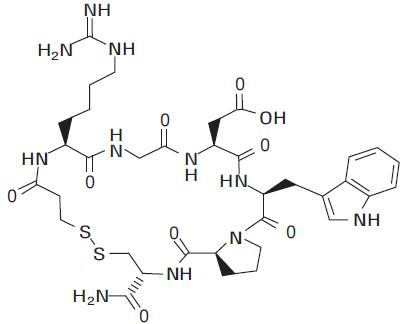
Active ingredient
Classification
Platelet aggregation inhibitors excl. heparinPlatelet Aggregation Inhibitor
Drug interactions
Eptifibatide has several drug interactions that increase the risk of bleeding.
- majorantiplatelet agents — increases the risk of bleeding
- majorthrombolytics — increases the risk of bleeding
- majorheparin — increases the risk of bleeding
- majoraspirin — increases the risk of bleeding
- majorNSAIDs — increases the risk of bleeding
- majorother glycoprotein (GP) IIb/IIIa inhibitors — should be avoided
Indications
INDICATIONS AND USAGE Eptifibatide injection is a platelet aggregation inhibitor indicated for: • Treatment of acute coronary syndrome (ACS) managed medically or with percutaneous coronary intervention (PCI) ( 1.1 ) • Treatment of patients undergoing PCI (including intracoronary stenting) ( 1.2 ) 1.1 Acute Coronary Syndrome (ACS) Eptifibatide injection is indicated to decrease the rate of a combined endpoint of death or new myocardial infarction (MI) in patients with ACS (unstable angina [UA]/non-ST- elevation myocardial infarction [NSTEMI]), including patients who are to be managed medically and those undergoing percutaneous coronary intervention (PCI). 1.2 Percutaneous Coronary Intervention (PCI) Eptifibatide injection is indicated to decrease the rate of a combined endpoint of death, new MI, or need for urgent intervention in patients undergoing PCI, including those undergoing intracoronary stenting [see Clinical Studies (14.1 , 14.2) ] .
Dosage
DOSAGE AND ADMINISTRATION Eptifibatide injection in Galaxy container is for intravenous infusion only, not for intravenous bolus use. Before infusion of eptifibatide injection, the following laboratory tests should be performed to identify pre-existing hemostatic abnormalities: hematocrit or hemoglobin, platelet count, serum creatinine, and PT/aPTT. In patients undergoing PCI, the activated clotting time (ACT) should also be measured. The activated partial thromboplastin time (aPTT) should be maintained between 50 and 70 seconds unless PCI is to be performed. In patients treated with heparin, bleeding can be minimized by close monitoring of the aPTT and ACT. Eptifibatide injection in Galaxy container is for intravenous infusion only, not for intravenous bolus use. ACS or PCI: 180 mcg/kg IV bolus as soon as possible after diagnosis followed by infusion at 2 mcg/kg/min. (2.1 , 2.2) PCI: Add a second 180 mcg/kg bolus at 10 minutes. ( 2.2 ) In patients with creatinine clearance less than 50 mL/min, reduce the infusion to 1 mcg/kg/min. (2.1, 2.2 , 2.3 ) 2.1 Dosage in Acute Coronary Syndrome (ACS) Indication Normal Renal Function Creatinine Clearance less than 50 mL/min Patients with ACS 180 mcg/kg intravenous (IV) bolus as soon as possible after diagnosis, followed by continuous infusion of 2 mcg/kg/min 180 mcg/kg IV bolus as soon as possible after diagnosis, followed by continuous infusion of 1 mcg/kg/min • Infusion should continue until hospital discharge or initiation of coronary artery bypass graft surgery (CABG), up to 72 hours • If a patient is to undergo PCI, the infusion should be continued until hospital discharge or for up to 18 to 24 hours after the procedure, whichever comes first, allowing for up to 96 hours of therapy • Aspirin, 160 to 325 mg, should be given daily Eptifibatide injection should be given concomitantly with heparin dosed to achieve the following parameters: During Medical Management : Target aPTT 50 to 70 seconds • If weight greater than or equal to 70 kg, 5000-unit bolus followed by infusion of 1000 units/h. • If weight less than 70 kg, 60-units/kg bolus followed by infusion of 12 units/kg/h. During PCI : Target ACT 200 to 300 seconds • If heparin is initiated prior to PCI, additional boluses during PCI to maintain an ACT target of 200 to 300 seconds. • Heparin infusion after the PCI is discouraged. 2.2 Dosage in Percutaneous Coronary Intervention (PCI) Indication Normal Renal Function Creatinine Clearance less than 50 mL/min Patients with PCI 180 mcg/kg IV bolus immediately before PCI followed by continuous infusion of 2 mcg/kg/min and a second bolus of 180 mcg/kg (given 10 minutes after the first bolus) 180 mcg/kg IV bolus immediately before PCI followed by continuous infusion of 1 mcg/kg/min and a second bolus of 180 mcg/kg (given 10 minutes after the first bolus) • Infusion should be continued until hospital discharge, or for up to 18 to 24 hours, whichever comes first. A minimum of 12 hours of infusion is recommended. • In patients who undergo CABG surgery, eptifibatide injection infusion should be discontinued prior to surgery. • Aspirin, 160 to 325 mg, should be given 1 to 24 hours prior to PCI and daily thereafter. • Eptifibatide injection should be given concomitantly with heparin to achieve a target ACT of 200 to 300 seconds. Administer 60-units/kg bolus initially in patients not treated with heparin within 6 hours prior to PCI. • Additional boluses during PCI to maintain ACT within target. • Heparin infusion after the PCI is strongly discouraged. Patients requiring thrombolytic therapy should discontinue eptifibatide injection. 2.3 Important Administration Instructions 1. Inspect eptifibatide injection for particulate matter and discoloration prior to administration. Use only if solution is clear and container and seals are intact. Check for minute leaks prior to use by squeezing bag firmly. If leaks are found, discard solution as sterility may be impaired. If the administration port protector is damaged, detached or not present, discard the container as the solution path sterility may be compromised. 2. Do not use Galaxy containers in series connections. Such use would result in air embolism due to residual air being drawn from the primary container before administration of the fluid from the secondary container is complete. If administration is controlled by a pumping device, care must be taken to discontinue pumping action before the container runs dry or air embolism may result. 3. This premixed solution is for intravenous infusion only, no further dilution is required. Not For Intravenous Bolus Use. 4. Do not introduce supplemental medication or additives into the Galaxy container. 5. May administer eptifibatide injection in the same intravenous line as alteplase, atropine, dobutamine, heparin, lidocaine, meperidine, metoprolol, midazolam, morphine, nitroglycerin, or verapamil. Do not administer eptifibatide injection through the same intravenous line as furosemide. 6. May administer eptifibatide injection in the same IV line with 0.9% NaCl or 0.9% NaCl/5% dextrose. With either vehicle, the infusion may also contain up to 60 mEq/L of potassium chloride. 7. Withdraw the bolus dose(s) of eptifibatide injection from the 10-mL vial into a syringe. Administer the bolus dose(s) by IV push. 8. Immediately following the bolus dose administration, initiate a continuous infusion of eptifibatide injection. When using an intravenous infusion pump, administer eptifibatide injection undiluted directly from the 100-mL Galaxy container. 9. The premixed Galaxy container is for single-dose only, discard any unused portion. Administer eptifibatide injection by volume according to patient weight (see Table 1). Table 1: Eptifibatide Injection Dosing Charts by Weight Patient Weight 180-mcg/kg Bolus Volume 2-mcg/kg/min Infusion Volume (CrCl greater than or equal to 50 mL/min) 1-mcg/kg/min Infusion Volume (CrCl less than 50 mL/min) (kg) (lb) (from 2 mg/mL vial) (from 0.75-mg/mL 100-mL Galaxy container) (from 0.75-mg/mL 100-mL Galaxy container) 37-41 81-91 3.4 mL 6 mL/h 3 mL/h 42-46 92-102 4 mL 7 mL/h 3.5 mL/h 47-53 103-117 4.5 mL 8 mL/h 4 mL/h 54-59 118-130 5 mL 9 mL/h 4.5 mL/h 60-65 131-143 5.6 mL 10 mL/h 5 mL/h 66-71 144-157 6.2 mL 11 mL/h 5.5 mL/h 72-78 158-172 6.8 mL 12 mL/h 6 mL/h 79-84 173-185 7.3 mL 13 mL/h 6.5 mL/h 85-90 186-198 7.9 mL 14 mL/h 7 mL/h 91-96 199-212 8.5 mL 15 mL/h 7.5 mL/h 97-103 213-227 9 mL 16 mL/h 8 mL/h 104-109 228-240 9.5 mL 17 mL/h 8.5 mL/h 110-115 241-253 10.2 mL 18 mL/h 9 mL/h 116-121 254-267 10.7 mL 19 mL/h 9.5 mL/h >121 >267 11.3 mL 20 mL/h 10 mL/h
Warnings
WARNINGS AND PRECAUTIONS Eptifibatide injection can cause serious bleeding. If bleeding cannot be controlled, discontinue eptifibatide injection immediately. Minimize vascular and other traumas. If heparin is given concomitantly, monitor aPTT or ACT. ( 5.1 ) Thrombocytopenia: Discontinue eptifibatide injection and heparin. Monitor and treat condition appropriately. ( 5.2 ) 5.1 Bleeding Bleeding is the most common complication encountered during eptifibatide injection therapy. Administration of eptifibatide injection is associated with an increase in major and minor bleeding, as classified by the criteria of the Thrombolysis in Myocardial Infarction Study group (TIMI) [see Adverse Reactions ( 6.1 )] . Most major bleeding associated with eptifibatide injection has been at the arterial access site for cardiac catheterization or from the gastrointestinal or genitourinary tract. Minimize the use of arterial and venous punctures, intramuscular injections, and the use of urinary catheters, nasotracheal intubation, and nasogastric tubes. When obtaining intravenous access, avoid non-compressible sites (e.g., subclavian or jugular veins). Use of Thrombolytics, Anticoagulants, and Other Antiplatelet Agents Risk factors for bleeding include older age, a history of bleeding disorders, and concomitant use of drugs that increase the risk of bleeding (thrombolytics, oral anticoagulants, nonsteroidal anti-inflammatory drugs, and P2Y 12 inhibitors). Concomitant treatment with other inhibitors of platelet receptor glycoprotein (GP) IIb/IIIa should be avoided. In patients treated with heparin, bleeding can be minimized by close monitoring of the aPTT and ACT [see Dosage and Administration ( 2 )] . Care of the Femoral Artery Access Site in Patients Undergoing Percutaneous Coronary Intervention (PCI) In patients undergoing PCI, treatment with eptifibatide injection is associated with an increase in major and minor bleeding at the site of arterial sheath placement. After PCI, eptifibatide infusion should be continued until hospital discharge or up to 18 to 24 hours, whichever comes first. Heparin use is discouraged after the PCI procedure. Early sheath removal is encouraged while eptifibatide injection is being infused. Prior to removing the sheath, it is recommended that heparin be discontinued for 3 to 4 hours and an aPTT of <45 seconds or ACT <150 seconds be achieved. In any case, both heparin and eptifibatide injection should be discontinued and sheath hemostasis should be achieved at least 2 to 4 hours before hospital discharge. If bleeding at access site cannot be controlled with pressure, infusion of eptifibatide injection and heparin should be discontinued immediately. 5.2 Thrombocytopenia There have been reports of acute, profound thrombocytopenia (immune-mediated and non-immune mediated) with eptifibatide injection. In the event of acute profound thrombocytopenia or a confirmed platelet decrease to <100,000/mm 3 , discontinue eptifibatide injection and heparin (unfractionated or low-molecular weight). Monitor serial platelet counts, assess the presence of drug-dependent antibodies, and treat as appropriate [see Adverse Reactions ( 6.1 )] . There has been no clinical experience with eptifibatide injection initiated in patients with a baseline platelet count <100,000/mm 3 . If a patient with low platelet counts is receiving eptifibatide injection, their platelet count should be monitored closely.
Contraindications
CONTRAINDICATIONS Treatment with eptifibatide is contraindicated in patients with: • A history of bleeding diathesis, or evidence of active abnormal bleeding within the previous 30 days • Severe hypertension (systolic blood pressure >200 mm Hg or diastolic blood pressure >110 mm Hg) not adequately controlled on antihypertensive therapy • Major surgery within the preceding 6 weeks • History of stroke within 30 days or any history of hemorrhagic stroke • Current or planned administration of another parenteral GP IIb/IIIa inhibitor • Dependency on renal dialysis • Hypersensitivity to eptifibatide or any component of the product (hypersensitivity reactions that occurred included anaphylaxis and urticaria). • Bleeding diathesis or bleeding within the previous 30 days ( 4 ) • Severe uncontrolled hypertension ( 4 ) • Major surgery within the preceding 6 weeks ( 4 ) • Stroke within 30 days or any history of hemorrhagic stroke ( 4 ) • Coadministration of another parenteral GP IIb/IIIa inhibitor ( 4 ) • Dependency on renal dialysis ( 4 ) • Known hypersensitivity to any component of the product ( 4 )
Mechanism of action
Mechanism of Action Eptifibatide reversibly inhibits platelet aggregation by preventing the binding of fibrinogen, von Willebrand factor, and other adhesive ligands to GP IIb/IIIa. When administered intravenously, eptifibatide inhibits ex vivo platelet aggregation in a dose- and concentration-dependent manner. Platelet aggregation inhibition is reversible following cessation of the eptifibatide infusion; this is thought to result from dissociation of eptifibatide from the platelet.
Source: RxNorm + openFDA + RxClass + FAERS · 2026
Look up another medication